Norway's plan for a fleet of electric planes

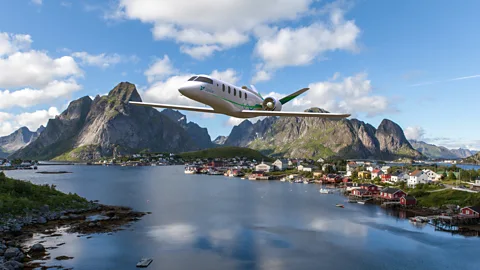 Zunum Aero
By 2040, Norway has promised all of its short-haul flights will be on electric aircraft. It could revolutionise the airline industry.
In July 2018, Norway’s transport minister Ketil Solvik-Olsen and Dag Falk-Petersen, the head of the country’s airport company Avinor, took a very special flight together.
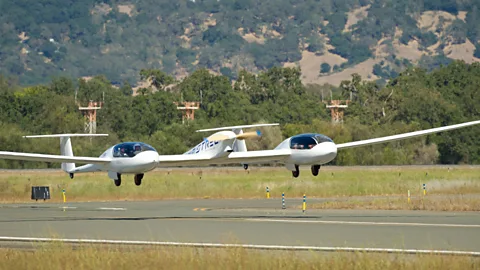
In front of the press they squeezed into the cockpit of a two-seat plane made by the Slovenian company Pipistrel. With Falk-Petersen at the controls, the pair took a short flight lasting a few minutes around Oslo in an Alpha Electro G2.
The flight’s novelty is partly explained by the aircraft’s name; it’s entirely powered by electricity. Battery-powered aircraft have made the leap from fantasy to drawing board to production. But it’s just the start.
If you enjoy this, you might also enjoy other stories in the Future Now series:
- How smart are your decisions – a five minute test
- The new phones that are stuck in the past
- Five grand ideas that will shape this century
Solvik-Olsen and Falk-Petersen weren’t just flying this plane for a lark; it was to underline one of Norway’s most dramatic plans to cut down on its carbon emissions in the decades ahead. By 2040, Norway intends all short-haul flights leaving its airports to be on aircraft powered by electricity.
It’s one of the most far-reaching promises yet to cut down on aviation’s contribution to greenhouse gas emissions. But there is one major barrier – there are no airliner-size electric-powered aircraft being built yet.
The electric aircraft market currently consists of small aircraft; the one the Norwegian pair flew barely has room for two fully grown adults to fly together (both Solvik-Olsen and Falk-Petersen said they went on strict diets before the flight). But Falk-Peterson says that will change very quickly.
 Alamy
AlamyHe says that a few years ago, Norway’s aviation chiefs had a sceptical view of all-electric aviation.
“Then about three years ago our board of directors went down to Airbus, in Toulouse,” says Falk-Peterson. “Airbus told us they had been doing a lot of work in this area already. And Boeing, through [aircraft maker] Zunum Aero and also with Nasa. That’s why we decided to have a programme to electrify the flights in Norway.”
Norway is a good place for such experiments. Much of the country’s terrain is mountainous and there are many offshore islands, which means there are a lot of short-haul flights (Avinor runs no fewer than 46 airports in Norway). Road, rail or boat travel often take a lot longer than a short flight, especially during the winter when snow and ice can block roads and tracks.
“A lot of the flights here are only 15 to 30 minutes,” says Falk-Peterson, “and we have all sorts of mountainous terrain. That’s why we decided to set up a programme where we can actually have aircraft makers tender for it in one or two years.”
Norway wants those aircraft makers to come up with a 25-to-30-seat airliner powered by electric motors, with the first of them introduced into service as early as 2025.
“We are sure that an aircraft like that can be electrified,” says Falk-Peterson.
Electric-powered aircraft are enjoying a boom at the moment; last year, the consulting firm Roland Berger found there were more than 100 electric-powered aircraft projects underway around the world.
 Alamy
AlamySlovenia’s Pipistrel is only one of them. Spokesman Taja Boscarol says the company are now making “several four-seaters, the most notable probably being the Taurus G4, the first fully electric four-seat aircraft in the world.
“Since then we developed some other four-seat prototypes with alternative means of propulsion, such as a hydrogen-powered four-seat aircraft. We have also developed a hybrid engine for a four-seat aircraft. The engine is fully functional, and the aircraft will take off in 2019, according to plan.”
Pipistrel says they see training aircraft – two and four-seaters like the ones they currently build – as the bulk of the electric plane market for the near future, but they also intend to build a 19-passenger “hybrid fuel cell commuter aircraft” by 2025.
Pipistrel will have some competition. Zunum Aero, based in Kirkland, a suburb of Seattle, is another company planning to produce the kind of aircraft Norway wants to see on its short-haul routes.
Founded in 2013, Zunum Aero has received investment from airliner giant Boeing, and has been working on a range of ever-bigger and heavier aircraft.
Its CEO Ashish Kumar says the company was instantly intrigued by Norway’s plans, which came as part of a wider programme to try and cut emissions from transport.
“We’ve been in this space for five years now,” Kumar says. “We’ve looked at what the others are doing in the industry, and we’ve learned from them.”
Zunum Aero initially has plans for a 12-seat short-haul airliner they intend to fly by 2022, and a 50-seater aircraft with a range of 1,000 miles by 2027. And their plans don’t end there. “A 100-seat, 1500-mile aircraft we think will be viable by the late 2020s,” says Kumar. “We can get to what Norway wants to do.”
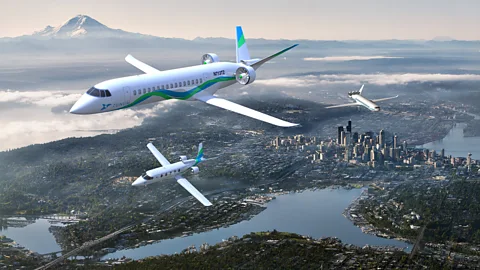 Zunum Aero
The ambition is all the more interesting given the challenges that continue to face electric-powered airliners. Aircraft carrying dozens of passengers – and their luggage – require an enormous amount of energy to get in the air and stay aloft. Today’s airliners are lighter and more fuel economical than any generation before them, but no fuel apart from kerosene currently has an energy density – the amount of energy it is able to store – high enough for airliner use.
Batteries can obviously store electricity, but it was previously thought that so many would be needed to power a small airliner that the weight would be prohibitive. Kumar, however, says “batteries are in some ways the least of the problems”.
He says the biggest challenges are around the rest of the electronic systems. Can batteries reliably and safely maintain power so that flight-critical systems have power at all times? And how do you deal with the heat generated by all those batteries?
One solution may be to reduce the overall size of the planes being used for short-haul flights. At the moment most aircraft are built “largely for medium to long-haul flights. They’re designed for flights as long as 4,000 miles but 80% of them are under 1,500 miles. These are medium-to-long-haul aircraft but they’re flying short-haul.” Kumar says the time has come to stop using these larger, heavier, more expensive aircraft on such short routes.
“For shorter distances, you design a different aircraft.” Kumar says.
Both Zunum Aero and Avinor say that using all-electric planes will have benefits beyond emissions – the smaller aircraft will need smaller runways, which means they can use smaller airports. They will be quieter too, which means that they can be used earlier in the morning and later at night. And if the weight of batteries can be reduced the planes are likely to be lighter, meaning they will require less power.
That final factor may mean lower running costs and therefore cheaper tickets – and cheaper tickets are a powerful incentive for change within the aviation industry (as the rise of low-cost airlines has proven).
 Alamy
AlamyKumar says current aircraft are already generating an enormous amount of energy to power their onboard systems – for instance the Boeing 787 Dreamliner can generate as much as 1.3MW, which is enough electricity to power about 850 houses. “You don’t have to match the energy density of kerosene,” he says, “but you do have to make it work.” The big challenge, he says, will be trying to raise that power generation to around 5MW – the power that might be needed for a plane carrying 100 passengers, for instance.
Falk-Peterson says it’s likely that at least the first generation of Norway’s greener planes will use hybrid technology. Under aviation safety laws, aircraft have to carry enough reserve fuel to ensure they can divert to an alternative airport in case of problems. It is the kind of system – think of the Toyota Prius hybrid, now a stalwart of app-taxi services like Uber – that kickstarted the electric car. Batteries could be charged and stored until needed, and swapped with the spent batteries which are then charged and used on a different aircraft.
Norway’s plan, if it goes ahead, will be felt outside its borders. If all flights lasting fewer than 90 minutes are flown with electric planes, that will mean those planes are landing in other cities in Scandinavia, and beyond. Aircraft makers will have to sell these aircraft to more countries than just Norway to make them viable.
“Already, Airbus is looking at an electric aircraft that can carry 100 passengers 1,000km by 2030, says Falk-Peterson.
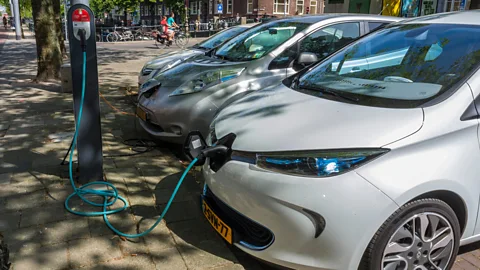
Infrastructure will be one of the biggest challenges. Norway is a rich country blessed with good transport links, but even in a country this well-developed, transporting kerosene is complicated and expensive. Norway will have to work out if the charging stations its new aircraft will need will be hooked to the grid, or whether they will use alternative means to generate the electricity.
 Alamy
AlamyIn the meantime, Norway’s first steps to an all-electric short-haul fleet are happening.
Falk-Peterson’s flight for the press was not a one-off. The trained pilot took part in another demonstration last week. “It was a 15-20-minute flight, and I did 12 of them on the day. And we didn’t have to wait around for charging even once. We’d taken off fully charged, after a 20-minute flight we’d return, and we’d have used 25% of our battery.
“We’d park the plane, a technician would start charging it, and we’d go off and do the debrief and then brief for the next flight, head back to the aircraft and you’re recharged like you were for the start of the previous flight. We think the technology is already here.”
Join 900,000+ Future fans by liking us on Facebook, or follow us on Twitter or Instagram.
If you liked this story, sign up for the weekly bbc.com features newsletter, called “If You Only Read 6 Things This Week”. A handpicked selection of stories from BBC Future, Culture, Capital, and Travel, delivered to your inbox every Friday.
