The hidden world that moves your luggage


 Heathrow Airport
As we wander through duty-free on the way to our planes, a vast network is ensuring our bags travel with us. BBC Future investigates.
Few of us give much thought to what happens to our bags once we drop them off at the airport. We tend to be more concerned about our hand luggage (will they confiscate my shampoo at security?) and duty-free shopping (is this really cheaper than I can find it online?)
But behind the scenes a vast network of conveyors, robots, and people work together to make sure the bag you dropped off at check-in gets on the same plane as you. Few of us actually know what that system involves.
BBC Future was given rare access to this hidden infrastructure at Heathrow airport, so if you have ever wanted to know what happens to your luggage, now you can click here and follow a bag on its journey:

According to the most recent report from Sita (Société Internationale de Télécommunications Aéronautiques), a specialist in air transport communications and information technology, your luggage is becoming less likely to be lost, with the number of “mishandled” bags down by 21.2%. Part of that improvement may be down to the introduction of better technology to transport the cases – and that is continually improving.
 Heathrow Airport
At check-in, bags are tagged with a barcode that enables them to be tracked. British Airways, however, is testing a new ‘digital bag tag’ which has a reusable e-ink screen and enables passengers to load their own barcode using an app. The company hopes it will save frequent fliers valuable minutes by not having to queue for a paper tag to be printed. You can see the digital tag in action in the timelapse (above).
“It’s a process that’s been around for decades and what we’re looking to do is take something that is quite ‘legacy’ into the 21st Century,” says British Airways’ Martin Thomas.
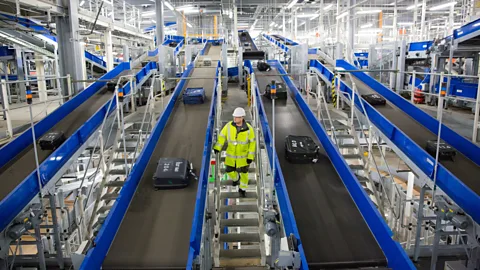
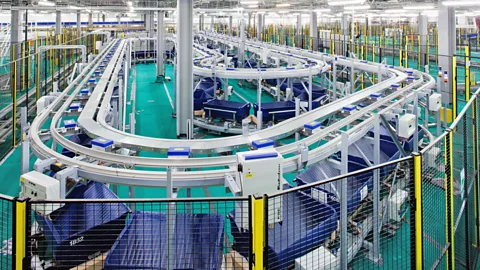
Once the bags leave passengers, they are routed through a maze of layered conveyors, through X-ray machines and other security devices, with regular checks of the barcode along the route to ensure they are going to the right place.
 Heathrow Airport
Heathrow is in the process of developing new baggage handling systems, including one at Terminal 3 known as T3IB. When it’s finished it will be the most modern baggage facility in Europe. The airport claims the system should be capable of handling 110 million bags every year.
T3IB is four storeys high and covers an area roughly equivalent to two football pitches. There are eight miles (13km) of baggage conveyors inside. When fully operational, this part of the airport should be able to deal with 7,200 bags an hour, instead of the current 5,400.
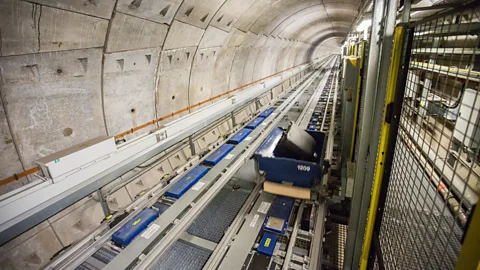
For bags that need to move between terminals, usually for connecting flights, a 0.75mile (1.2km) baggage tunnel connects Terminal 5’s hi-tech facility to the new T3IB in the Central Terminal Area. Automated carts carry bags through the tunnel at up to 26mph (42km/h).
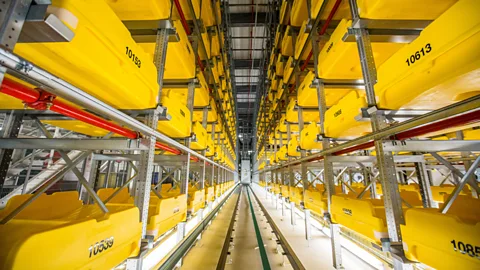
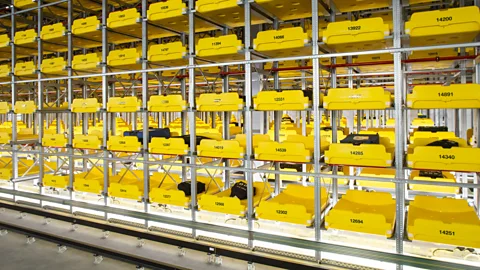
An early bag store, for bags that are dropped off too early to be sent straight to a loading bay and a plane, provides automated storage. Bags are stacked individually in yellow trays in a towering metal structure. Robotic cranes slot them in and out of the racks as needed. BBC Future got an explanation of how it works:
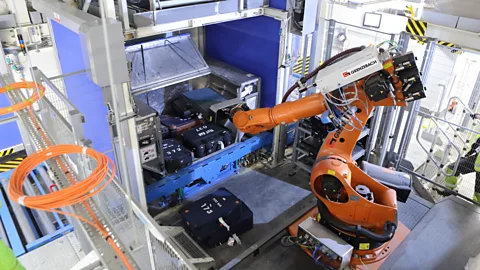
When it is time to travel, bags are placed back into the system of conveyors to be sent to a loading bay. There, they are slotted into ‘cans’ – metal containers – which fit exactly into the cargo holds of planes. This can be done by humans using a load assistance device – a type of mechanical platform which takes the weight of the bags. Heathrow is also testing robot arms to automate the process of loading cans.
 Heathrow Airport
Not everything here is bleeding edge technology: bamboo is used extensively throughout the system as trays to carry bags. Experience has taught the designers that it has the right frictional qualities to hold and release bags made of all sorts of materials. It beats anything man-made.
Then, it is on to the plane, and hopefully on to your destination for you to pick back up off the carousel.
 Heathrow Airport
 Heathrow Airport