Why sharks make us fear death

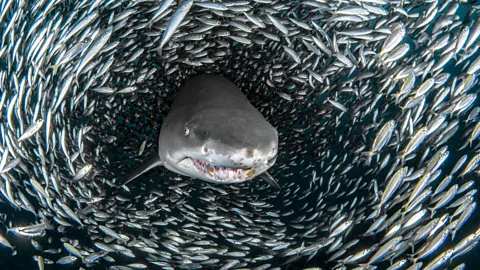 Tanya Houppermans / Caters
A recent viral photo reminds us that from the 18th Century to Damien Hirst, artists have been captivated by the menacing power of the underwater predator, writes Kelly Grovier.
In 1749, a tiger shark prowling Cuba’s Havana Harbour bit off the foot of a 14-year-old English boy and changed the course of art history. Three decades later, a depiction of the horrifying event by the victim’s friend, the Anglo-American painter John Singleton Copley, caused a stir when it was first exhibited at the Royal Academy of Arts in London in 1778. Copley’s painting, Watson and the Shark (the boy, Brook Watson, later became the Lord Mayor of London) suspends the instant just before a member of a rescue boat thrusts his harpoon into the pouncing fish’s slippery side. The image would forever fix the shark in popular culture as a primal power - one ceaselessly surging to the surface.
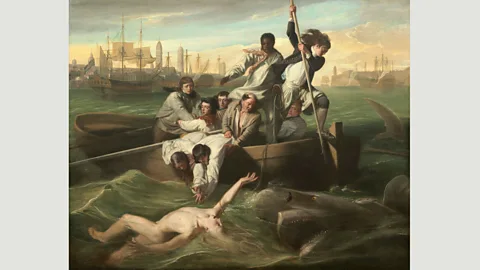 Ferdinand Lammot Belin Fund
A lineage can be traced from Copley’s sensational painting (hailed by one critic at the time as “a perfect picture of its kind”) to its distant descendant, Spielberg’s Jaws, two centuries later. Predating mankind by over 400 million years, sharks lurk deep and archetypally in our psyche as a prototype of unmitigated malevolence. To be drawn to their primeval energy, as visitors were to Copley’s canvas in 1778 (and moviegoers to Spielberg’s film in 1979), is to tempt to the surface of consciousness one’s nethermost fears - to plumb the impossible depths of not being.
Copley’s slightly comical shark (his nose is ridiculously long) bobbed into my brain at the sight this week of an extraordinary photo of a sand tiger shark skulking off the coast of North Carolina that has gone viral on social media. Underwater photographer Tanya Houppermans has captured the predator piercing a dense ‘bait ball’ - a defensive formation into which a school of pursued fish will arrange itself when under attack.
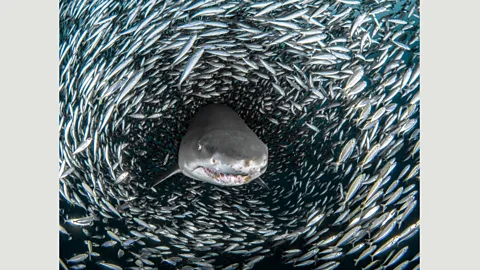 Tanya Houppermans/Caters
Exploding through the centre of the pulsing alignment, the shark bursts the bait ball into a shatter of scales that seem, for the millisecond of the camera’s snap, to form a processional tunnel. The resulting image of the shark threading the eye of what’s been called a “fish tornado” has charged across the internet like a dark epiphany - a bolt of adrenaline rushing through the fibre optics of our collective soul.
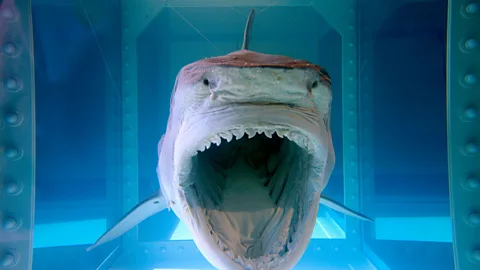 Alamy
AlamyBefore this week, the persistent shark, as a paradoxical emblem of irrepressibly repressed fears, had gone a little quiet. Its last significant sighting was a quarter-of-a-century ago when, in 1992, British artist Damien Hirst installed in Charles Saatchi’s gallery in St John’s Wood, London, a huge, formaldehyde-filled vitrine in which a floating tiger shark silently roars. By eschatologically entitling his work The Impossibility of Death in the Mind of Someone Living, Hirst pierces to the centre of the creature’s awful allure. This piscine howl, which channels the raw terror of Francis Bacon’s shrieking popes and Edvard Munch’s Scream, shoulders itself to the forefront of memorable images of the age, and testifies to the shared and insatiable savvy of the artist and the shark.
And if you liked this story,sign up for the weekly bbc.com features newsletter, called “If You Only Read 6 Things This Week”. A handpicked selection of stories from BBC Future, Earth, Culture, Capital and Travel, delivered to your inbox every Friday.
