Why this image chimes with a Trump photo

 Wikimedia
After a photo of Donald Trump signing an executive order was shared widely this week, Kelly Grovier looks at how it has echoes in a famous 19th-Century painting.
The Oval Office is America’s frontal lobe. It’s the place in the brain of a presidency where the world can witness the synapses of an administration snapping, its neurons firing – the space in which we assess its psychological motivations, see what makes it tick. Photos of John F Kennedy’s children romping there, of a stiff Richard Nixon attempting to unwind with Elvis Presley, and of the Obamas boogieing with a spry centenarian, have all imprinted themselves onto the US national consciousness and helped shape the way we regard the cerebral spirit of an administration – how we assess its mental health.
 AP Photo/Evan Vucci
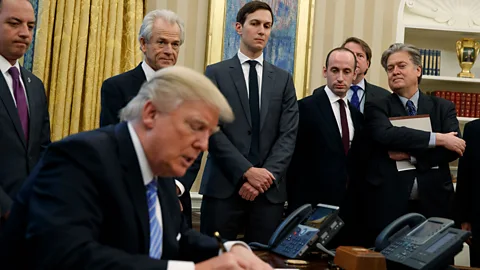
In the past, such glimpses into the sanctuary of executive power have been carefully choreographed, if not rare, and always designed to preserve the mystique of that simultaneously architectural and psychological space. This week, however, a flurry of images taken in the Oval Office have been released, revealing how the Trump administration converts instinct into action. One in particular has captured the public’s attention: a photo of the president, flanked by male advisers, inking into effect an order removing funding for international groups that perform or provide information on abortions.
He is not the first Republican US President to reinstate the so-called Mexico City Policy, which Ronald Reagan first introduced in 1984; George W Bush did so in 2001 after Bill Clinton had overturned it in 1993. Yet the boldness of Trump signing such a gender-sensitive decree unattended by a single female adviser two days after people across the globe gathered to march in protest against his perceived attitude towards women, seemed to many as audaciously defiant.
 Wikimedia
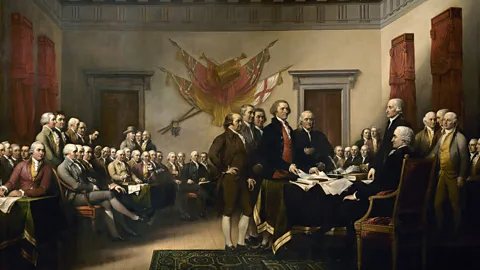
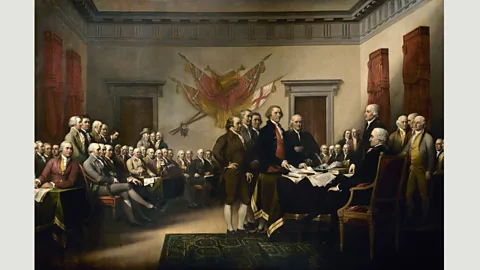
Admirers of the new president, especially those opposed on moral grounds to facilitating abortion, will doubtless see the image as evidence of Trump’s unflinching determination to act even in the face of robust opposition. Detractors, however, are likely to continue seeing the image, absent of any female counsel, as evidence of subverted democracy, as flagrantly obtuse to the perspective of those affected by the order as the American artist John Trumbull’s 1819 depiction of the signing of the Declaration of Independence. That famous painting, which has featured on official US stamps and currency notes, proudly portrays scores of white men, including many slaveholders, un-ironically congratulating themselves on pronouncing the equality and “inalienable rights” of all people.
If you would like to comment on this story or anything else you have seen on BBC Culture, head over to our Facebook page or message us onTwitter.
And if you liked this story, sign up for the weekly bbc.com features newsletter, called “If You Only Read 6 Things This Week”. A handpicked selection of stories from BBC Future, Earth, Culture, Capital, Travel and Autos, delivered to your inbox every Friday.