Striking photographs from a London bus

 George Georgiou
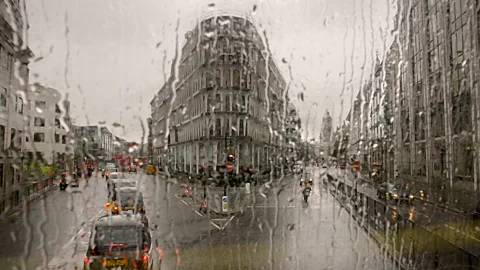
In his series Last Stop, George Georgiou photographs striking ‘micro-dramas’ around London – all from one of the city’s iconic red buses.
For more than 10 years, George Georgiou lived largely in his car. From a five-door hatchback, the native Londoner of Greek Cypriot descent and his wife, fellow photographer Vanessa Winship, travelled across Ukraine, Georgia, Turkey and the US – and shot pictures everywhere they went.
Three years ago, Georgiou decided to return home. He settled in Folkestone, close to the Channel Tunnel. On a homecoming to his native London, Georgiou caught one of the city’s red buses.
Observing from the window, he says, he was struck by the “profound state of flux” of the city of his birth. He had always called London his home – but now he hardly recognised the many new veins of the city, the ceaseless crowds, the rising new homes, the churning humanity.
 George Georgiou
“London had quite suddenly become the most international place on earth,” Georgiou says. “It had opened up to people who have no heritage or connection in London, apart from their wanting to make this their home. Seeing so many people living together, and, mostly, making it work – I found it very powerful.
“I realised that, for many, many people, London had become the last stop, the final destination on a long journey, the Holy Grail of the Western dream,” he says. “I wanted to try and understand this: the way people share the city, the everyday movements, the rhythms and rituals of the city.”
 George Georgiou
And so Last Stop was born. Entirely crowd-funded, it is a remarkable photographic assessment of London, taken from the perspective of the city’s iconic buses.
Fleeting moments
Arriving in London from the south coast, Georgiou would board the first bus that sparked his curiosity. “I wanted to explore the whole city,” he says, “from the centre to the suburbs. East, west, north and south.”
He would spend up to 12 hours a day riding bus routes’ entire length. “Sometimes, I would see a destination on a bus I hadn’t heard of before, or my familiarity was the name of the place on a map,” he says. “My curiosity would always make me pick that bus and follow it to the end of the line.”
 George Georgiou
Taking whichever seat was free, he would stare into the right-angle viewfinder of his camera resting on his lap, so that his subjects were oblivious to the lens trained on them.
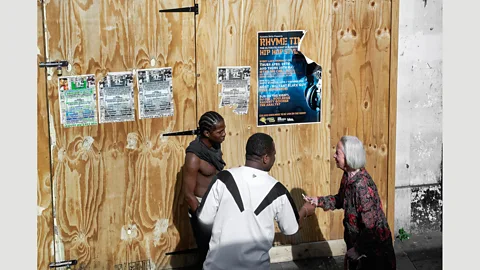
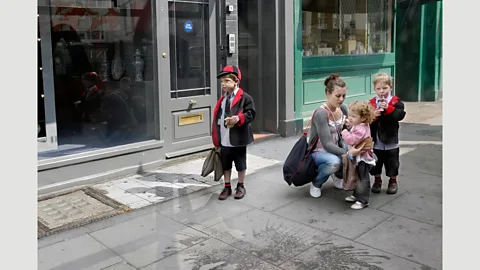
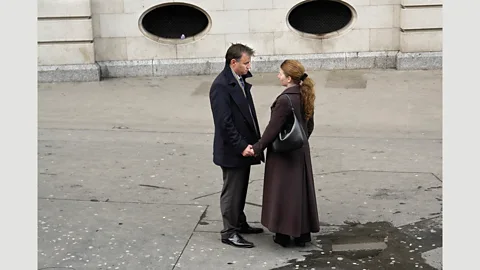
Georgiou began to view his photographs as "micro-dramas”. Each one froze a pregnant moment in strangers’ lives – caught fleetingly and randomly by the movement of the bus.
“I would see tiny scenes that could have been taken from a soap opera,” he says. “A small interaction or dynamic, an embrace, or an argument, a glance at another, or a moment of total solitude. I would find myself inventing narratives for the people I photographed,” he says.
 George Georgiou
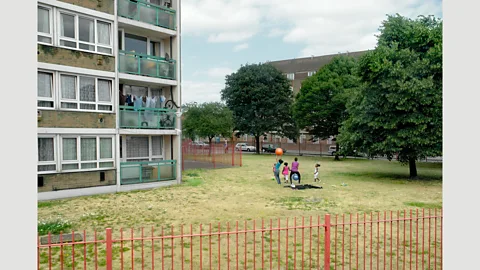
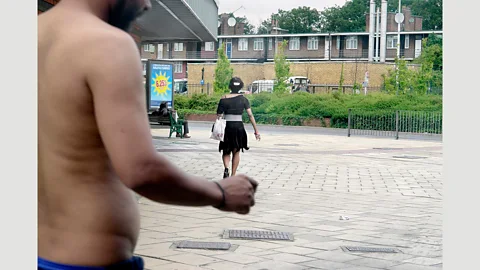
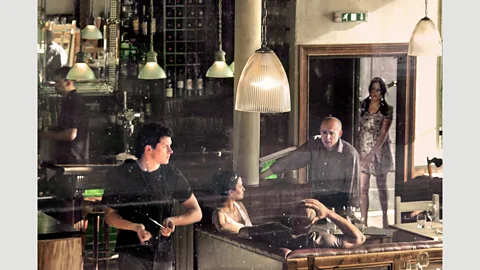
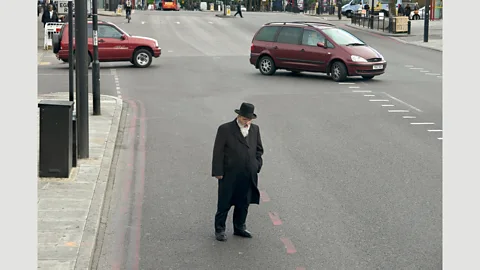
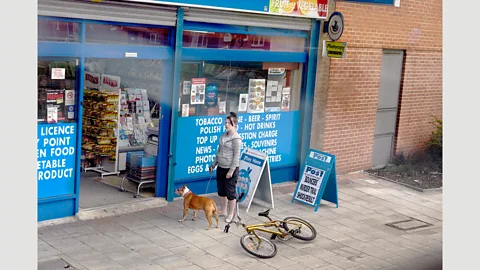
In one image, a couple stand stiffly opposite each other, holding hands yet keeping their distance. In another, an old woman seems to exchange a cigarette for something with two young men. An argument breaks out in an upmarket restaurant. A homeless man awakes, confused from a dream, on the edges of the wet streets. Children chase a huge balloon in the grounds of a council estate. An elderly gentleman stumbles along a busy road.
 George Georgiou
The photographs of Last Stop are searing in their intimacy. Georgiou, sat by the window, was often “close enough to touch” the people he photographed, he says. Only the window pane and his camera lens separated him from his accidental subjects.
Dramas from a distance
There’s an element of voyeurism here, a certain exploitation of private moments in public places.
“But this voyeuristic aspect is crucial to the experience of the city,” he says. “In a city, we’re always looking into other people’s lives. We all do it, but this voyeurism is what makes living in the city so beautiful; all this humanity and never-ending narratives and dramas. That’s why I love the experience of London, these small, random encounters, micro-dramas caught from a distance, allowing us fill the gaps.”
 George Georgiou
What’s striking, Georgiou says, is how intuitively we understand many of these moments. “With my camera, I can freeze these dramas,” he says. “But, looking back, we all know what’s happening. We can instantly recognise the emotion in the images.”
Last Stop is not purely about people. When Georgiou settled on the upper level of a bus, he allowed himself a broader view, situating the micro-dramas in their architectural context.
 George Georgiou
This triangulation between street portraiture, architectural studies and the landscape is a key aspect of Last Stop.
“Rules of interaction and proximity are changing, between what the French anthropologist Marc Augè calls non-places,” he writes in the introduction to Last Stop. “These public spaces are designed for people to move through in solitude but without isolation, layered against an organic historical city with deep traditions, where old and new are interwoven.”
 George Georgiou
After a successful Kickstarter campaign, Georgiou published Last Stop independently, selling copies through his website from his home in Folkestone. The photographs were published using an innovative “double-sided concertina” that allows us to view the images in any order we choose. Every time we leaf through the pages of Last Stop, a new sequence of images unfurl.
“I wanted to find a way of staying true to the experience of staring out of a bus window – the serendipity that lies behind such micro-dramas, of how we grow accustomed of sharing space with so many others, so many separate, complex lives,” Georgiou says.
“For I am part of this rhythm and community,” he adds. “It is my community, my security, my home.”
This story is a part of BBC Britain – a series focused on exploring this extraordinary island, one story at a time. Readers outside of the UK can see every BBC Britain story by heading to the Britain homepage; you also can see our latest stories by following us on Facebook and Twitter.
