'Faithful wife', virgin or tragic martyr?: Why this 16th-Century masterpiece is not what it seems

 Alamy/ Galleria Borghese
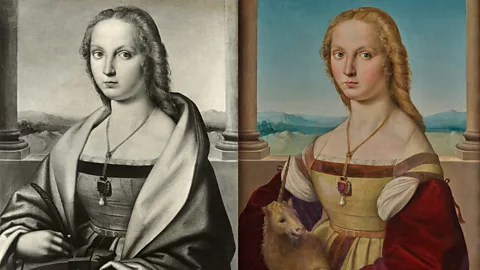
Overpainted images found hidden inside Raphael's Portrait of a Young Woman with a Unicorn help unlock the mystery behind it. They also show the ways that the image of the ideal woman has been carefully controlled by men through the centuries.
What do you get when you cross a mythical creature from folklore with a medieval torture device? The answer is one of the most intriguing portraits in all of art history: Raphael's Portrait of a Young Woman with a Unicorn – a restless masterpiece that refuses to stay still.
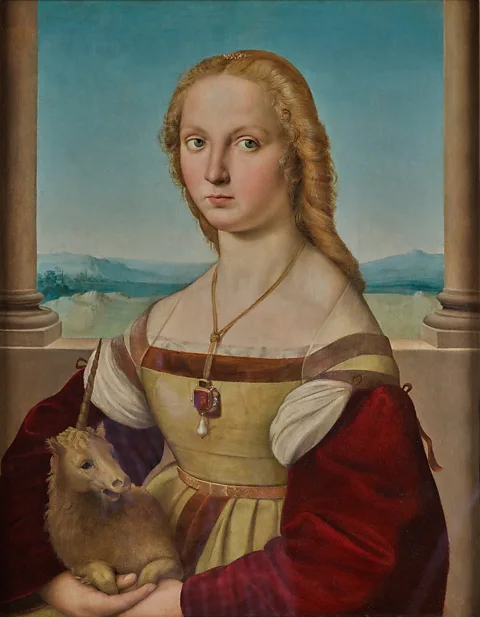
Originally painted by the precocious Italian master between 1505 and 1506, the work's surface has, over the centuries, repeatedly been painted over, each time to tell a different story. While the true identity of the woman that Raphael depicts remains a mystery to this day, she has been made to embody shifting ideals of femininity: from a chaste avatar of marital fidelity to a pious saint sitting beside a spiked execution wheel. The painting has, quite literally, struggled to keep its story straight.
 Galleria Borghese/ photo by Mauro Coen
The anti-Mona Lisa
At first glance, the likeness we encounter today appears deceptively straightforward. The sitter's three-quarter pose, her folded hands, and her placement before a soft, receding landscape echo – if perhaps a little too deferentially – the composition of the Mona Lisa, begun by Leonardo da Vinci just a few years earlier.
Raphael, who is thought to have studied the Mona Lisa in Florence, borrows the structure of his renowned contemporary's groundbreaking portrait but makes it his own by stripping away the Mona Lisa's enigmatic aura and smoky air of ambiguity. Wiped clean are the sfumato haze, the rocky terrain and meandering waters, not to mention her entrancingly inscrutable smile. Raphael has replaced them with coolness and clarity. In his portrait, the eyes are icier – the stare frostier.
The virgin and the unicorn
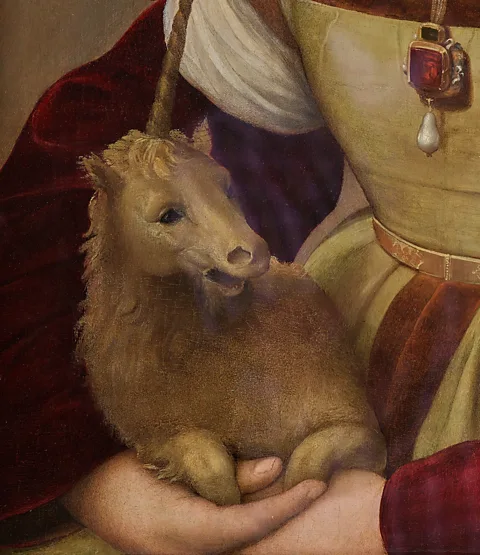
So chilly is the blue-steel gaze of Raphael's work, in fact, it risks rebuffing the viewer's. One could easily overlook altogether the mute neigh of the tiny wild unicorn (crouching in the bottom left hand corner of the painting) that the young woman has managed gently to restrain in her arms. Sown quietly into the fabric of the work, the playful unicorn does heavy symbolic lifting with its spiralling horn in establishing the work's original meaning. The creature's association with chastity and the legend that only a virgin could tame it had already been seized upon by many of Raphael's contemporaries, including the makers of the famous Hunt of the Unicorn tapestries, just completed in Brussels, and Da Vinci, who created two drawings on the subject.
In the light of that established symbolism, it is likely the painting was initially conceived and commissioned as a betrothal or marriage portrait, designed to project the young woman's inviolable virtue and suitability for marriage. Whether or not, as some scholars speculate, she is really 13-year-old Laura Orsini della Rovere, whose family famously employed the unicorn as its emblem, her true identity is arguably incidental.
 Galleria Borghese/ photo by Mauro Coen
She has been transmuted – exalted by Raphael into an archetype – a universal ideal of virginal femininity. More crisply cut and brightly lit than the mystifying Mona Lisa, whose very essence is the soul of shadowy enigma, Raphael's sitter seems as solidly fixed before us, whoever she is, as the oversized ruby and dangling drop pearl that tug at her necklace, which tether her beauty to the heft of male-provided material comforts. She's a set stone. Or is she?
The saint and the wheel
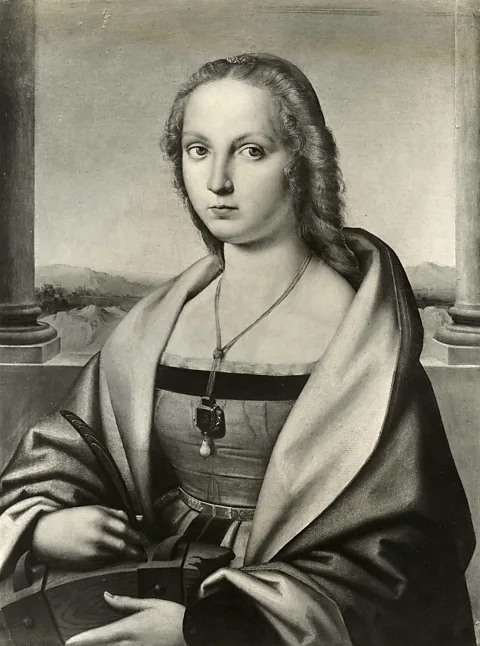
In fact, the woman we see today on the museum wall at the Metropolitan Museum of Art – among the highlights of its blockbuster exhibition Raphael: Sublime Poetry (the most comprehensive display of the artist's work ever staged in the US) – is hardly the same figure at all that visitors to the Galleria Borghese would have encountered for more than a quarter of a millennium, between the late-17th Century to the middle of the 20th. A century-and-a-half after Raphael died in 1520, aged just 37, Portrait of a Young Woman with a Unicorn was substantially remade, painted over to conceal altogether the work's connection with unicorn symbolism.
 Alamy
AlamySometime around 1682, an unremembered artist dramatically altered the work's narrative by transforming the young woman from a chaste virgin into the 18-year-old 3rd-Century Christian martyr, Saint Catherine of Alexandria, who was persecuted for converting pagan scholars into Christians. To make the swap, the 17th-Century artist hid the unicorn under a heavy veil of oil paint and inserted new objects emblematic of Saint Catherine's story, including the spiked wheel that miraculously broke when Emperor Maxentius first attempted to execute her.
The vanishing lapdog
By converting Raphael's secular statement on bridehood into a religious icon, a suffering saint, the painting becomes a morphing lava lamp of shifting aesthetic, ideological and social ideals. Not only was the unicorn buried, in a sense so was the young woman herself under a heavy mantle that was draped around her shoulders and arms to hide the curves of her body. Through his ham-fisted interventions, the 17th-Century intruder into Raphael's work sought aggressively to control an already strenuously controlled projection of what a woman should be. For more than two centuries, Raphael's work was known purely by its pious imposture – by the lie that it told.
 Alamy
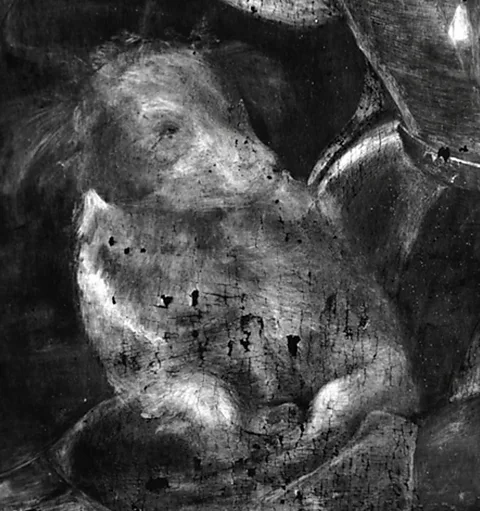
AlamyIn the 1930s, detailed X-ray analyses of the painting were undertaken and the unicorn discovered and restored. Later, in the 1950s, decades after every trace of the Saint Catherine disguise had been removed from the portrait, further radiographic analysis of the painting's hidden layers revealed what appeared to be an even deeper truth – that Raphael himself had applied an early filter to his painting to conceal what he had initially intended to place in the young woman's lap: a small floppy-eared lapdog – a stock symbol for marital fidelity that invigorates paintings from Jan van Eyck's Arnolfini Portrait, 1434, to Titian's Venus of Urbino, 1538.
The palimpsest
For the past 70 years, the painting has been understood as a tangled tissue of muddled meanings – as much about what is not there as what is. As a result, it has become a poignant palimpsest of enforced feminine ideals, as the subject has fitfully mutated from faithful wife to incorruptible virgin to divine saint. Whether there was, in fact, ever really a lapdog beneath the unicorn (the curators of the current exhibition think not), there is little doubting the power of Raphael's mercurial masterpiece, one of more than 170 paintings, drawings, and tapestries assembled for Raphael: Sublime Poetry.
Once unpacked, the alternately hidden and restored layers of Raphael's transfixing portrait chronicle the ever-evolving ideals of and demands on femininity as set by male master painters and patrons. The restless image speaks with remarkable urgency to our own age's obsession with carefully curated identity – how we forge, finesse, and falsify who we are and who we are told to be, seeking simultaneously to preserve and erase ourselves in an avalanche of filtered selfies and fabricated identities. Never before has an age been so technologically equipped to record and store semblances of itself while at the same time so self-consciously uncertain about who it really is.
Raphael: Sublime Poetry is at the Metropolitan Museum of Art until 28 June.
--
If you liked this story, sign up for The Essential List newsletter – a handpicked selection of features, videos and can't-miss news, delivered to your inbox twice a week.
For more Culture stories from the BBC, follow us on Facebook and Instagram.
