'The Unabomber's ego may have led to his downfall': The serial killer unmasked by his own writing

 Getty Images
The Unabomber's campaign of violence had baffled investigators for almost two decades. The BBC reported on his arrest 30 years ago when the "brilliant" mathematician "laid a trail to his own front door".
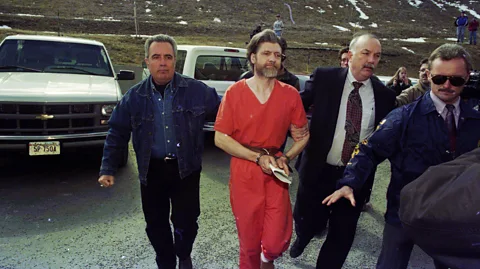
On 3 April 1996, US federal agents surrounded a remote log cabin in the Montana woods and led out Theodore "Ted" Kaczynski, a dishevelled figure who until then had existed in the public mind only as a hooded man in dark glasses from a "wanted" poster sketch. For almost 18 years, the Unabomber was one of the US's most wanted criminals, a mystery man whose primitive parcel bombs were mailed with no clear motive or regular pattern.
What finally trapped him was his own writing. Two major American newspapers agreed to publish his anti-technology manifesto if he promised not to kill again. His distinctive words were first identified by his brother's wife, whom he had never even met. As BBC Newsnight's Krishnan Guru-Murthy noted, "The academic who dropped out to live in a primitive cabin had laid a trail to his own front door."
The search for the Unabomber began in May 1978 when a primitive homemade bomb was mailed to Northwestern University in Illinois, followed by a second attack almost a year later. In November 1979, an altitude-triggered bomb he had mailed went off aboard an American Airlines flight. While it did not work as intended, 12 people were treated for smoke inhalation.
Because his targets seemed to be universities and airlines, the FBI came up with the code name UNABOM. Over the following years he used increasingly sophisticated bombs to attack a further 13 times, killing three people: computer rental shop-owner Hugh Scrutton, advertising executive Thomas Mosser and timber industry lobbyist Gilbert Murray.
As his targets were essentially random, and his bombs were built from common items such as pieces of wood and lamp cords, investigators were working with little more than scraps. FBI chief ballistics investigator Chris Ronay dubbed him the "recycle bomber". He told the BBC in 1996: "He's rummaging through trash cans and used-materials bins and finding things that he can then create like a Neanderthal."
To justify his violence, in April 1995 the Unabomber sent the New York Times and Washington Post a 35,000-word academic diatribe titled Industrial Society and its Future. In the essay, he argued that modern life eroded human freedom and dignity, and claimed that only dismantling technological systems could prevent further psychological and social harm. He offered to stop killing people if the screed was published by the two most prestigious newspapers in the country. Washington Post publisher Donald Graham told the BBC in 2016: "The initial anxiety was obvious. If you succumb to this demand and agreed to print this document, might it trigger other demands to print other such documents?"
FBI special agent Terry Turchie told the BBC that investigators initially thought it would be a bad idea to publish the manifesto "because it was just too far out there", but then they had a rethink. They reasoned that if the manifesto were published, someone would almost certainly recognise the voice behind it "because these words are so passionate". After three months of agonising, on FBI advice the newspapers' bosses decided to publish the Unabomber's essay. Many Americans wondered why a fugitive, whose hooded image stared out from so many FBI posters, had been handed what they saw as a gift for any terrorist: a public platform to spread his views.
Two hundred serious suspects
The FBI was offering a $1m reward for information leading to the Unabomber's identification and conviction. Set up in 1993, its toll-free hotline, 1-800-701-BOMB, received more than 50,000 tip-offs. With all the fresh clues contained in the manifesto, the image of the mystery bomber was coming into sharper focus. "The Unabomber's ego may have led to his downfall," said Guru-Murthy on BBC Newsnight. "As well as the ideas in the treatise, more was being learned about the bomber's academic background from his letters to prominent scientists." The FBI UNABOM taskforce compiled a list of 200 serious suspects. Five of them were put under constant surveillance, all in Northern California where detectives believed he was hiding.
In History
In History is a series which uses the BBC's unique audio and video archive to explore historical events that still resonate today. Sign up to the accompanying weekly newsletter.
The big breakthrough in the case came from an unlikely source, a US citizen holidaying in France with her husband, David Kaczynski. Linda Patrik, a philosophy professor, had been reading a series of articles about the Unabomber in the International Herald Tribune, an English-language newspaper published in Paris. She told the BBC in 2016: "Just about every other day, I'd look at these articles and kind of scratch my head and say, 'wow, this kind of sounds like Dave's brother'." One report mentioned the suspect's carpentry skills. Another described his aversion to technology. Others listed cities where bombs had detonated – places she knew David's brother had lived or worked. Taken together, she said, the pattern became impossible to ignore. She had to ask him the awkward question: "I said, 'Is it possible that your brother could be the Unabomber?'"
David did not believe this could be true, Patrik said, but when he read the manifesto he was stunned. "Dave sat there looking at the computer screen," she said. "I could see him reading the first page and his expression changed radically." It was a nightmarish scenario, David told the BBC. "I was literally considering the possibility that my brother was a serial killer, the most wanted person in America, perhaps in the whole world," he said. The family's dilemma was stark. If they stayed silent, their inaction could result in more carnage. But if Ted proved to be the Unabomber, he could face the death penalty. David said: "What would it be like to go through the rest of my life with my brother's blood on my hands?"
More like this:
• The shocking kidnap of a teenage newspaper heiress
In the 17-year hunt for the Unabomber, Theodore Kaczynski was UNABOM suspect number 2,416. FBI special agent Dr Kathleen Puckett told the BBC's Witness History in 2025: "There was a trunk that their mother kept in Chicago at the family home, and in the trunk we found the original handwritten version of the manifesto." It was an essay Kaczynski had written in 1971 that contained many of the same ideas.
Investigators gathered enough evidence for a warrant to search Kaczynski's backwoods log cabin, where he lived without running water or electricity. According to Puckett, "The cabin was full of evidence. It was a goldmine." Among the discoveries were bomb components; 40,000 pages of handwritten journals detailing bomb experiments and accounts of the Unabomber's crimes; and a live bomb ready to be mailed.
From maths prodigy to drop-out
Kaczynski's brother David was shocked when he saw the arrest on the news. He told the BBC World Service in 2006: "He was led out of his cabin between two federal marshals and he really looked horrible. He was completely unkempt. His clothing was nothing but rags and he had not bathed in months. And then to hear him described as a serial killer, a terrorist? The information people had wasn't informed with all the memories I had of Ted, you know, the nice little boy who had been my big brother."
 Alamy
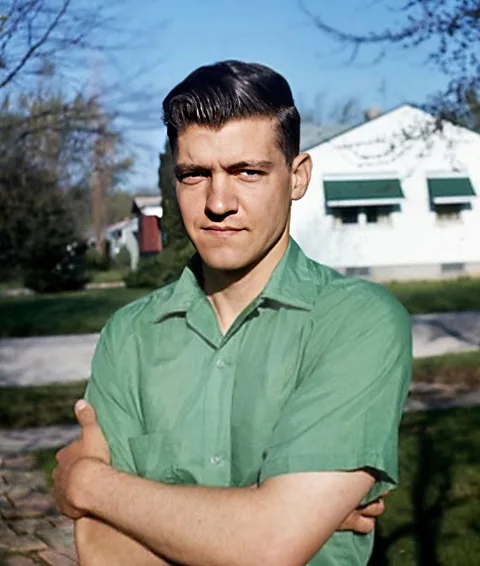
AlamyA picture of Kaczynski's early life and background soon emerged. A maths prodigy with an IQ of 167, he skipped two grades to attend Harvard University, aged just 16. After graduating aged 20, he went on to the University of Michigan. According to his former professor Peter Duren, "He had a lot of good ideas, a very original mathematician, and on the strength of the thesis he got a job at Berkeley and seemed he was launched on a brilliant career in mathematics."
But something changed Kaczynski's worldview, said Guru-Murthy. "He rebelled against the discipline he excelled in, and within two years dropped out of academia. After spells in Utah, he moved to Montana, beginning a rural isolated existence in a small community of about 1,000 people." It was clear that he had "an exceptional mind", continued Guru-Murthy. "But if the investigators are right, all it served to do was to fuel the rage of a man who despised what his work represented."
Kaczynski was sentenced to life without parole in 1996 and spent the next three decades in prisons across the US, primarily at the federal Supermax prison in Florence, Colorado. While he was diagnosed as a paranoid schizophrenic by a psychiatrist who interviewed him in prison, he claimed he had always known exactly what he was doing. "I'm confident that I'm sane, personally," he said in an interview with Time magazine in 1999. Suffering from declining health, Kaczynski killed himself in 2023, aged 81.
--
For more stories and never-before-published radio scripts to your inbox, sign up to the In History newsletter, while The Essential List delivers a handpicked selection of features and insights twice a week.
For more Culture stories from the BBC, follow us on Facebook and Instagram.
