'The soldiers would follow him anywhere': The WW2 general who outwitted his arch-rival

 Getty Images
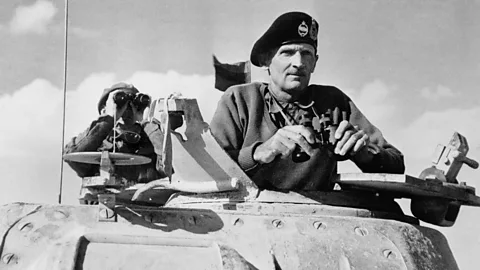
Field Marshal Bernard "Monty" Montgomery died 50 years ago. In 1968, he told the BBC about the Battle of El Alamein, and his German counterpart Erwin Rommel, the "Desert Fox".
"In defeat, unbeatable; in victory, unbearable." In one remark, Winston Churchill captured the infuriating brilliance of Field Marshal Bernard Montgomery, the brains behind the celebrated November 1942 victory at the Second Battle of El Alamein. Seen as a turning point in World War Two, the battle in North Africa inspired another famous Churchill quote: "Now, this is not the end. It is not even the beginning of the end. But it is, perhaps, the end of the beginning."
By the time of the general's death on 24 March 1976, aged 88, the now Lord Montgomery of Alamein had enjoyed a long and sometimes controversial retirement. A prickly character unafraid of stirring up trouble, in his memoir he had dismissed General Dwight D Eisenhower, his old supreme commander and future US president, with the typically arrogant: "Nice chap. No soldier." In a moment of self-awareness, he once joked: "My business, as you know, is fighting – fighting the Germans or anybody else, too, who wants to have a fight."
When Montgomery arrived in Egypt in July 1942 as the newly appointed head of the British Eighth Army, the Allies were in trouble on several fronts. In the Pacific, the Japanese had weakened British and American power and taken Hong Kong and Singapore. In the Atlantic, German submarines threatened to starve Britain into submission. In Egypt, the German Army looked likely to overrun the capital Cairo, just as they had conquered most of Europe. Having come to North Africa the year before to defend their Italian allies in Libya, they had their eyes on a bigger prize.
They had sent Field Marshal Erwin Rommel, one of their best generals, to smash through the British army and take Egypt and the Middle East, along with the oil supplies that fuelled the British war effort. Rommel was so effective as the commander of Afrika Korps, the elite German expeditionary force, that he was nicknamed the Desert Fox.
In 1968, Montgomery was interviewed by the BBC's Cliff Michelmore in the same caravan he had used in the Egyptian desert while plotting to outwit his arch-rival. To help him visualise what he should do, Montgomery had a photograph of Rommel pinned to the wall of his mobile headquarters. "I used to look at it and I used to say to myself, what sort of guy is that? If I do this, what's he likely to do? And in some curious way, it helped. I think a lot of people thought I was mad. But you know, I've so often been considered mad that I now regard it as rather a compliment."
Before Montgomery's arrival in North Africa, Rommel had a fearsome reputation among the British who had built up an image of him as a military genius. Churchill even went so far as to name him in the House of Commons: "We have a very daring and skilful opponent against us and, may I say across the havoc of war, a great general." According to historian Dr Niall Barr, this image "helped take the edge off the numerous failings of the British army in the desert. It was, after all, easier to explain away the numerous defeats by highlighting their enemy's strengths, than it was to face up to British shortcomings."
Montgomery, when asked by Michelmore about Rommel, said he was "quite different to what a lot of people thought". He called him a "Prince Rupert type of figure," a dashing frontline commander who preferred being with his troops rather than directing operations from headquarters. While Rommel's soldiers "loved him and would follow him anywhere", Montgomery said this approach was ill-suited to high command. "I don't think that Rommel understood administration [which is] terribly important in war. I realised that what I wanted to achieve in front must be commensurate with my administration behind. Otherwise, you couldn't do it."
 Getty Images
When Montgomery first arrived in the desert, he was an unknown quantity with "white knees", a term of contempt used by cynical veterans for pale newcomers shipped over from Britain. He made an immediate impact with his brash confidence, telling his troops: "Our mandate from the prime minister is to destroy the Axis forces in North Africa. It can be done and it will be done, beyond any possibility of doubt." In his effort to restore morale, Montgomery tried to visit as many Army units as he could to articulate his vision of what would happen next. His key message was there would be no more retreats. "We will stand and fight here. If we can't stay here alive, then let us stay here dead. I want to impress on everyone that the bad times are over. They are finished."
The battle's three stages
He later recalled to the BBC: "I told them my ideas and my thoughts of the future. I think maybe some of them reckoned I was a bit too big for my boots. I'd been in the desert less than 12 hours and here I was telling them what to do and issuing orders with the greatest confidence as if I'd been there all my life. Anyhow, one thing had been made very clear. There was to be no more uncertainty about anything."
The village of El Alamein sits between the Mediterranean coast on one side and impassable salt marshes to the south. Since the first Battle of El Alamein in July, the Eighth Army had been dug in there, holding back Rommel's advance towards Cairo. For several months Montgomery continued to train and re-equip his soldiers while working on his grand plan. He told his troops: "Now, my forecast of this battle is that there will be three definite stages. First, the break-in. Then, the dogfight. I believe that the dogfight battle will become a hard killing match and will last for 10 or 12 days." He wanted to assure his soldiers that everything would be planned to the last detail. "The enemy will crack. Then will come the break-out and that will lead to the end of Rommel in Africa."
In History
In History is a series which uses the BBC's unique audio and video archive to explore historical events that still resonate today. Sign up to the accompanying weekly newsletter.
By 23 October he was ready to attack. It began with the largest British bombardment since World War One. Sickened by the carnage of that war in which he had himself been badly injured, he was determined to avoid unnecessary loss of life. According to historian Richard Holmes, the bombardment reflected Montgomery's "desire to let metal, not flesh, do his business wherever possible".
Engineers cleared channels through the deep German minefields, allowing the Allied tanks to pass through. While the weight of tanks would have exploded the mines laid by the Germans, soldiers were able to cross the territory. Montgomery gave this part of his plan the apt name of Operation Lightfoot. Losses mounted rapidly on both sides, but the Germans and Italians were outnumbered two to one. Rommel's tanks, far from their supply depots, were running short of fuel.
On the night of 1 to 2 November, the second phase of the offensive, Operation Supercharge, began: British armoured divisions pushed through the final layer of Axis defences. The advance was still far from straightforward. On 3 November, the Ninth Armoured Brigade lost 102 of its 128 tanks. After the battle, Montgomery led his victorious Eighth Army across 2,000 miles of North Africa. Rommel had begun with 500 tanks: by the end of the first phase, he was down to just 100, and after a massive tank battle on the last day he was left with only 30 serviceable tanks. Elements of Rommel's mobile forces managed to slip away because Montgomery, true to form, refused to gamble during the pursuit. Even so, most of their infantry was taken prisoner. By May 1943, the remaining Axis forces in North Africa had surrendered.
More like this:
While Rommel did not live to see the end of the war, he was not killed in battle. When he was implicated in the 1944 plot to kill Hitler, the Nazis offered him the chance to take his own life to avoid the spectacle of putting their celebrated general on trial in public. Historians remain divided over Rommel. While some see him as an ambitious but essentially apolitical commander who fought a clean war, others argue that his career and prestige were bound up with the Nazis' brutal and murderous regime.
The victory at El Alamein was a massive morale boost for the British war effort. No longer an unknown general, Montgomery was now "Monty", a hero to his troops and to the people back home. He returned to lead the D-Day landings with four allied armies under his command and won the Battle of Normandy.
The BBC's 1987 documentary Monty: In Love and War gathered testimony from many who had served with him. Their accounts varied widely, revealing the complexity of his character. US Army General Bill Carter said: "We had no respect for Montgomery at all. He was a poseur, he was rude, he didn't respect his allies and he was a complete politician."
Lt Col Trumbull Warren, Montgomery's Canadian aide-de-camp and personal assistant, said: "I think the people that knew him well – and served him closely – worshipped him. And the people that didn't, I would say a great many of them hated him. He was the right guy at the right time and he got the right breaks. We needed a fellow like Montgomery." According to British intelligence officer Brig Sir Edgar Williams, "he wasn't a nice man, but nice men don't win wars."
--
For more stories and never-before-published radio scripts to your inbox, sign up to the In History newsletter, while The Essential List delivers a handpicked selection of features and insights twice a week.
