A hidden village carved into a cliff

 Ibrahim Shehab
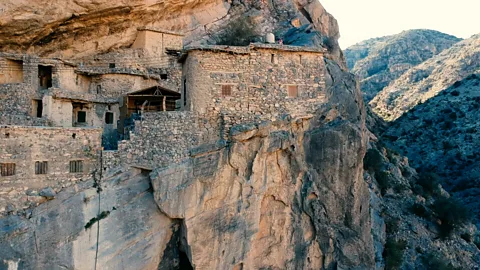
For more than 500 years, a remote tribe has lived suspended on a cliff-side in the mountains of Oman.
 Ibrahim Shehab
Around 195km south-west of Muscat’s sand-fringed coastline, Oman’s dusty plains rise into the limestone folds of the Jabal al Akhdar – a 2,980m-high massif known as the ‘Green Mountain’. This maze of twisting valleys and deep canyons is one of the country’s most remote corners, and as the road loses its asphalt, the only way forward is on foot, by mule or by all-terrain vehicle.
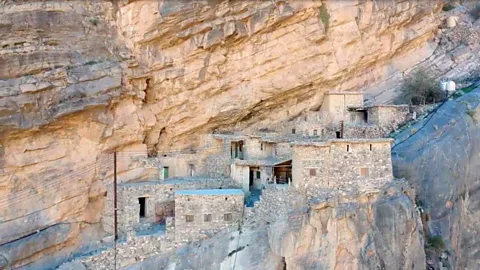
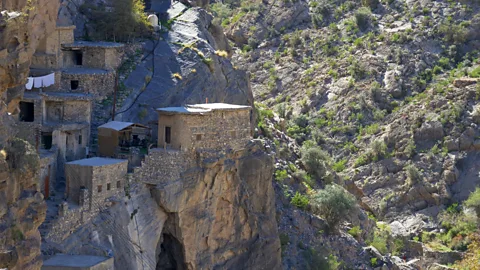
After climbing for 20 more kilometres through steep switchbacks, a tiny cluster of homes seemingly suspended on a cliff’s edge appears across a canyon. This is Al Sogara: an isolated village carved into the mountainside where people have lived for more than 500 years.
 Ibrahim Shehab
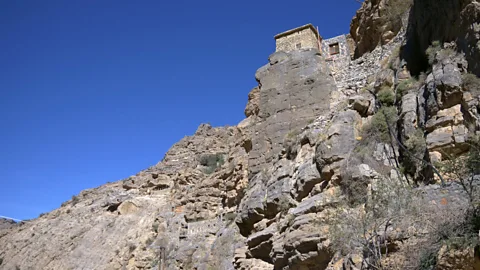
Although the Green Mountain is considered one of Oman’s most breath-taking backdrops, few travellers ever reach Al Sogara. Until 2005, foreigners were forbidden from entering the mountain range as the Omani government maintained a military presence in the area.
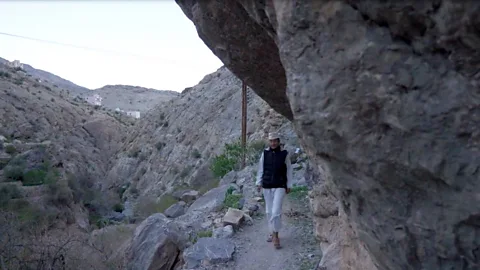
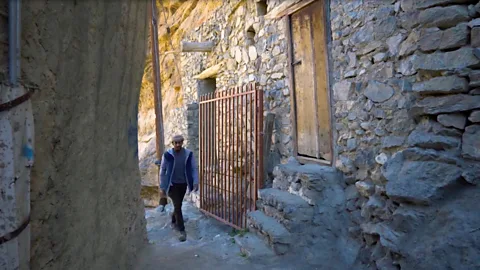
These days, the only way in and out of the hamlet is to leave your vehicle at the end of a gravel road and hike 20 minutes up a steep stone staircase leading from the canyon floor. And while similar villages are sprinkled throughout the region, Al Sogara is the only one that’s still inhabited. Set some 40km from the main mountain city of Seih Qatana, Al Sogara is the most isolated village in the region, and among the most remote settlements in all of Oman.
 Ibrahim Shehab
Until 14 years ago, there was no electricity or phones in Al Sogara, and the nearest road was 15km away. Traditionally, mules were used to haul goods to the village from the nearby towns of Nizwa and Birkat Al Mouz. But in 2005, crafty villagers strung two pulley cables above the valley to carry supplies from across the canyon where the gravel road ends.
Locals can’t remember a time when there were more than 45 people in Al Sogara, and because there were no schools, past generations learned to read and write at home. Since the 1970s, however, students have been attending school 14km away in Sayq. To get there, they hike down the village’s narrow staircase and back up the other side of the mountain where cars can pick them up at the road.
 Ibrahim Shehab
We live here and we love it. People differ, but they will always love their homeland,” said Mohammad Nasser Alshariqi, a student who has lived his entire life in Al Sogara.
 Ibrahim Shehab
Today, this rocky outcrop is home to five families from the Alshariqi tribe, a group that migrated from Jordan more than 1,000 years ago and settled throughout Oman. “There are only 25 villagers in Al Sogara,” said Salem Alshariqi, who was born and raised here. “It’s a small number because the village is small. It must fit us.”
According to Salem and other residents, the villagers descended from a common ancestor who arrived in Al Sogara more than 500 years ago, when the settlement was inhabited by members of different tribes. Throughout the generations, the Alshariqi have continued the ancient practice of building their homes with stone and clay or carving them directly into the rock face – just as their ancestors have done over the centuries.
 Ibrahim Shehab
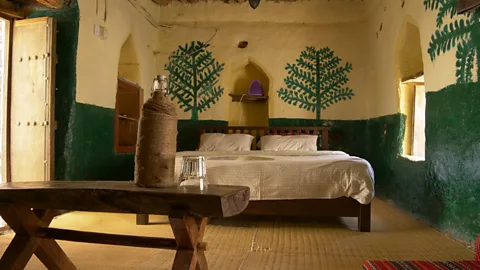
When our ancestors came here, they built walls from the outside and lived in the mountain. From the inside, our homes are caves. If the walls were not there, you could only see a cave on the mountains,” said Salem.
 Ibrahim Shehab
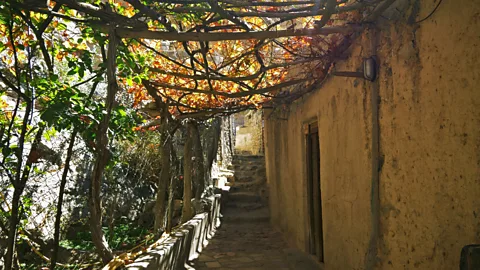
At 2,700m above sea level, Al Sogara is perched in one of the few places in Oman where it regularly snows. “Winter can be very hard here,” Mohammad Nasser said. “We build homes from clay and limestone because it insulates us from the cold winters that hit the Green Mountain, and [keeps us cool] in the hot summers.”
According to the villagers, their ancestors used the limited resources available to them on the mountain to build their cliff-top dwellings, mixing water with stones to mould clay walls or chisel rooms directly into the limestone.
 Ibrahim Shehab
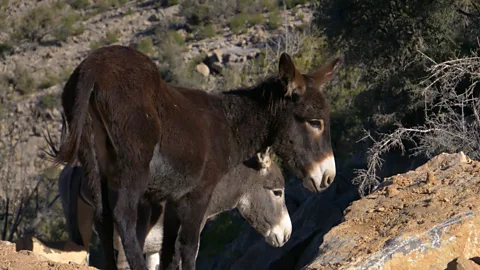
Villagers don’t only carve their homes into the mountainside, but also use these caves as shelters for their herds. For centuries, families in Al Sogara have built fences on the entrances of these cave openings to keep their flock safe from wild animals. For the Alshariqi tribe and many others in the region, animals signify prosperity: the more goats, lambs and mules you have, the wealthier you are.
“We work in agriculture and herding,” Mohammad Nasser said. “We plant pomegranates, walnuts, peaches, apricots, oranges, figs, garlic, onions and many different kinds of vegetables when we have water.”
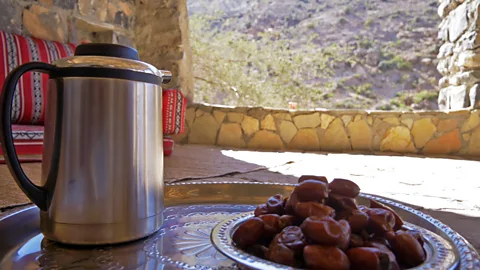
As with many people in Oman and other Arabic countries, the Al Sogara tribe practices a traditional custom of hospitality in which villagers extend their homes to guests offering them food and drink for three full days before asking the reason for their stay.
 Ibrahim Shehab
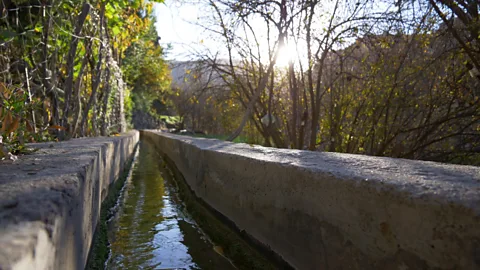
To sustain life in the remote reaches of Oman, ancient settlers invented an ingenious irrigation system known as ‘aflaj’, in which water is channelled from underground springs using gravity. Dating back as far as 500AD, these Unesco-inscribed canals were once so important to life that watchtowers were built to defend them.
Today, roughly 3,000 of these canals can be found scattered across Oman – including at Al Sogara, where an aflaj routes water from a spring in the valley below. Yet, due to shifting weather patterns, many of these 20- to 50km-long waterways have turned more trickle than torrent. And this once-green mountain is now more of a dusty sandstone.
“These canals were built hundreds of years ago by the families who lived here. Each family shared a canal and each one of them had their daily amount of water for their plantations, depending on their share in building the canal.” Mohammad Nasser explained. “But now as there is less water, our [crop] is becoming less and less.”
 Ibrahim Shehab
In recent years, a dearth of local jobs has led several of Al Sogara’s residents to Muscat and Nizwa in search of work, and, in an increasingly connected world, the future of this far-flung stone settlement remains in doubt. Yet, while some villagers may venture away from this once-green mountain, others still wake each morning and tend to their goats, pick dates from their orchards and walk to the aflaj to fetch water – just as they have always done.
“The future is dependent on the present,” Mohammad Nasser said. “If we take care of this place, the next generations or our grandchildren will do too. If we don’t take care of these houses, it may be destroyed in 15 years.”
To the Ends of the Earthis a multimedia series from BBC Travel venturing to some of the most remote corners of the planet and unveiling what it’s like to live there.
