The newly discovered desert city that's rewriting the history of the Americas

 Zona Arqueológica Caral
On Peru's desert hillsides, archaeologists have uncovered a 3,800-year-old city that may reshape our understanding of the cradle of civilisation in the Americas.
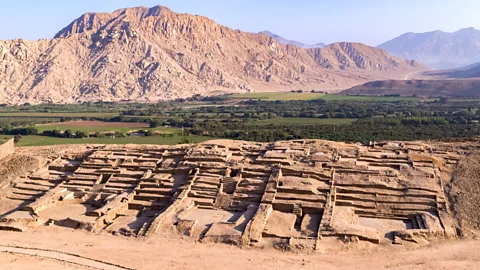
Four hours north of Lima, the ochre slopes of the Supe Valley seem inhospitable: windswept plains, crumbled adobe walls and the shimmer of heat rising from the desert. It's hard to imagine that these dry slopes once supported one of the world's first great civilisations – and that, once-buried beneath this desert, a new discovery is rewriting the history of the Americas.
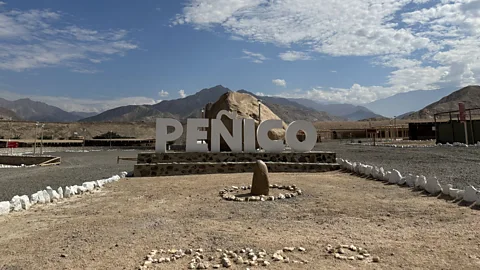
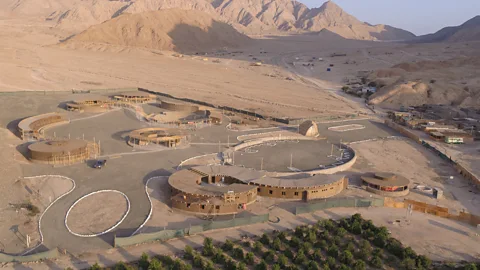
In July 2025, Peruvian archaeologist Dr Ruth Shady unveiled Peñico, a 3,800 year-old city of Peru's ancient Caral civilisation. The newly excavated site features 18 structures, including ceremonial temples and residential compounds. Most importantly, it provides fresh evidence that the Caral people adapted to climate disaster without turning to war – a survival strategy that feels as extraordinary today as it must have been millennia ago.
"Peñico continues the Caral civilisation's vision of life without conflicts," said Shady, who has led research in the valley for three decades.
The peaceful cradle of the Americas
Long before the Aztec, Maya or Inca, Peru's arid coast was home to the Caral, one of the world's most ancient and peaceful societies. Their main settlement of Caral-Supe – considered the cradle of civilisation in the Americas and Unesco-listed since 2009 – flourished 5,000 years ago in parallel with the earliest urban centres of Mesopotamia and Egypt on the other side of the globe. "Caral was inhabited [from] 3000BC to 1800BC," explains Shady.
 Zona Arqueológica Caral
But unlike its Old World counterparts, Caral had no defensive walls and researchers have found no evidence of any weapons. When Shady began excavating Caral in 1994, she uncovered a society built on trade, music, ritual and consensus.
According to Shady's findings, about 3,000 people lived in Caral, plus several smaller nearby villages. The Supe Valley's strategic position linked the Pacific coast to fertile Andean valleys and the distant Amazon, which created a network of cultural and commercial exchange. The Caral people grew cotton, sweet potatoes, squash, fruit and chilli peppers, trading for minerals from the mountains and squirrel monkeys and macaws as pets from the Amazon. Along the coast, they gathered shellfish, seaweed and fish.
Visiting Caral and Peñico
Caral is open daily from 09:00-17:00, with the last tour starting at 16:00. Entrance tickets include Caral's onsite museum, the nearby sites of Áspero and Vichama, and local guides, most of whom speak only Spanish. Go with a guide who can translate Spanish and who knows the way, since the roads are poorly signed once you leave the Pan-American highway and turn onto the Caral-Ambar road. Peñico is 11km past Caral with the same opening hours.
Visitor tip: Guides at both sites are locals trained by Shady's team, offering rich insights into politics, religion, astronomy and agriculture.
"They had intercultural relationships with people of the jungle, the mountains and across large distances as far as Ecuador and Bolivia, but always peacefully," said Shady. In contrast, the Aztec, Maya and Inca were militaristic states, often waging long campaigns against neighbouring groups.
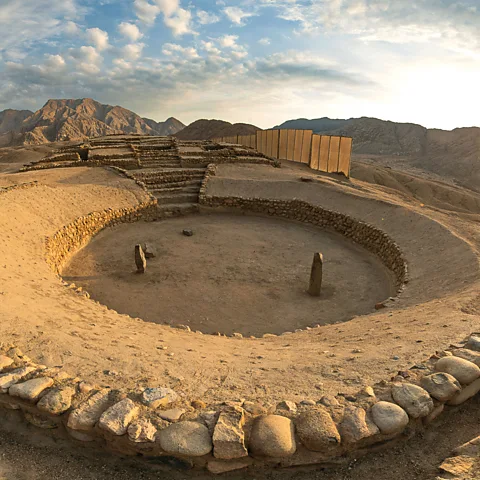
Caral's ingenuity extended to architecture and the arts. The city's amphitheatre was seismically sound, designed to withstand the Pacific Rim's strongest earthquakes, and had a unique acoustic design for large concerts. Excavations have revealed 32 transverse flutes, some carved from pelican bones, others decorated with monkeys and condors – material proof of long-distance trade and cultural inclusion.
"With these instruments they welcomed people from the coast, the mountains and the jungle in rituals and ceremonies," said Shady.
 Zona Arqueológica Caral
Collapse in the desert
Despite its societal success, Caral faced a formidable challenge: climate. Approximately 4,000 years ago, a 130-year drought – part of a wider global shift that also disrupted Mesopotamia, Egypt and China – led to crop failures and famine. Caral's monumental plazas and pyramids were abandoned to the desert.
"Climate change caused a crisis in Caral," says Shady. "The rivers and fields dried up. They had to abandon urban centres, which also happened in Mesopotamia."
For years Shady's team theorised that the starving survivors fled entirely to the coast where they could gather shellfish and fish. Excavations at Vichama, a site in the neighbouring Huaura Valley, seemed to support that idea.
But the recent discovery of Peñico tells another story.
Peñico: survival through adaptation
Built upriver from Caral at 600m above sea level, just 10km from Caral-Supe, Peñico shows how some of the Caral people adapted by moving closer to glacial-fed water sources. In a valley where rivers had run dry, proximity to mountain meltwater meant survival.
What makes this remarkable is not just the relocation itself, but how the society responded. There is no evidence of warfare, weapons or fortified walls at Peñico – a rare outcome in times of scarcity.
 Zona Arqueológica Caral
"Peñico continues Caral's tradition of living in harmony with nature and relating to other cultures with respect," said Shady.
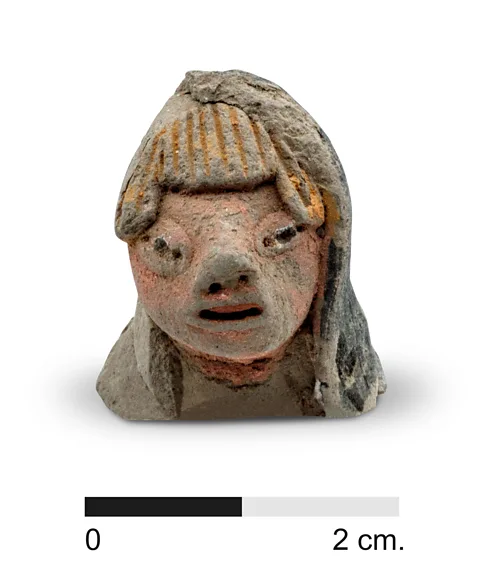
Excavations have also revealed advances in art and ritual. Shady's team has uncovered sophisticated clay figurines, beaded necklaces and carved bones – including one fashioned into the shape of a human skull. A striking sculpture depicts a woman's head with an elaborate hairstyle, her face painted red with hematite pigment. These objects suggest that even with a reduced population, the community invested in cultural expression as a way of sustaining identity and cohesion.
Learn more about Peru's rich pre-Incan history
• North of the Supe Valley, near the city of Trujillo, the ancient city of Chan Chan was built around AD850 by the Chimú, famous for their finely sculpted ceramics and for surfing on reed crafts.
• In Lima, archaeological sites like the Huaca Pucllana and Pachacamac preserve the memory of the Lima culture, which flourished on the coast around AD200-700.
• South of Lima, the Nazca lines are the most impressive testimony to the great Nazca civilisation that thrived in the desert from AD100-800. They are best visited on flyovers from the towns of Pisco or Nazca.
The site is already open to visitors who can explore its ceremonial temples and residential compounds. A new visitor centre with interpretive exhibits has a circular design that echoes Caral and Peñico's most fascinating feature: round central plazas. These plazas are in sections of the cities that archaeologists theorise were administrative areas, evidence of a society that may have functioned on consensus, possibly with a similar democratic structure to Greece some 2,000 years later.
Gaspar Sihue, a tour guide at Caral, encourages travellers to make the trip before the sites become widely known. "I enjoy guiding in the Supe Valley because it's so far off the main tourist trail," he says.
At the same time, Shady cautions that excavations in Peñico are relatively recent, and many buildings are still covered by the desert. "We still have a lot more to learn," she says.
 Zona Arqueológica Caral
Lessons from the past
Standing among Peñico's plazas, it is fascinating to consider how an ancient society responded to crisis with adaptation rather than conquest. Its survival strategy – moving closer to water, maintaining trade networks and sustaining art and ritual – is a 3,800-year-old reminder of how cooperation can endure even in times of extreme stress.
More like this:
This message feels urgent today. Peru still relies on Andean glaciers for its water supply yet has lost 56% of its tropical ice in the past 58 years, according to government glaciologists.
"There are many things we have to do as we’re facing climate change," says Shady of the lessons gleaned from Peñico. "We have to change how we see life and how we see the changes that are happening to our planet so that human society can continue with a good quality of life and mutual respect."
Even half-buried in the Peruvian desert, the city feels like a discovery with lessons for the world.
--
If you liked this story, sign up for The Essential List newsletter – a handpicked selection of features, videos and can't-miss news, delivered to your inbox twice a week.
