The royal roots of Quebec's French


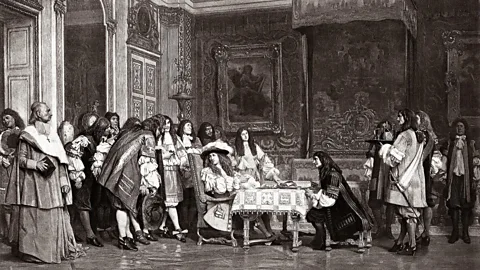
Quebecois French has long been mocked for its rough-and-tumble sound, but this version of French is more likely what 17th-Century French aristocracy spoke – including the king.
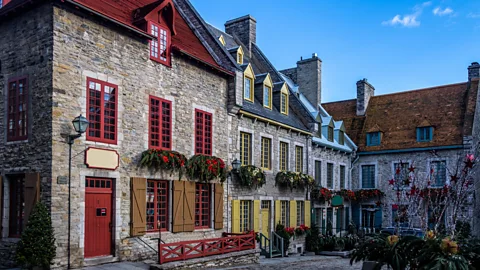
It was a perfect sun-splashed summer afternoon as my mother and I meandered through Quebec City's old town, stopping at Place Royale, a 400-year-old cobblestone square of historical greystone buildings with dormer windows and pitched roofs in red, copper and slate. My mother was born and raised in this French-speaking city, so I knew that now, at 80, it meant a lot to her to be back for a visit.
As we reminisced, the sound of the local accent floated around us – and I thought about something I'd recently heard: that while the French spoken in Quebec may not ring as romantic or mellifluous to the ear as contemporary Parisian French, now considered the gold standard, the way the Quebecois speak is actually closer in pronunciation to the French used by 17th-Century aristocrats – and even the king.
I grew up in Montreal in the 1960s and '70s, when anglophones, along with the French from France, mocked the rough-and-tumble pronunciation of Quebec French, comparing it to the quacking of ducks. I myself was always deeply embarrassed in the company of my anglophone classmates at French immersion school. So-called pundits and my teachers, who hailed from France and Morocco, said that the relaxed Quebec pronunciation was disgraceful, that it made a mockery of the language of Molière.
As it turns out, the celebrated 17th-Century playwright likely sounded more like a modern-day Quebecois – rather than a contemporary Parisian – than they knew.
I'd actually baulked when someone told me this a few weeks earlier over lunch at a café in North Hatley, a quaint village in the gently mountainous Eastern Townships, south-east of Montreal. I'd known that Quebecois French had retained many vestiges of "le français du roy" or "the king's French", especially in its vocabulary, but I drew the line at pronunciation. "There's no way that Louis XIV said 'paw, voilaw', or 'toé et moé'!" I'd said incredulously, as I compared those to the more commonly accepted pronunciations of pas, voilà, and toi et moi.
But there are logical linguistic and historical reasons why Quebecois French is different from French French (what linguists call "normative" or "neutralised" French).
 Getty
Getty"There is one thing that characterises Quebecois French and that is its rhythm," said Chantal Bouchard, a sociolinguist in the French department at Montreal's McGill University and author of Méchante Langue: La Légitimité Linquistique du Français Parlé au Quebéc (Wicked Language: The Linguistic Legitimacy of the French Spoken in Quebec). "We in Quebec have conserved something from 17th-Century French: the distinction between the long vowels and the short vowels."
She gave the example of the ai/ê vowel. If one says vous faites ("you do/make"), the Quebecois vowel is short (as in "get"), but if one says la fête ("the party"), the vowel is long (as in "hey").
"The French have not conserved this short/long vowel difference," she explained. "They still spell faites and fête differently, but they pronounce them both the same way."
Claude Poirier, a historian of Quebec French at the Université Laval in Quebec City, has spent a lot of time poring over 17th-Century archival documents to determine if the spelling of certain words could give us an idea of their pronunciation. He found that in the 1658 court acts, a lawyer who came to Quebec from Poitou in west-central France "spelled perdre ('lose') as pardre, which is closer to how some people in Quebec still pronounce the word." Another example he found was the word devoir ("must" or "to be obligated to"). It was spelled devour, he said, and was pronounced devou-air, the way many elderly Quebecois still pronounce it today.
 Getty
GettyAnother major difference is vocabulary. Words like char for "car"; piasse, slang for "dollar"; dispendieux for "expensive"; patate for "potato"; and barré for "locked" instead of the normative French fermé à clef ("closed with a key") all originate from a more antiquated French no longer used in France.
So how is that Quebec's version retained more 17th-Century aristocratic relics than what's spoken in Paris, the accepted seat of the French language?
Both Bouchard and Poirier noted that 16th- and 17th-Century French settlers who immigrated to Quebec, then known as New France, tended to be natives of northern and western France. Aside from royalty and the aristocracy, only one-third of the people in France spoke French at that time. The rest spoke their regional languages, such as Breton, Provencal or Norman.
In New France, however, concerted efforts were made to teach the new arrivals French – and it was the version spoken at the royal court by the aristocrats of the north and west. Thus, aristocratic French became generalised among the settlers. In the mid 1700s, French explorer Louis Antoine de Bougainville even wrote that "the Canadian accent is as pure as that of the Parisians".
But everything began to change in 1759 when France lost its colony to the British at the Battle of the Plains of Abraham in Quebec City. Contact between France and New France was ruptured, and with the signing of the Treaty of Paris in 1763, a good part of the elite returned to Europe.
More dramatic changes came with the French Revolution, cutting off the mother country from its former colony for another four decades.
According to Poirier, during this period of alienation, scholars in France embarked on a massive effort to spread the use of French and standardise its grammar and pronunciation. "The bourgeoisie dumped all the pronunciations they didn't deem perfect, and they continued their purification through the 18th Century," he said.
In short, French in France changed, while in Quebec it stayed more or less the same. "The Quebecois are conservatives," said Poirier. "They conserved the French language as it was spoken in the 'ancien régime'."
By the time the French began travelling to Quebec again, then known as Lower Canada, around 1830, the differences had become extreme. When famous French thinker Alexis de Tocqueville visited in 1831, he wrote in a letter to his mother: "Canada raises our curiosity. The French nation has been preserved there. As a result, one can observe the customs and the language spoken during Louis XIV's reign." And in another letter, he admitted: "It seems more like Old France lives on in Canada, and that it is our country [France] which is the new one."
 Elizabeth Warkentin
Though some YouTubers still make fun of the Quebec accent, perceptions have changed a lot over the past 10 to 20 years as a huge influx of French expats has arrived, particularly to Montreal and Quebec City. Marielle Lumineau and her sister Irène Lumineau relocated from France to Quebec 20 and 16 years ago, respectively, and fell hard for "la belle province" – so much so that they wrote Icitte: Les Français au Québec, a humorous, light-hearted guide for other expats. The duo have picked up some of the tell-tale Quebec accent and inflections, and their kids, who range from 7 to 16, are "completely Quebecois", said Marielle. Younger generations in France, Belgium and francophone Switzerland have also embraced the accent. What's more, Quebec films have garnered the prestigious César award at Cannes, and Quebec comedians like Sugar Sammy are in huge demand on French stages.
The French language and the sense of pride in the Quebecois identity have indeed come a long way. "The French language is central to the Quebec identity," said Bouchard. "We've made a lot of progress since the 1960s with regard to the presence of French in the public space, French as the common language, the right to work in French, the number of people here who are fluent in French, but things remain very fragile."
Indeed, many here still remain self-conscious about the way they speak. But Dominique Chouinard, a former French teacher in Montreal and now a curriculum consultant to other French teachers, wants this attitude to end. "French is full of idiosyncrasies – every country in the French-speaking world has its own peculiarities," she said. "Some immigrants who come here from France and French-speaking countries like Morocco, who insist that their kids not speak Quebecois French, are just being snobs. We have to stop beating ourselves up about it. We need to stop thinking we don't speak proper French."
---
If you liked this story, sign up for the weekly bbc.com features newsletter called "The Essential List". A handpicked selection of stories from BBC Future, Culture, Worklife and Travel, delivered to your inbox every Friday.
