Guernsey targets 'net zero' greenhouse gas emissions by 2050

 JR Photography
Guernsey will aim to reach net zero greenhouse gas emissions by 2050, after a 30-year energy strategy was approved by the States.
The energy policy sets an "interim" target of a 57% reduction on 1990 emission levels over the next 10 years.
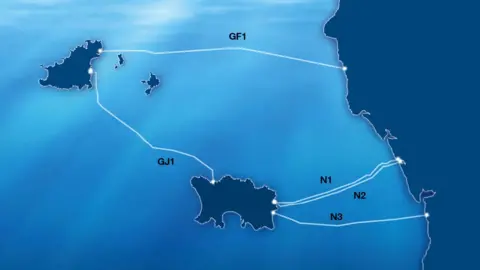
Deputies also agreed to plans for a direct undersea cable to France, subject to approval of a business case.
Another goal of the strategy is to facilitate "on-island renewable or low-carbon generation" through competition.
The Committee for Environment and Infrastructure's (E&I) policy letter lays out the overall objectives:
- Decarbonisation
- Security and resilience of supply
- Consumer value and choice
- Equity and fairness
- Supportive of a vibrant economy
- Greater energy independence
The island's CO2 emissions rose by eight times when the cable connecting it to Jersey was down between October 2018 and November 2019.
The approval of a direct line to the European grid will provide greater access to hydroelectric and nuclear-generated electricity, provide "security of supply" and support the expansion of "on-island [including offshore] renewables", the letter outlines.
 Guernsey Electricity
One of the ways the strategy seeks to reduce emissions is investigating opening up the electricity market, as currently supply is exclusively delivered by States-owned Guernsey Electricity.
The strategy instructs the Committee for Economic Development and E&I to consult and prepare a report on the viability of allowing competition from local renewable and low-carbon energy producers.
The committees must submit their findings by the end of 2021.
During debate, president of E&I Barry Brehaut argued the policy would ensure the States had a "strategic direction for energy" and emphasised Guernsey Electricity had expressed support for it.
Deputy Brehaut said: "With the flexibility that is built into this policy, it can adapt to the challenges we face now and in the future."
