Plan to trap Guernsey's Asian hornet queens

 Getty Images
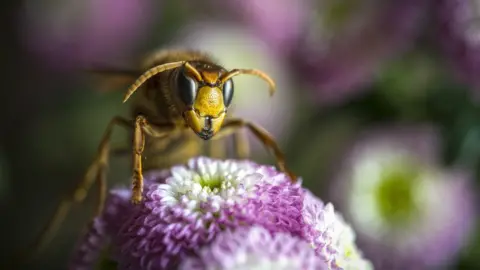
The States of Guernsey says it will try to capture and eradicate as many Asian hornet queens as it can when they emerge from hibernation next spring.
Authorities say the number of nests found on the island increased from two in 2017 to eight in 2018.
Asian hornets have been found in trees, hedges and a hedgehog house in Guernsey as well as a compost heap in Jersey.
A programme of "Spring Queening" was trialled this year in Alderney, with 55 queen hornets caught this spring.
Bait will be used that does not attract other insects, such as bumblebees and butterflies, and traps will be modified so that any smaller insects that are caught are able to escape.
The first sightings of Asian hornets in the Channel Islands were in Alderney in July 2016, and then Jersey in August last year.
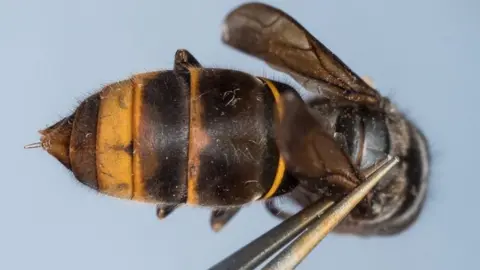
Vespa velutina queens are up to 3cm (1.2in) in length and have a dark brown or black velvety body, bordered with a fine yellow band.
 Barry Wells
Biodiversity education officer at Environment Guernsey, Julia Henney, said the impact of invasive species on native wildlife was "second only to climate change".
"With the measures being recommended to reduce the likelihood of our native bees and butterflies being caught during the spring trapping for hornets, we're very optimistic that this will be a very positive programme for Guernsey's wildlife."

The spread of Asian hornets across Europe
- Asian hornets have spread through Europe since arriving in France in a consignment of pottery in 2004
- In 2012 two nests were detected in northern Spain - it now has 10,000
- The insects pose a threat to native insects and public health
- On average, 30% of its diet is made up of honeybees
- While an Asian hornet sting is not considered to be worse than that of a bee, hornets are aggressively defensive
- One person was taken to hospital in Jersey this year after disturbing an Asian hornet nest
