Gerry Adams: New York in 1994 visit 'pivotal to peace'

 AFP/GETTY
Sinn Féin's Gerry Adams has said the IRA ceasefire would not have happened without an intervention by the then US president Bill Clinton 25 years ago.
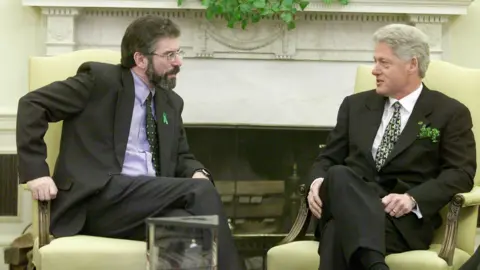
Mr Adams said President Clinton's decision to allow him to travel to America in 1994 helped to pave the way for the IRA truce seven months later.
The decision was made against the advice of the UK government.
On the 25th anniversary of the visit, Mr Adams said: "The visa granting was pivotal."
On Friday, Mr Clinton tweeted that the decision was "highly controversial but critical" to jumpstarting the peace process.
"Gerry made it clear this would advance peace and I'll always be grateful he kept his word," he added.
Allow X content?
Speaking to BBC News NI about the granting of the visa, former Sinn Féin president Mr Adams said: "Symbolically it was very important.
"It was important in showing that you could build an alternative… an alternative to armed struggle.
"And you could enlist support from powerful people in the USA."
On the IRA ceasefire, which was called in August 1994, he said: "It wouldn't have happened at the time that it happened if the visa hadn't been granted."
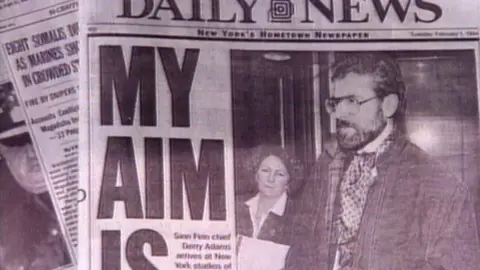
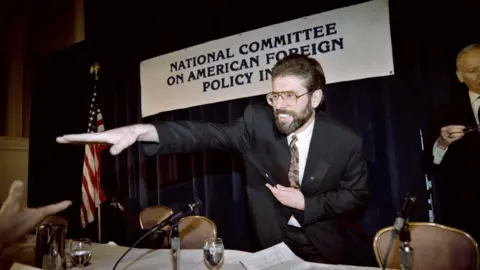
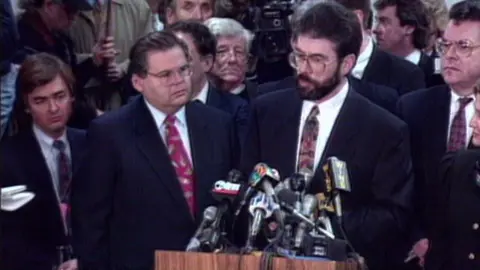
The 48-hour visit to New York was hugely contentious.
The IRA was armed and active at the time and the then UK prime minister John Major felt the trip would simply be used for propaganda purposes.
Threatened 'special relationship'
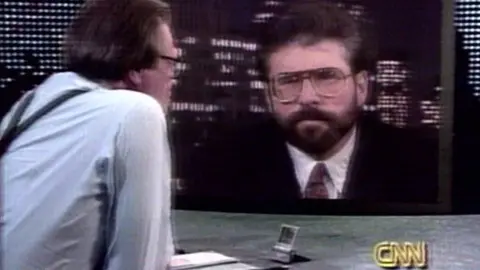
As the president of Sinn Féin, the IRA's political wing, Mr Adams was banned from speaking on TV and radio in the UK.
However, in America he was invited to speak on primetime TV shows including CNN's Larry King Live.
 AFP/Getty Images
He packed as many interviews and meetings into the two-day visit as he could.
He recalls: "I remember when I got back on the plane to go home I fell asleep before we took off."
Granting the visa was a risk for President Clinton.
It threatened the long-standing 'special relationship' between the UK and the USA and there was no guarantee that the visit would bring an end to violence any closer.
 CNN
CNNSo why was the visa granted?
Gerry Adams believes President Clinton had a better grasp of the peace process than many others.
"At times, he would have been more knowledgeable than the average official in the Irish or British government," he said.
"There was a lot of work done behind the scenes.
"You can see the resistance from within the British system when you read the (state) papers - it was foolish and stupid.
"They described this as the worst crisis since the Suez crisis, which is a bit of an overstatement."
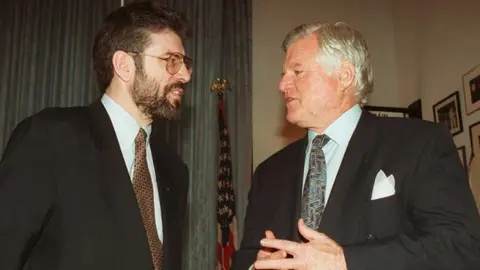
He paid tribute to work done in the background at the time by a number of people, including the then American ambassador in Dublin Jean Kennedy-Smith, US Senator Ted Kennedy, the SDLP's John Hume and west Belfast priest Father Alex Reid.
"He (Fr Reid) was talking to her (Kennedy-Smith) on the side and she was talking to her brother Teddy (Kennedy)," revealed Mr Adams.
Landmark moment
In America, there was also lobbying taking place.
A number of influential Irish-Americans were singled out by Mr Adams, including Bruce Morrison, Bill Flynn and Chuck Feeney.
The US State Department was against the visit but President Clinton ignored their advice.
 Getty Images
Instead, he listened to other White House advisers.
In the words of one official, the calculation was that the trip was a diplomatic win-win: "Engage him... or show him to be a fraud."
During the visit, Mr Adams was not allowed to travel more than 25 miles (40km) outside New York and was banned from fundraising.
Looking back, he said it was a landmark moment in the peace process.
He said: "It was a reinforcement of the need to talk.
"And it must be among the top five examples of that in our time."
See the full interview on BBC Newsline on BBC One Northern Ireland at 18:30 GMT on Friday, 1 February 2019.
