Undocumented steelworks unearthed at Sheffield Castle site

 Wessex Archaeology
Archaeologists have uncovered new evidence of Sheffield's industrial heritage during recent excavations at the site of the city's castle.
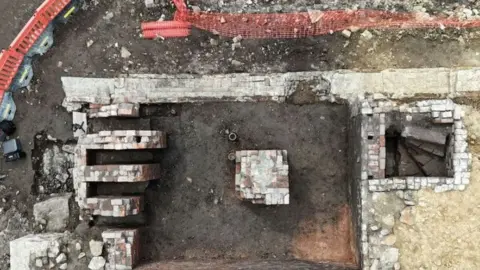
Undocumented remnants of a 19th Century steelworks were found during work in the area once home to Sheffield Castle.
Experts at Wessex Archaeology said the findings highlighted the role steel had played in the city's development.
The team is carrying out a 10-week dig at the site as part of the council's plans to redevelop the Castlegate area.
Their work has revealed the remains of the steelworks' crucible furnace, which is not recorded on contemporary maps.
 Wessex Archaeology
 Wessex Archaeology
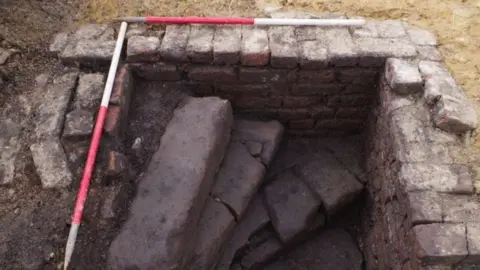
As well as helping the archaeologists to better understand the layout and workings of the furnace - which would have been used to refine blister steel into higher quality crucible steel - the team said they had uncovered several clues about the people who operated it, and the working conditions at the steelworks.
With temperatures reaching 1200C, the firing process was "unpleasant and challenging", say experts.
The team said they had found the letter 'H' scratched into the brickwork on the walls of the crucible cellar and posited whether it was "the initial of someone who toiled in the cellar day in and day out".
 Wessex Archaeology
 Wessex Archaeology
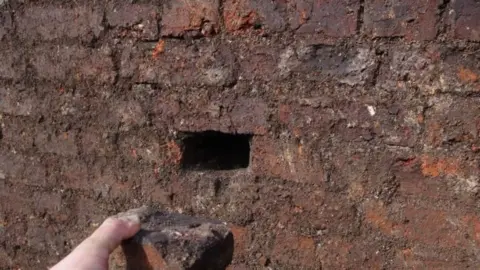
The archaeologists also uncovered a hole in the wall which had been dug out and then concealed with another brick.
They said they believed this to be "someone's secret hiding place".
Ashley Tuck, the archaeologist leading the dig, said: "These remnants of Sheffield's industrial past not only remind us of the role steel working played in the growth and identity of this city, but also encourage us to consider the people behind it - who would, by modern standards at least, have worked in an unpleasant and challenging environment."
 Picture sheffield
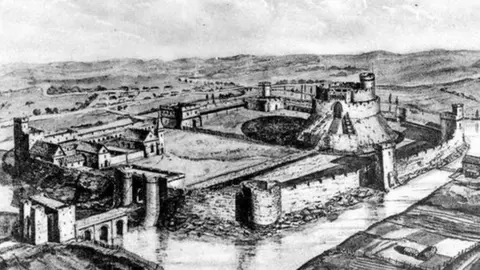
Castlegate is the oldest part of Sheffield and has been inhabited since at least the 11th Century.
Mary, Queen of Scots, was imprisoned for 14 years at the castle and at Manor Lodge in the 1500s, under the care of the Earl of Shrewsbury.
The castle complex was destroyed in 1648 during the English Civil War. The remains were covered by Castle Market in the 1960s, with the only visible evidence of the original castle found in basements of the complex.
The indoor market was demolished in 2015, allowing excavation work to begin.
Members of the public have been joining in with the current dig with further opportunities for people to get involved in May.

Follow BBC Yorkshire on Facebook, X (formerly Twitter) and Instagram. Send your story ideas to yorkslincs.news@bbc.co.uk.
