Storms unearth East Runton World War Two pillbox

 Watch keeper Kate/NCI
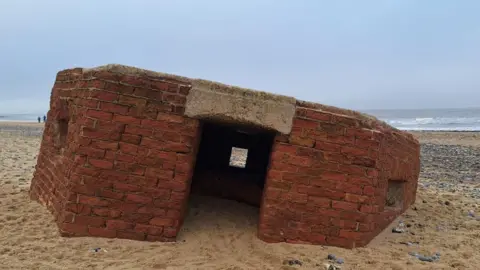
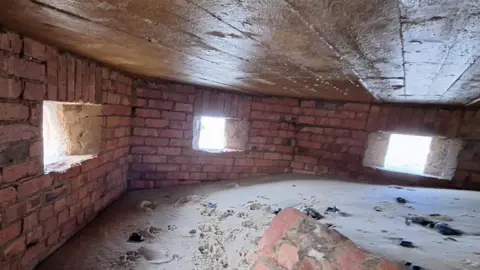
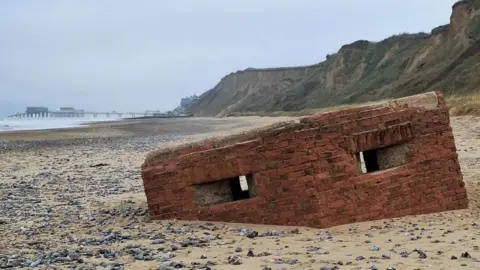
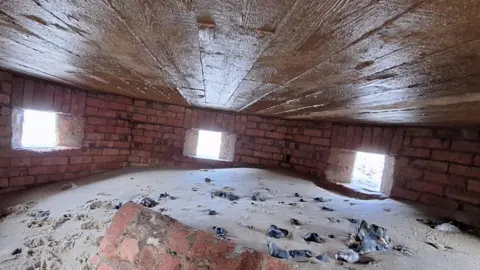
Winter storms have unearthed a World War Two pillbox on a sandy beach and revealed its interior.
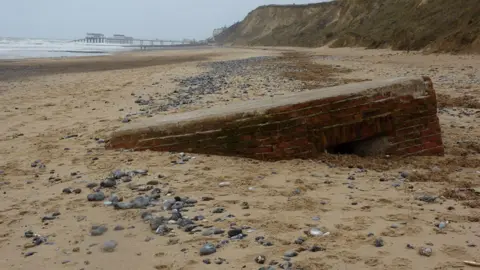
The bunker-like structure was buried nearly roof-deep at East Runton, Norfolk, after a cliff collapsed.
Niels Thomas, of National Coastwatch Institution Cromer, said: "The recent stormy seas have effectively jet-washed the pillbox and removed the sand."
About 28,000 pillboxes were built in 1940 and 1941 to protect the United Kingdom's beaches from invasion.
 Watch keeper Kate/NCI
Measuring about 6m by 6m (19ft), its roof is usually no more than 1m (3.2ft) above the beach.
Mr Thomas said a series of "extremely stormy seas" over the past two to three weeks "have washed out the pillbox".
"Normally the sand is much higher, you can just about peer inside and the sand is almost up to the roof," he said.
He advised people not to attempt to go inside the pillbox "for safety reasons, especially not when the tide's coming in".
 Peter Barr/Geograph
What is a World War Two pillbox?
- They are small defensive forts, usually made of concrete and sometimes faced with brick, built on the south and east coast of England and Scotland
- The first ones were created in World War One as a response to the use of machine guns
- In World War Two, they became part of an integrated invasion defence system, alongside anti-tank obstacles, barbed wire and mined areas
- Their aim was to block the progress of German armoured columns and provide cover for counter attacks
Source: Heritage Norfolk/Pillbox Study Group
Mr Thomas said: "They were an essential part of the defences of the coastline during that time."
The squat structures were built to various designs, round, square or hexagonal, which reminded people of containers used to store pills, which gave them their name.
The cliff East Runton's pillbox once perched on collapsed years ago, as a result of coastal erosion.
 Watch keeper Kate/NCI
Kate, one of the charity's watch keepers, took the photographs of its revealed interiors.
She is one of about 30 Coastwatch volunteers at Cromer who keep a visual watch over the beach and sea, acting as the "eyes and ears of HM Coastguard".
"Our watch station sits on the clifftop at East Runton, only two miles out of Cromer," said Mr Thomas.
"With the right visibility conditions, we can see about 30 nautical miles (55km) out to sea, as well as over to Cromer Pier."
 Watch keeper Kate/NCI
If the volunteers see an incident which puts "people, animals or vessels at risk", they contact HM Coastguard.
Like the RNLI, the National Coastwatch Institution it is entirely funded by public donations.
Follow East of England news on Facebook, Instagram and X. Got a story? Email eastofenglandnews@bbc.co.uk or WhatsApp 0800 169 183
