River Thames: Mudlarker discovers rare Tudor leather wrist guard

 Alessio Checconi
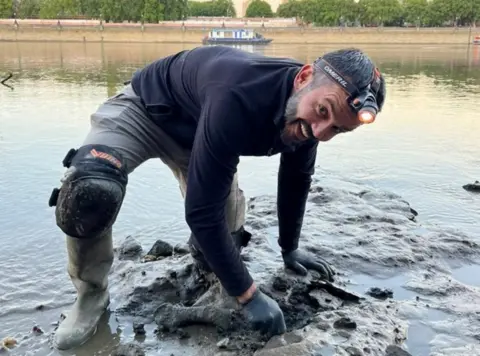
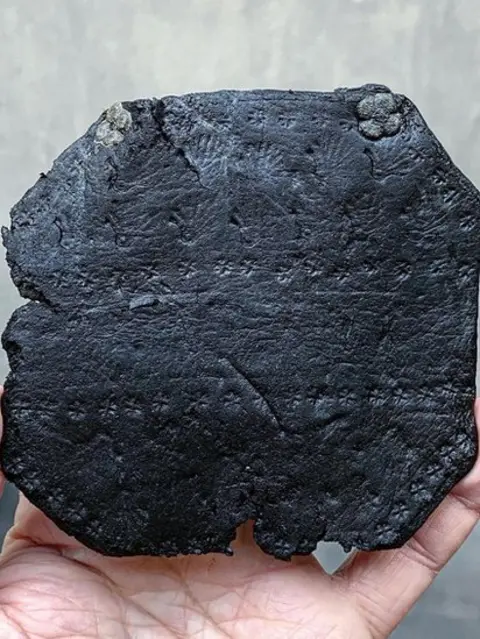
A well-preserved archer's leather wrist guard, thought to date back to Tudor times, has been unearthed on the Thames riverbank.
Found by London mudlarker Alessio Checconi on 18 February, the Museum of London has confirmed its authenticity.
Mr Checconi, from Vauxhall, who started the "mindful hobby" during lockdown, said it was an "exciting find".
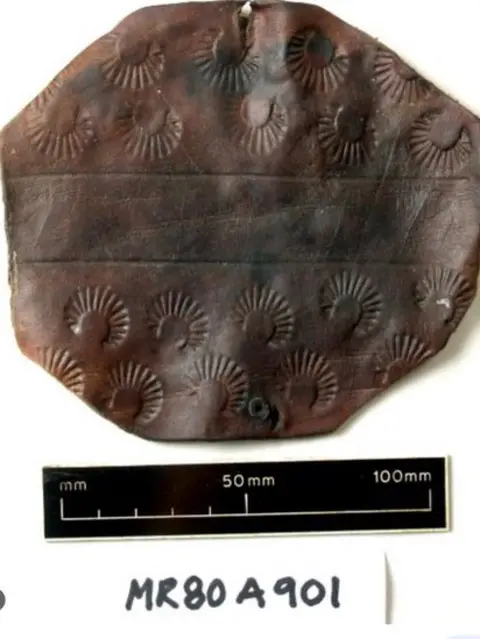
Similar examples have been found on the Mary Rose which sank in 1545.
 Alessio Checconi
Made of thick leather, and decorated with punched scallop shell and small cross motifs, the Museum of London confirmed they believed the wrist guard was from the first half of the 16th century.
Mudlarking, searching the banks of the Thames at low tide for interesting historical objects, was popularised in Victorian times.
The riverbank, having been inhabited since prehistoric times, is awash with artefacts from the Roman times and before.
The conditions in the river's mud mean that leather and even furs can be well-preserved due to the lack of oxygen.
Mr Checconi, who is a palaeontologist by trade, said it was a rare and exciting find.
 Mary Rose Trust
Mr Checconi took up mudlarking during lockdown when only a short period of daily exercise was allowed outdoors.
"I first started finding clay pipes. Everything that we find, which may be of historical significance or fall under the Treasure Act, we have to flag to the Museum of London, and they indicate whether it's of value.
"Since then, I have a better idea of identifying something whether it's valuable", he said.

Notable Thames finds:
Mudlarking has increased in popularity and now requires a permit from the Port of London Authority.
Before regulation, searchers would dig deep into mud to find precious artefacts, but now they can only investigate what naturally washes up to prevent further erosion of the riverbanks.
The wrist guard is now undergoing further analysis at the Museum of London and will be recorded on the Portable Antiquities Scheme database.
Mr Checconi said he "recognised the old symbolic shapes and immediately was excited, the flowers indicated it could be Tudor.
"I took it home and put it in my fridge. It's quite exceptional, it's almost complete.
"Now the museum will dry it properly with machines", he said.
Follow BBC London on Facebook, Twitter and Instagram. Send your story ideas to hellobbclondon@bbc.co.uk
