The good fortune behind Cutty Sark's 150 years

 Getty Images
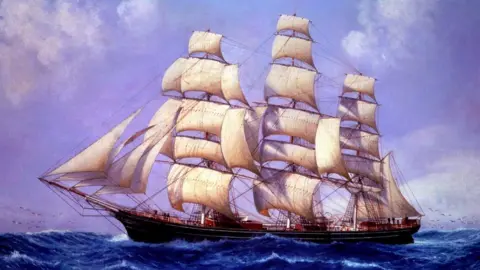
The world's only remaining tea clipper is celebrating its 150th birthday this weekend, but the fact the famous ship has survived for so long has much to do with luck.
Cutty Sark first set sail from Dumbarton, Scotland, in November 1869.
While at sea, it set records for travelling between Australia and England, but new technology and a devastating fire almost led to its end.
"There have been tribulations but also many instances of good fortune," said curator Louise MacFarlane.
 National Maritime Museum
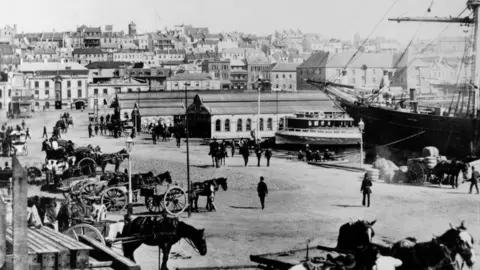
Cutty Sark was built for a cost of £16,150 and was launched from Dumbarton on 22 November 1869.
It first departed London for Shanghai on 16 February 1870, taking large amounts of wine, spirits and beer and returning with 1.3 million lbs (600,000 kg) of tea - enough for more than 200 million cups.
Yet its service began at a time when clippers were in decline as steamships took over the seas.
The ships were generally built to last for 30 years but as its contemporaries disappeared Cutty Sark "survived through its adaptability", according to Ms MacFarlane.
 National Maritime Museum
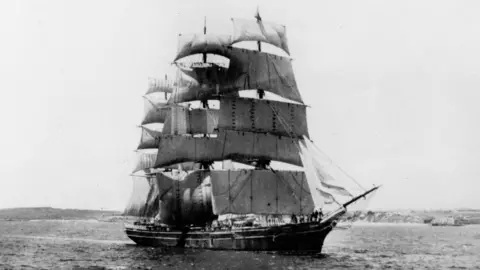
For several years it carried a variety of cargo around the world and began setting records as the fastest ship of the era when bringing Australian wool to the UK.
Following a decline in profits, the ship was sold to a Portuguese company in 1895 and gradually fell into disrepair.
 Getty Images
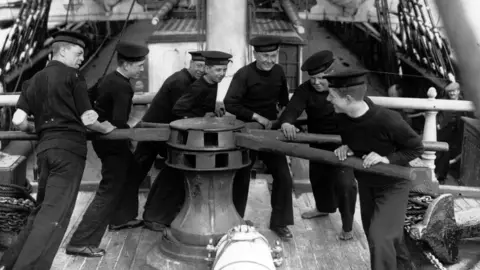
Cutty Sark's return to the UK in 1922 was all a matter of luck.
Now called the Maria do Amparo, it arrived in Falmouth, Cornwall, having been damaged in a storm, but while there it happened to be recognised by retired sea captain Wilfred Dowman, who vowed to save it for the nation.
"Had he not spotted the ship then, it probably never would have survived," said Ms MacFarlane.

Cutty Sark in numbers
- Overall length - 280 ft (85m)
- Top speed - 17.5 knots (roughly 20mph)
- Length of rigging - 11 miles (18km)
- Height of main mast - 153 ft (47m)
- Number of sails - 32
- Total area of sails when they were all out - 32,000 sq ft (2,973 sq m)

 PA Media
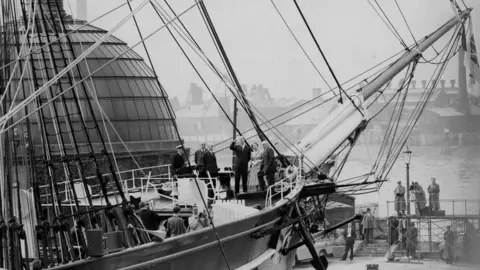
Cutty Sark's arrival in Greenwich, where it has been based for several decades, also had a lot to do with good fortune.
The dry dock had been meant for HMS Implacable, an 18th Century ship that had survived the Battle of Trafalgar but was scuttled off the Isle of Wight after World War II.
 PA Media
There was even an element of luck in the headline-attracting blaze of May 2007, which ripped through the ship's three decks as the fire reached temperatures of about 1,000 C (1,832 F).
"It was devastating but a conservation project had already begun, meaning the majority of the material had been taken out.
"As a result less than 2% of the original ship was lost," the curator explained.
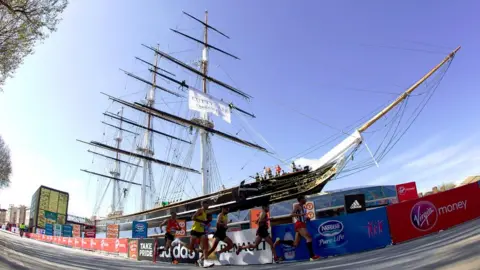
The attraction reopened in 2012 and has had more than a million visitors since then.
 Getty Images
Numerous events are taking place across the weekend to celebrate its 150th birthday, while residents of Greenwich and Dumbarton can visit the site for free.
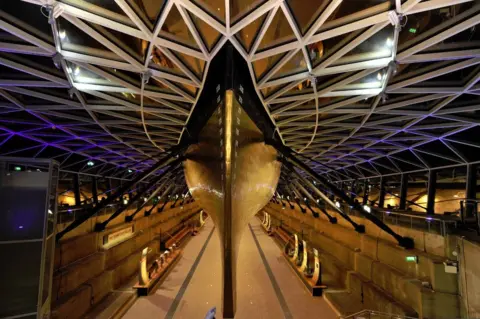
But the work to maintain Cutty Sark for another 150 years goes on.
"It leaks, it's exposed to the elements. It's a ship which will always need attention," Ms MacFarlane said.
 National Maritime Museum
All images subject to copyright.
