Story of Humber's lost town Ravenser Odd to be told

 David Nichols
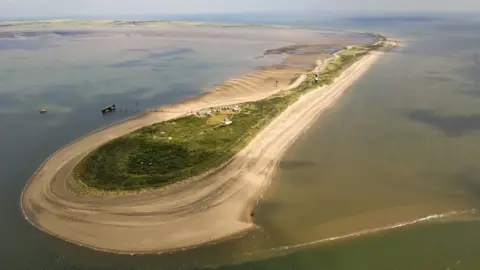
The story of a town lost to the sea more than 650 years ago will be told at an exhibition in Hull.
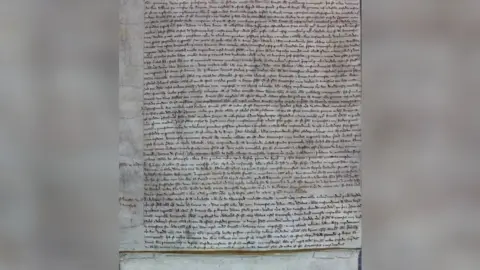
Ravenser Odd, near Spurn Point, was granted its charter, along with Hull, by King Edward I on 1 April 1299.
Those original charters, on loan from the National Archives, will be on display for the first time outside of London.
Archivist Martin Taylor says it is a "real coup" for Hull.
Called Hull/Ravenser Odd: Twin Cities, Sunken Pasts, the exhibition will display the documents along with items from the collection at Hull History Centre.
Ravenser became a thriving Humber port in medieval times. According to author Phil Mathison, it had two MPs, warehouses, a large fishing fleet and "its power rivalled at least Grimsby and Hull".
Over the course of about 100 years, some of the town's buildings were lost to erosion before it disappeared in the 1360s.
In 2022, an underwater sonar search by the University of Hull uncovered sand dunes on the seabed, which suggested stone structures underneath.
Experts said the sonar findings were similar to other sites around the world where ancient buildings have been uncovered.
 National Archives
The exhibition opens on Tuesday 26 March and runs until 30 May 2024.
Dr Kathryn Maude, from the National Archives, and Dr Emily Robinson, from the University of Sussex, will give a talk about the history and folklore of Ravenser Odd on 9 April.

Follow BBC East Yorkshire and Lincolnshire on Facebook, X (formerly Twitter) and Instagram. Send your story ideas to yorkslincs.news@bbc.co.uk
