Archive reveals hidden stories of Queer Norfolk

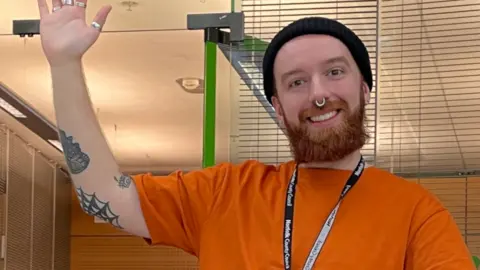 Adam Baker
A lesbian couple at the centre of their community and a pair of brothers said to have been among the first people to medically transition are among the people whose stories are told in the Queer Norfolk archive. Who were they and how have they shaped the county?
Housed inside the Millennium Library in Norwich, the archive was set up in 2022 with a collection of items dating back to the 1700s, and artefacts including posters, leaflets and magazines from across the county.
Archivist Adam Baker wanted to bring all of Norfolk's queer history together in one place, taking hidden stories out of the archives "into the streets, to bring them out and have pride in them and showcase the amazing LGBT history that we have".
With Baker's help, a Sounds series by BBC Radio Norfolk is opening up the archive to delve into the history behind those featured in it and the impact they had.
'Really ahead of her time'
 Emma Craig/BBC
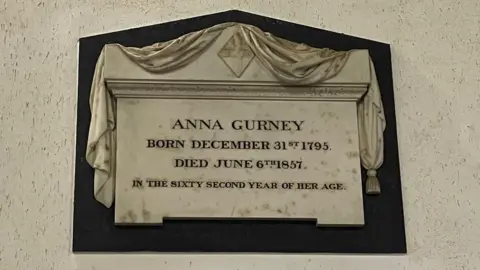
Referred to as the "cottage ladies" – a term for cohabiting lesbians at the time – Anna Gurney and her partner Sarah-Maria Buxton are buried at St Martin's Chuch in Overstrand, near Cromer.
Born in 1795, Gurney lived in Cromer before moving to Northrepps Cottage in Overstrand with her partner.
She died in 1857 but her legacy lives on in the area.
"Anna Gurney is so much more than her sexuality," said Baker.
"She was a great philanthropist. She founded the school in her village; she and Sarah-Maria paid for a new school to be built; she funded the lifeboat in Overstrand... she was very invested in the life of her local community.
"She also had this amazing worldview – she was really ahead of her time."
Gurney was involved in the movement to abolish slavery, studied local rock formations and was the first female member of the British Archaeological Association.
She founded The Belfry School in Overstrand in 1830, teaching the children of local fishermen to read and write, decades before state education was introduced.
"She really looked after everyone, whether she knew them or not," said Baker.
"She just kind of busied herself with the things she really cared about and her passions… it was her pursuit of knowledge and her curiosity."
'She was a strong ally'
 Oasis Norfolk
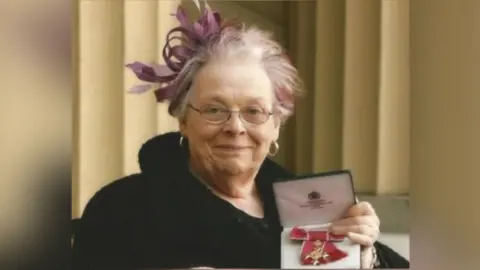
Barbara Ross, a former social worker in Norwich, founded trans support group, Oasis Norfolk, which has been meeting twice monthly for the past 25 years, from her living room.
Already involved in gender counselling, she founded Norfolk-based Gender Identity Services after moving to the county in the 1970s.
"I think the thing that really stood out to me about Barbara's story is I didn't know she was there," said Baker.
Despite her death in 2015, the group continues to meet with members describing Ross as a "lovely voice on the other end of the phone" who saved their lives.
Baker said: "She was so important and integral to the trans community in Norwich… there was a strong ally locally that really, really, fought for trans rights, in spite of the fact she wasn't trans.
"On the international stage, Barbara was of huge standing. But you could walk past her in the street and you wouldn't have known at the time she was so influential in certain circles."
'It was better to be a man'
 Emma Craig/BBC
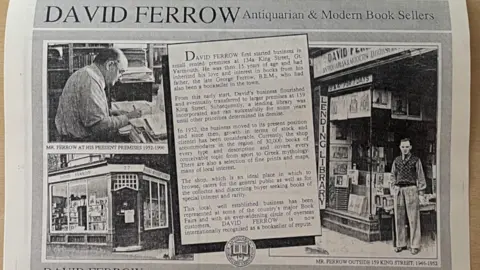
The Ferrow Brothers lived on Middlegate Street in Great Yarmouth.
Census records show they were born in 1922 and 1924, registered originally as Marjorie and Daisy and then re-registered as Mark and David.
Baker discovered their story with the help of community librarian, Rachel Ridealgh.
"The thing that struck us most, was the way that newspapers reported on the two sisters becoming male," she said.
"It was completely sensationalised, completely not politicised at all... it was something that people probably didn't hear about that often.
"It's very representative of attitudes towards men and women and those stereotypes at the time... it was actually presenting it that it was probably better to live life as a man. It was easier."
She said Mark went on to receive a commendation for brave conduct in Civil Defence during World War Two.
David became a rare book dealer, went on to marry and was said to have been a "big part of life" in the town.
Mark died in 1991 and David died in 2006.
Why is the archive important?
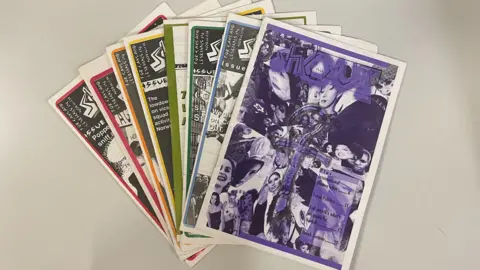 Emma Craig/BBC
Serena, who sought the support of Ross, after her wife discovered she was transgender in 2012, said she had previously felt "naive and uninformed" about transgender history.
She has donated items, including photographs, to the archive.
"There was an awful lot more known and talked about with the 'LGB' and the 'T' [Transgender] has come up much, much later," she said.
"I think we are still finding the 'T' history and that's why it's important to research it and preserve it... growing up, I knew nothing about it.
"It's really, really important that people that come after me have this history to look back at."
BBC Radio Norfolk's five-part sounds series, Norfolk: That's a Queer ol' Place, is for download from BBC Sounds.
Follow Norfolk news on BBC Sounds, Facebook, Instagram and X.
