Hull Castle Street dig: Bomb site and jail unearthed

 Highways England
An 18th Century jail, a suspected World War Two bomb site and traces of a medieval settlement have been found by archaeologists during a dig in Hull.
The discoveries were made during work to exhume 19,000 bodies from Trinity burial ground, which sits on the site of a major road improvement scheme.
The work is being carried out as part a £355m revamp of the A63 Castle Street.
Fran Oliver, from Highways England, said the team hoped to find "a wealth of information" in the year-long dig.
 Highways England
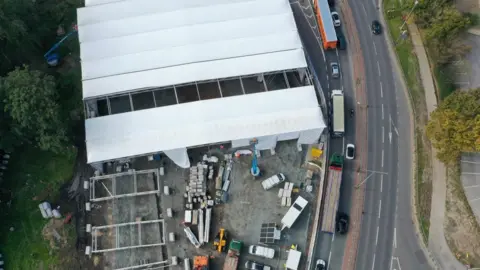
Two giant tents cover the investigations to ensure work to exhume the bodies from the 237-year-old burial ground can be carried out with "utmost sensitivity and care".
All the remains unearthed at the site will be analysed and then reburied at the end of the project.
Since work began in October, the 70-strong team has made a number of early discoveries, including parts of Hull's New Gaol, which was used for more than 40 years from 1785.
The building, which featured six large rooms and 13 individual cells, held people awaiting trial and those facing transportation to penal colonies like Australia.
 Highways England
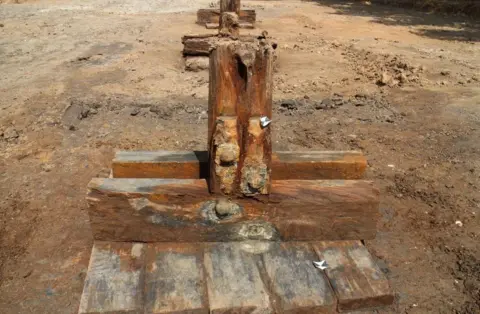
Archaeologists have also uncovered rows of fire-ravaged timbers, which they believe were part of a warehouse damaged by a bomb in World War Two.
Meanwhile, the discovery of partial footprints of two buildings believed to date back to the medieval period has been described as potentially "significant for the history of Hull".
Stephen Rowland, from Oxford Archaeology North, said they may be part of the "poorly understood settlement of Wyke" situated around the old course of the River Hull, which flowed along what is now Commercial Road and Manor House Road until being diverted.
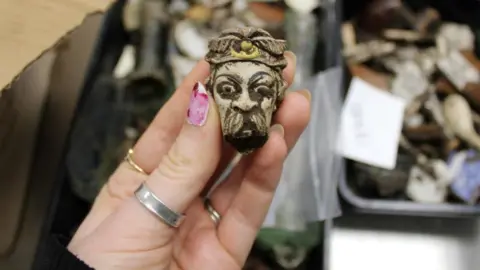
Other discoveries at the site include a bone domino piece and a decorated clay pipe bowl.

Follow BBC Yorkshire on Facebook, Twitter and Instagram. Send your story ideas to yorkslincs.news@bbc.co.uk or send video here.
