Marine reptile fossil found by dog 16 years ago goes on show

 Bill Burn
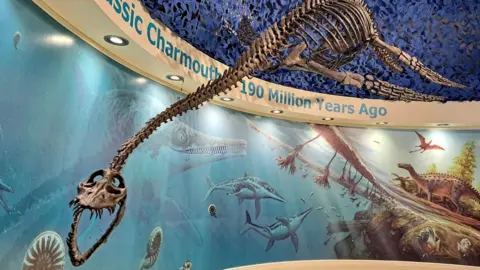
A 200-million-year-old marine reptile fossil found by a dog in 2007 has finally gone on display.
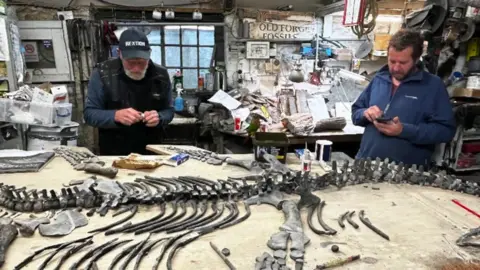
Experts spent 16 years working to extract and restore the 3.2m-long (10.5ft) plesiosaur skeleton.
It has been nicknamed Raffle after Tracey Barclay's dog who first spotted the vertebrae in rocks near Lyme Regis, Dorset.
Charmouth Heritage Coast Centre said the three-dimensional display was one of only a few of its kind in the world.
 Tracey Barclay
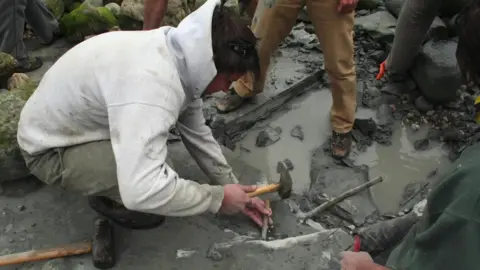
The plesiosaur was discovered on the so-called "ammonite pavement", a rock bed at Monmouth Beach renowned for its ammonite fossils.
Ms Barclay said her dog started to scratch at a dark-coloured shape on a pale background.
She said: "I had a look and saw it was a row of vertebrae so [I was] very excited. I knew it was bone material straight away but didn't know if that was it."
 Charmouth Heritage Coast Centre
Her partner Chris Moore recognised it as a plesiosaur, a reptile with a long neck and paddle-like limbs that lived in the Early Jurassic period.
Mr Moore said: "We spent almost 15 years' preparation on the piece to reveal the bones, get them out of the rock and then finally to mount them in three dimensions like this.
 Charmouth Heritage Coast Centre
"It's great, just amazing. It's such a relief to have got it here safely. When you put so much effort into something and you get the final result it's like, 'Wow'."
The couple have loaned the 70%-complete skeleton to the heritage centre, which said it was one of only a few three-dimensional Lower Jurassic plesiosaur specimens in the world.

Follow BBC South on Facebook, Twitter, or Instagram. Send your story ideas to south.newsonline@bbc.co.uk.
