Roman oil and wine pottery found at Ipplepen dig site

 University of Exeter
Archaeologists say pre-Roman Britons who lived in a rural location since the 4th Century BC may have enjoyed Mediterranean oil and wine.
Radiocarbon analysis of a dig site showed there was a settlement at Ipplepen, Devon, for about 1200 years longer than previously thought.
The discovery of Roman pottery suggests there was a community trading widely with the Roman world.
University of Exeter archaeologists are digging at the site this month.
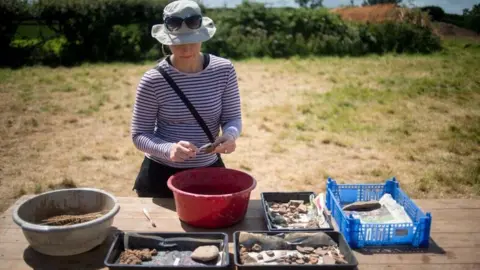
Archaeologists said the samples were Roman amphora used to transport wine and olive oil.
 University of Exeter
 University of Exeter
Professor Stephen Rippon, of the University of Exeter, said: "When we started excavating we thought that the site was only used during the Roman period, but the appliance of science has shown that it was occupied for well over a thousand years.
"Our excavations have given us further insight into how people made a living too."

Uncovering Ipplepen's past
- 2009: Roman coins are first discovered at Ipplepen, near Newton Abbot
- 2011: Trial excavations begin
- 2012: A Roman road, a square enclosure ditch of Roman date, and an Iron Age/Romano-British round house are discovered
- February 2015: A Roman cemetery is been discovered, revealing 15 skeletons
- June 2016: The boundaries of the Roman Empire are redrawn after it is discovered the settlement had trade links to the rest of the Empire
 University of Exeter
The archaeologists speculated the settlement may have been a farming community after the remains of a granary were found.
There is also evidence of industry at the site, after debris from iron working was found near what is thought to be the edge of the settlement.
 University of Exeter
Dr Chris Smart, of the University of Exeter, said: "We are so excited to be able to show everyone the hidden past of Ipplepen.
"The generosity of the Heritage Lottery Fund will enable us to help the community to record some of the most important archaeological and historic sites within the region and this will be of huge benefit to future generations."
 University of Exeter