Women mock the way they are portrayed by male writers

George PierpointBBC UGC and Social News
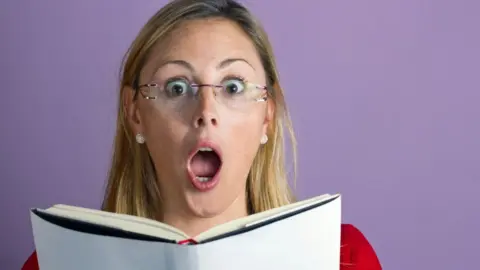
News imageGetty Images photo shows a woman reading a book with a shocked expressionGetty Images

Women have been sharing parodies on social media of they way they feel they are portrayed by male authors.

The responses caricature the tendency of male authors to focus on the physical appearance of female characters, and the often florid language used to describe their bodies.

Many replies also highlight the way women who are not deemed to be young and attractive, are dismissed as "cranks", "frightening" and "intimidating".

Allow X content?

This article contains content provided by X. We ask for your permission before anything is loaded, as they may be using cookies and other technologies. You may want to read  and  before accepting. To view this content choose ‘accept and continue’.

The challenge has generated almost 2,000 comments mocking the simplistic writing tropes used by some male authors.

A number of women wrote replies focusing on the representation of ethnic minority women as "exotic".

Allow X content?

This article contains content provided by X. We ask for your permission before anything is loaded, as they may be using cookies and other technologies. You may want to read  and  before accepting. To view this content choose ‘accept and continue’.

Allow X content?

This article contains content provided by X. We ask for your permission before anything is loaded, as they may be using cookies and other technologies. You may want to read  and  before accepting. To view this content choose ‘accept and continue’.

Allow X content?

This article contains content provided by X. We ask for your permission before anything is loaded, as they may be using cookies and other technologies. You may want to read  and  before accepting. To view this content choose ‘accept and continue’.

The trend began in response to a tweet by young adult novelist Gwen C. Katz.

Katz called out a fellow author for criticising the #ownvoices campaign which champions more diverse characters written by people from those diverse groups.

Many women used the format to ridicule the portrayal of older women in literature.

Most of these replies focused on the "sad" lack of youth, and the characterisation of older women as "maternal".

Allow X content?

This article contains content provided by X. We ask for your permission before anything is loaded, as they may be using cookies and other technologies. You may want to read  and  before accepting. To view this content choose ‘accept and continue’.

Allow X content?

This article contains content provided by X. We ask for your permission before anything is loaded, as they may be using cookies and other technologies. You may want to read  and  before accepting. To view this content choose ‘accept and continue’.

One woman reflected on the way she would be described having undergone a mastectomy.

Allow X content?

This article contains content provided by X. We ask for your permission before anything is loaded, as they may be using cookies and other technologies. You may want to read  and  before accepting. To view this content choose ‘accept and continue’.

Another called Kathleen replied to the thread to say that as a "middle-aged woman in tech" she would be overlooked by male authors all together.

Allow X content?

This article contains content provided by X. We ask for your permission before anything is loaded, as they may be using cookies and other technologies. You may want to read  and  before accepting. To view this content choose ‘accept and continue’.

However, fellow Twitter-user Gabrielle took it upon herself to pen a description of Kathleen's "intimidating presence".

Allow X content?

This article contains content provided by X. We ask for your permission before anything is loaded, as they may be using cookies and other technologies. You may want to read  and  before accepting. To view this content choose ‘accept and continue’.

Kathleen responded to her description to thank Gabrielle and suggested male authors should take writing tips from her.

Other women who also suggested they would not receive a description simply described the scene in which their character might appear.

Allow X content?

This article contains content provided by X. We ask for your permission before anything is loaded, as they may be using cookies and other technologies. You may want to read  and  before accepting. To view this content choose ‘accept and continue’.

Twitter-user Isabella Mori agreed, stating that "tea bringers need no name".