Fishermen's choirs sing on amid 'dwindling' numbers

 Grace Shaw/BBC
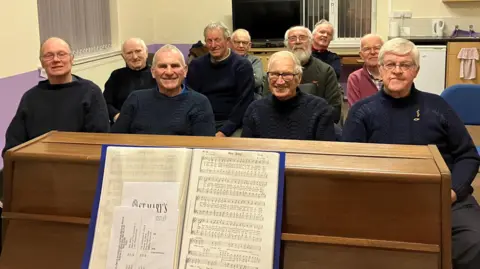
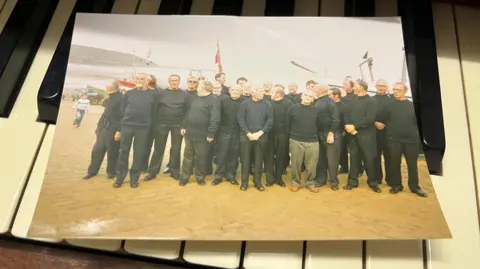
On a rainy December night in a little room above Filey Methodist Church, 10 members of Filey Fishermen's Choir rehearse for the annual RNLI Memorial Concert which takes place each Christmas at St Mary's Church in Scarborough.
The men, all wearing their navy fishermen's jumpers, known locally as ganseys, are practising Ship Ahoy for their upcoming concert, which, as with almost every performance in its near-200-year history, will end with the choir's "signature" song of Sailing Home.
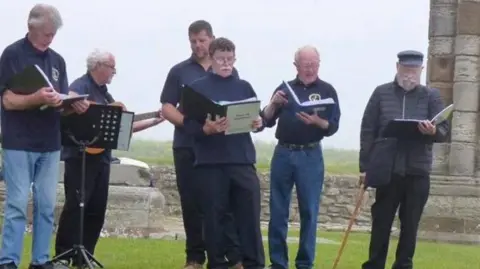
About 35 miles (56 km) up the coast, members of the Men of Staithes choir, what was once known as Staithes Fishermen's Choir, are also preparing for their next concert.
The roots of both choirs date back to the 19th Century, but, despite their long, proud and fascinating histories, at the end of 2025 their numbers are dwindling and there are perhaps doubts about their long-term future.
These days, neither choir requires members to be fishermen, and both say they really need new and younger members so their centuries-old traditions do not die.
 Francis Appleby/Connor McPherson
Francis Appleby, chairman of Filey Fishermen's Choir, joined the group over half a century ago at the age of 29.
A former fisherman like his dad and grandad, he remembers seeing the choir's performances at St Sepulchre Street Church in Scarborough's old town where his dad was organist - and was clearly inspired by what he saw.
"They'd pass my dad a book and ask him to play for them," he recalls.
Much like his dad, Mr Appleby plays the piano and organ for the choir and he says the group still sings only hymns, true to the choir's original religious purpose.
"Our main purpose is to take the Christian message to all through the old hymns we sing, like our predecessors did," he said.
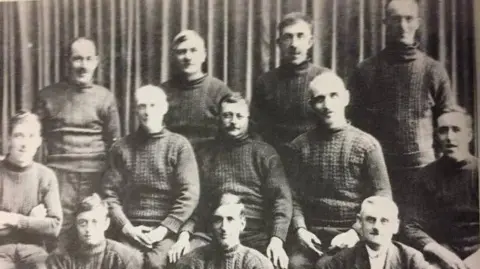
Mr Appleby says the group continues its traditions dating from when Filey's "rough-living, drunken fishermen" converted to Christianity in the 1820s.
 Filey Fishermen's Choir
Alan Botterill, a singer and historian, says the choir's rich Christian heritage dates back to when Filey was a somewhat "desperate and dangerous" place.
Mr Botterill explains that a preacher called John Oxtoby was even once chased away from the town "by people throwing dried skate at him".
"Filey in the 1800s was lawless and three times dead," Mr Botterill said.
"There was no Christian witness in the town, and a lot of superstition."
However, Mr Botterill explains that Oxtoby returned to convert Filey's fishermen to Christianity and the choir was eventually born as a result of that.
Increasingly larger chapels were built using seamen's wages - and that is where the roots of Filey Fishermen's Choir are to be found, he says.
But, while Mr Appleby, who is now nearly 80, joins his fellow choir members in their distinctive Filey-pattern ganseys to rehearse every Saturday, he says he worries for the ensemble's future.
The total membership of Filey Fishermen's Choir now stands at "14 if we're at full strength all together", he says.
"We're finding it very difficult to get new members," Mr Appleby admits.
"We go through good times and less good times."
 Men of Staithes
The choir at Staithes can also trace its heritage back to the 1800s, starting with men singing on the harbourside before church.
Member Lee Jackson, who is a ship's pilot for the River Tees and also volunteers for the RNLI, says things have changed a great deal in Staithes since the group was founded as a fishermen's choir.
"They gathered before church on the seafront on Sundays and sang, then went up the street into their different chapels. That's how our choir formed," Mr Jackson explains.
He says that in the 1980s, when his parents ran the pub in which the choir rehearsed, it had about 20 members - and there were probably even more members "further back when more people lived in the village".
"When it started, Staithes was a busy seafaring fishing hub with 100 or so fishing boats. Now only a couple of us have boats," he says.
 Men of Staithes
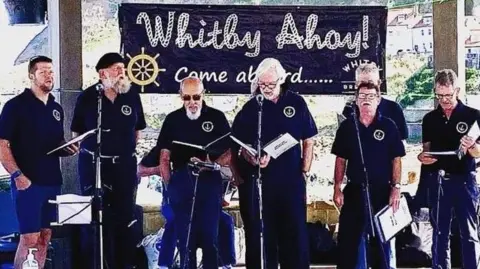
Currently 12-strong, with its oldest member 100 years old, the membership of the Men of Staithes choir is actually now up from a low of about six members at one point.
Previously the Staithes Fishermen's Choir, it changed to its current name a while ago in a bid to show "all are welcome, you don't have to be a fisherman to join".
However, in 2025, the choir's repertoire remains rooted in fishing traditions, though its members now sing more shanty-style pieces in an effort to appeal to younger generations.
"We often do a mix but there has to be a sea connection, but what we sing depends on who we perform to and where we perform," Mr Jackson says.
"Most sea songs, whether hymns or shanties, are inevitably superstitious and religious because of the danger of sea fishing - relying on the weather and good fortune for catching for many of them.
"A lot of the hymns are about God and Jesus showing people the way home too: 'pilot me, keep me safe'."
When asked about the future of the choir, Mr Jackson, who, at 50, considers himself the "baby" of the group, says: "We'll just see what happens."
"We want to keep the choir going obviously, but we're quite a laid-back group so we aren't vigorously pushing a recruitment drive," he adds.
 Magnus Johnson
Between Staithes and Filey another small shanty group is also active.
Marine scientist Magnus Johnson started the group near Scarborough with his neighbour and hurdy-gurdy player Ian Waughman.
"We sort of lead, but it's very informal. Anyone can suggest anything any time," Mr Johnson explains.
Also including women among its membership, about seven singers meet weekly, usually in a pub or at someone's house.
They focus on shanties as "they're memorable, written for anyone to sing", Mr Johnson says.
"They're work songs. Some have a long pause - if you're hauling a rope, there's a slow rhythm like 'heave away, haul away'.
"Others, like while working the capstan [for pulling in ropes], have a very different rhythm."
 Grace Shaw/BBC/Filey Fisherman's Choir
Mr Johnson, who grew up in Shetland, where he sailed, fished, dived and played the fiddle, says his dad had a small boat and they often went scallop fishing.
He says he started singing because he loved music as much as the sea and his favourite song is Bones in the Ocean, a lament about lost friends.
That song "rings true" because he was at sea when his boat's sister-ship sank, drowning 15 men, Mr Johnson explains.
Meanwhile, Mr Jackson, from the Men of Staithes choir, says despite "dwindling" memberships in many such choirs, an important thing to remember is that all the singers love their groups - and their audiences do, too.
"There's a bit of adrenaline that comes from performing in front of people," he says.
"You come away feeling elated and it's really sociable, too."
Listen to highlights from North Yorkshire on BBC Sounds, catch up with the latest episode of Look North.
