How a 'fairytale' upbringing set artist on the road to success

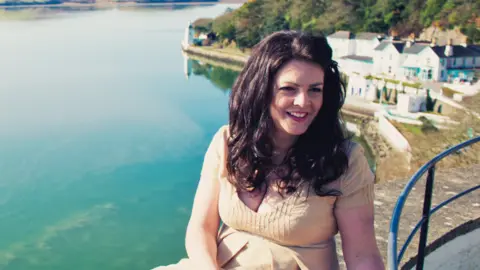 Amy Swann
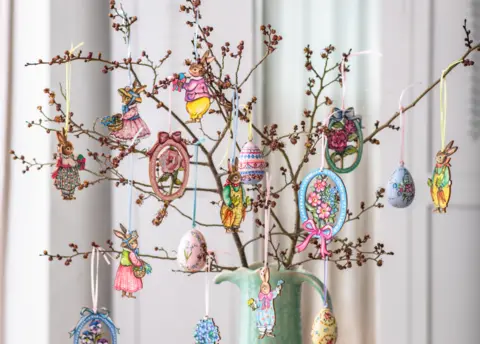
Are you doorscaping your home with chicks and bunnies and hanging ornaments on an Easter tree?
Yes, an Easter tree is a thing these days.
Decorating your door with reams of foliage, bows, lights and anything else you fancy isn't just for Christmas and Halloween - it's now a growing trend of celebrating the spring holiday.
And if you're on board with the "twig style" Easter tree creation, there's a chance one of your ornaments might be the work of a Welsh artist who came early to the burgeoning trend for Easter celebrations.
Amy Swann, from Llanfrothen near the famous Italianate village of Portmeirion in Gwynedd, has gone from being an art teacher to a creator whose work is sold across the UK, including in London's oldest department store, Fortnum and Mason.
Amy credits her environment as a child with shaping her approach to art, with its strong emphasis on the natural world that was her first inspiration.
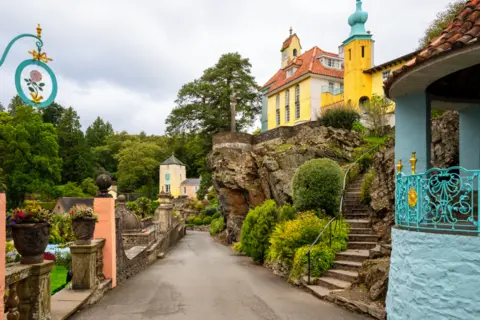
Not only was she immersed in nature, but the tiny village of Llanfrothen, at the foot of the Cnicht mountain, is also home to the beautifully sculpted estate of Plas Brondanw, the former home of architect Clough Williams-Ellis, who designed much of the landscape.
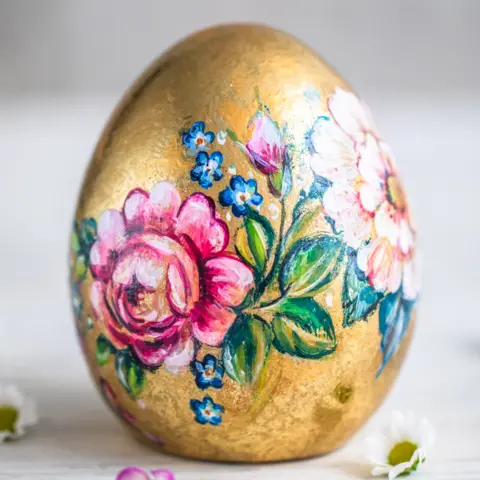 Amy Swann
A foundation set up by him also manages about 50 homes in the area for the benefit of local people in an effort to maintain a community.
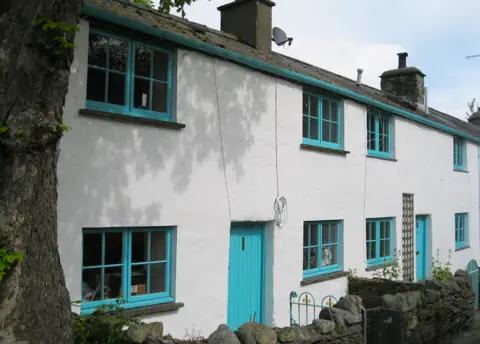
They are often painted in a distinctive whitewash and his signature turquoise blue woodwork, giving a picture book quality to Amy's surroundings in "quite an ancient village" as a child.
"There's some Roman paths there and it feels a bit like it's stuck in history in some way in the older parts.
"It's stayed the same since I was a child."
 Amy Swann
While still very young, she used to pick wildflowers and bring them home to draw.
At school she learned about "traditions and folklore and local history. It was quite a crucial part of my upbringing to understand my Welshness," she said.
She also credits some of her budding artistic inclinations to her mother who had "good taste in books... she used to buy me beautifully illustrated books".
"Things like Brambly Hedge, Flower Fairies, but even earlier than that. She kept all the books she had as a little girl, so my first memory of art is in books, in those nostalgic illustrations, where the colour palettes are so soft and sensitive."
 Getty Images
Living so close to a rich natural environment meant she could trace a direct line from the written word to the real world.
"In Brambly Hedge, for example, you'd see the little mice in hedgerows that if I went out of my door, I'd see the same where I lived.
"There were little secret pathways through trees or holes in little oak trees where mice might live, or primroses lining a little ancient pathway.
"The pathway between my imagination and reality was very close. I could see it in a book and I could see it where I lived."
After being inspired by art teachers like Luned Parry who were also practising Welsh artists, Amy did a degree in printed textiles at Loughborough University and then taught visual arts at a college in Chester for 12 years.
 Alan Fryer/Geograph
While on her honeymoon to Austria near Christmas, she stumbled across a crafting tradition that was to plant a seed which, many years later, fruited into a new direction for her work.
"There were so many beautiful Christmas decorations that were made there, and people were buying them because they were made there.
"They wanted something that felt authentic, not a souvenir even, just something that felt real, because it was a Christmassy place.
"I went to see a little woodcarver who'd carved everything there himself and I remember saying to my husband 'why don't we have anything like that in our country'?"
After having a baby and then discovered she was pregnant with twins, she wanted to do something which worked around her family.
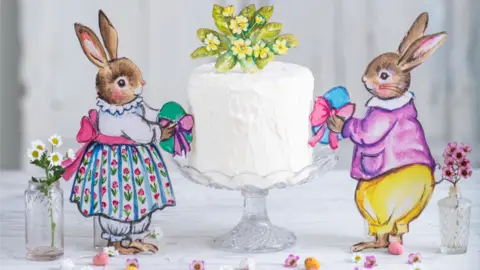
Living back in Llanfrothen, she started sculpting flowers from icing and other materials, and friends started asking if she could decorate their wedding cakes.
"I was drawing on my childhood. I thought it would be lovely to have a cake covered in flowers that looked like you'd just picked them from the meadow or the hedgerow.
"That really took off. I was contacted by magazines asking me if I could do things for their cover shots for the magazines, and also features inside."
 Amy Swann
She also appeared with Kirstie Allsopp on her show Kirstie's Handmade Christmas in 2016 as knowledge of her work started to spread.
But as Covid hit and weddings dried up, Amy's thoughts turned more to the Austrian woodcarver and his handmade Christmas decorations.
"Because I was in a place where I wasn't working as a teacher or anything, I had the space to think 'what next?'
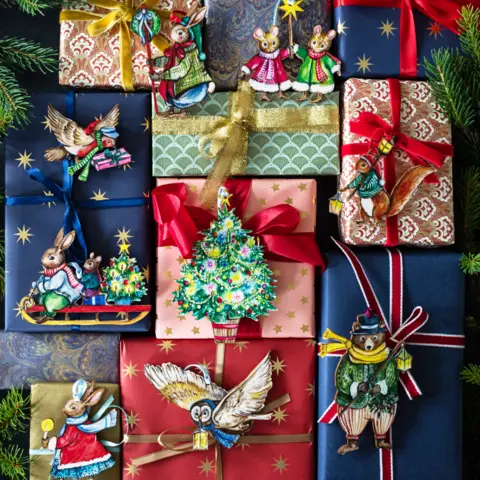
"During Covid everybody was being quite creative anyway. September of that year I was painting baubles – it's quite a thing now but it wasn't then.
"A bauble on a tree was personalised or hand-made in this country and not shipped over."
 Amy Swann/Fortnum and Mason
People saw her work on Instagram and bought directly from her and the business started growing.
Then, in 2023, Fortnum and Mason came calling.
Amy designed a series of decorations based on the 12 days of Christmas for the store and has continued to work with them every year.
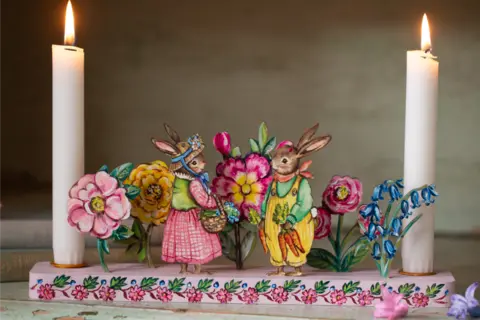
Although Christmas remains her busiest time, she has seen first hand the rise in demand for Easter and spring decorations.
According to consumer market agency Mintel, Easter spending has grown from £550m in 2016 to £1.7bn in 2025.
"I think people are moving towards the trend of investing in Easter now," she said.
"People want to decorate and make things pretty at home.
"It's about sustainability as well, and making sure that people are investing in things that are made in this country but also things that will last."
 Amy Swann
She is keen that her work is recognised as being wholly made in Wales as it is "a big part of my identity in what I do".
"I'm always trying to promote it because I do think as Welsh artists we can get lost in the ether of being from Great Britain," she added.
In future she hopes to create a book on Welsh folklore and traditions, some of which were a part of the rhythm of the year as seasons shifted.
"When you grow up in rural Wales, you're very much aware of the seasons because you look to nature for those changes.
"I remember my nain [grandmother] who lived in the village saying 'oh I heard the cuckoo today' and that marks the beginning of a new phase, or the lambs that are in the field and you know spring's coming.
"Anything like that that embeds itself in you as a child stays with you."
