Disabled woman put in nursing home against her will says she feels 'betrayed'

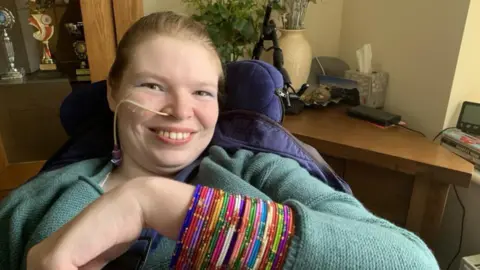 Lucinda Ritchie
A 33-year-old disabled woman says she feels "betrayed, worthless and frightened" after being moved to a nursing home against her will.
Lucinda Ritchie previously lived in her own adapted bungalow in Billingshurst, West Sussex. She was admitted to hospital with pneumonia last April, but 10 months later was not allowed to return home.
Instead, this February, she was taken to a nursing home in Uckfield - an hour from her home and family. Within two days of being there, her condition deteriorated and she was returned to hospital.
NHS Sussex said it was "committed to working with Lucinda and her family to make sure she receives high quality and safe care to meet her needs".
Neil Allen, an independent barrister, told the BBC it was "very unusual" for an adult with full mental capacity to be moved to a residential home against their will as it was "totally unlawful".
The NHS has denied that funding considerations played any part in the decision-making around Ritchie's care, saying it was based on her clinical safety.
But Allen said disputes over the funding of people's healthcare packages were happening up and down the country all the time.
"That is a national issue at the moment," he explained.
'Life will not be worth living if I can't go home'
Ritchie has Ehlers-Danlos syndrome, a condition that affects the joints; functional neurological disorder, which impacts her mobility; Addison's disease, a hormonal disorder; and epilepsy.
She has a tracheostomy and sometimes uses a ventilator. Able to speak when she was younger, she has primarily used eye-gaze technology to communicate since 2017.
Before her hospital admission, Ritchie had 24‑hour one‑to‑one nursing funded in her own home by NHS Continuing Healthcare (CHC).
She was studying for a master's in sustainability at Southampton University, as well as acting as a charity ambassador and keynote speaker.
In 2023 and 2024 Ritchie was recognised as one of the most influential disabled people in the UK for her pioneering work supporting communication using eye movement.
She was admitted to East Surrey hospital last April with pneumonia and suffered further complications which prolonged her stay.
She wanted to be discharged back to her own home, but this did not happen.
Instead, her mother Christine Ritchie says care commissioners at NHS Sussex All Age Continuing Care (AACC) told them Ritchie would be going to a nursing home.
Ritchie refused.
On the day she was transferred, Ritchie told the BBC she was "devastated" and wanted to get back to her own home.
More recently, she explained: "In my own home, with my nurses, I feel safe and can see my friends and family easily.
"My dad visits me almost daily. I can have meetings easily and I am not dictated to by the home rules or policies."
She said living at home gave her agency and control of her own surroundings - and the ability to use a wheelchair-adapted van to go out to events, shopping and university.
"Life will not be worth living if I cannot go home," she said.
When she was taken from East Surrey Hospital to Temple Grove Nursing Home, Ritchie's mother said her powered wheelchair was "switched off and pushed".
"She didn't consent to go," she told the BBC. "It's absolutely horrific."
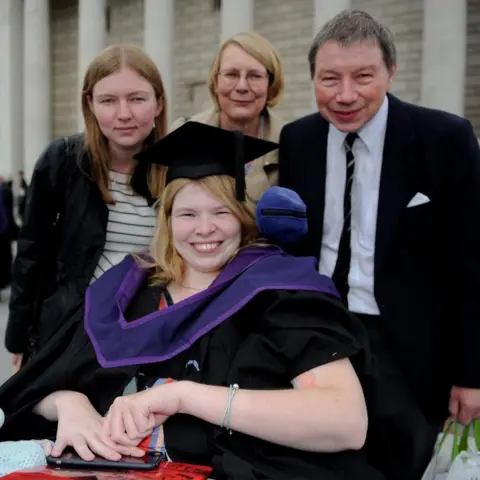 Lucinda Ritchie
Ritchie said no care plans for the new placement were shared by NHS Sussex AACC with her or her legal team.
Her then-solicitor, Andy McKay of Martin Searle Solicitors, said his firm had been trying since autumn to secure "meaningful engagement" from the NHS commissioners about a safe return‑home plan.
He argued it would have been safe and viable for Ritchie to return to her own home, where she has had 24/7 nursing for eight years.
McKay explained that her established nursing provider had confirmed it could safely continue to meet her complex needs at home, including tracheostomy and intermittent ventilation care.
He said he wrote to NHS Sussex AACC to explain this, but that the nursing agency confirmed they were never approached by the care board to ask if they could indeed meet those needs at Ritchie's home.
"We've raised those specific questions to the care board. There's been no substantive response," he said.
McKay described Ritchie as "a very bright, intelligent woman who has an independent life, although she needs an awful lot of support to maintain that independent life.
"Ultimately, I believe it's all about funding."
The issue of funding
Only around 50,000 people in England with the highest needs are eligible for CHC, which is fully funded by the NHS.
CHC can be provided at home or in a care or nursing home - and the decision must be "person‑centred", according to NHS rules.
A regional NHS care board commissions the care package. They're required to assess someone's clinical need and also their "associated social needs" - which could include things like seeing family and studying.
Cost can only "come into the equation" when someone's needs can be fully met in different ways, according to Allen.
"If Lucinda's needs can only be met at home, regardless of cost, they would have to pay that," he added.
If someone has capacity and refuses a residential home, that must be respected, even if others think it unwise.
NHS Sussex has confirmed to the BBC it recognises that Ritchie has capacity. They have not explained their legal rationale for moving her against her will. They denied that funding played any part in the decisions around Ritchie's care.
 Lucinda Ritchie
Currently, CHC is under strain. Local NHS boards must pay the full cost of high‑need packages, but tight budgets and rising demand mean decisions can be slow and what people receive varies widely by area.
Disputes between families and their local NHS care boards are happening "up and down the country all the time", according to Allen.
Based on typical UK prices, a 24/7 nurse‑led home package for someone with tracheostomy and ventilation needs works out at about £9,000–£12,000 a week.
Nursing‑home fees in southeast England are usually around £1,500–£1,800 a week.
Ritchie, her family and previous solicitor believe the decision to move her to a nursing home was driven by cost rather than Ritchie's needs.
"It's a money grab," said her mother, who believes Ritchie's long hospital stay gave the NHS an opportunity to switch to a less expensive package than the nurse‑led support she had at home.
But NHS Sussex told the BBC the decision was made on safety grounds after her long stay in ICU, and denied that funding considerations played a part.
'Why did they do this to me?'
Within two days of arriving at the nursing home, Ritchie's family said they were called by staff in the middle of the night and an ambulance transferred Ritchie to hospital in Tunbridge Wells.
Her condition ultimately stabilised, her mum said.
Ritchie told the BBC the experience of being put into the care home affected her "profoundly".
"I felt utterly worthless and frightened. Why did they do this to me? I said I did not give my consent."
She now fears being moved back into a nursing home again.
Allison Cannon, chief nursing officer at NHS Sussex, said: "We are very sorry to hear the concerns of Lucinda's family about her care over the last week. We are committed to working with Lucinda and her family to make sure she receives high quality and safe care to meet her needs.
"We worked with our partners to prepare for Lucinda to leave hospital, and there were plans in place for the care she would receive.
"Our priority now is to ensure she is able to access the support she needs in hospital, and for us to work with Lucinda and her family to plan together for her long-term care."
A spokesperson for Medici Healthcare, which owns Temple Grove Nursing Home, said: "We can't comment on specific clinical details.
"However, we can confirm we did admit a resident on Monday and whilst we were able to meet their needs, it was agreed by all parties that our home did not provide a long-term solution to their ongoing wishes and needs.
"As such, and with the agreement of the resident and their family, the individual has now been moved to a hospital setting."
Clarification: This article has been updated to reflect the fact that Lucinda's care provider said the typical UK cost of 24/7 nurse‑led home packages for someone with tracheostomy and ventilation was £9,000–£12,000 a week rather than £8,000–£16,000 a week as originally stated.
