'I will fight on to get justice for my three brothers'

 BBC
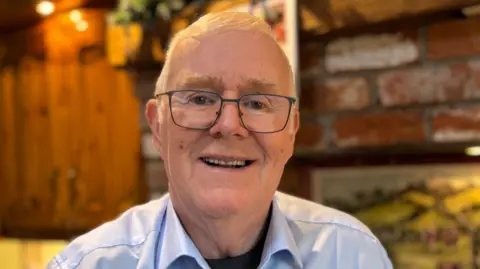
BBCFifty years after three of his brothers died as a result of a loyalist gun attack, Eugene Reavey had hoped to be able to close the book on their murders.
"But the Ministry of Defence (MoD) and the Police Service of Northern Ireland (PSNI) had other thoughts," the 78-year-old said.
Mr Reavey is suing both parties, but a postponement of the case has overshadowed the anniversary of the shootings this weekend.
He has questioned whether he has the "stamina" to carry on, but he says he knows he must.
The Ulster Volunteer Force (UVF) attack happened at the Reavey family home at Whitecross in County Armagh on 4 January 1976.
The gunmen shot the three occupants who were home watching TV - John Martin, 24, Brian, 22, and Anthony, 17.
The youngest victim died days afterwards, while the others were killed outright.
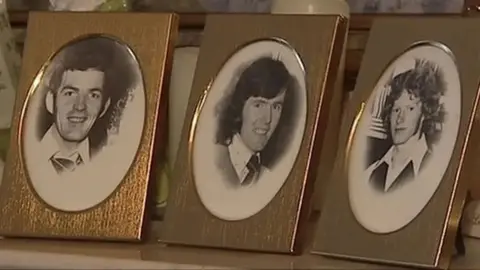
"Before they could even draw their breath, this big fella opened fire on John Martin sitting by the fireplace," Mr Reavey said.
"The other boys tried to get out of the room. Brian was shot in the back and Anthony dived on to the bed, but the gunman followed him and sprayed the bed."
The attack was carried out by a unit known as the Glenanne gang, some of whose members were police officers and soldiers.
In 2024, the Public Prosecution Service (PPS) took decisions not to prosecute two former officers as the evidence was considered to be insufficient.
"There was never any justification (for the attack)," Mr Reavey said.
"Nobody in our house had any interest in politics.
"They said there were traces of PIRA. There were no traces of PIRA about our house... Never was and never will be."
50th anniversary
The 24-hour period in 1976 witnessed 16 murders - within minutes of the Whitecross attack, the UVF shot Joe, Barry and Declan O'Dowd near Gilford.
The following day, IRA gunmen murdered 10 Protestant workmen at Kingsmills.
Mr Reavey is suing the MoD and the PSNI over alleged collusion in the murder of his brothers.
The case has been put back until April because of a delay involving the disclosure of sensitive documents.
"I thought I was going to have the law cases all sorted by this 50th anniversary," he said.
"That was going to be the end of my involvement... I'm not fit for it.
"I'd myself built up to get this finished, and I thought I would have, but the MoD and the PSNI had other thoughts."
Mr Reavey said he was "satisfied" the names of he and his siblings have been cleared.
Vowing to battle on in court, he added: "You can't have three innocent lads murdered and have the population think they were in the IRA.
"I would never let that happen and my father asked me on his death bed to make sure to try to get justice for the boys."
Who were the Glennane gang?
The Glenanne gang were members of the loyalist paramilitary group the UVF.
The gang was based at a farm in Glenanne, County Armagh, in the 1970s, and allegedly contained members of the Royal Ulster Constabulary (RUC) and Ulster Defence Regiment (UDR).
The gang's members are believed to have been responsible for up to 120 murders in nearly 90 attacks in the Troubles.
