The 'superhero' oyster species helping to clean water
Thousands of European oysters have been placed on the Belfast Lough seabed, in a bid to bring back native reefs that had almost disappeared.
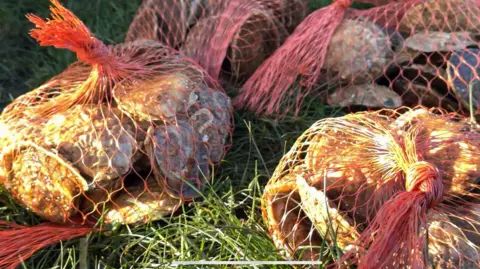
The 2,000 adult oysters and 30,000 juveniles - called spat on shells - were brought to Belfast from a nursery in Scotland to support the return of the species.
It is part of efforts by Ulster Wildlife to restore the once-abundant native oyster beds that help provide clean water and healthy fisheries.
The charity's marine conservation manager Dr Nick Baker-Horne said it marked "a significant step forward in helping to restore this small but mighty ocean superhero".
Not suitable for consumption

This seabed deployment is a first for Northern Ireland.
Several native oyster nurseries have been created at Bangor Marina, Belfast Harbour, Glenarm and Carrickfergus.
In Belfast Lough, the oysters are placed on the seabed to form a natural reef over time and potentially provide habitat for spat from the nurseries to settle on.
After measuring a sample, staff and volunteers from Ulster Wildlife put the oysters in biodegradable potato starch bags for laying on the seabed.
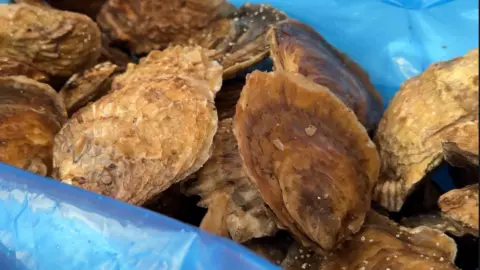
None of the oysters are suitable for consumption.
Instead, Baker-Horne pointed out, their purpose is purely environmental – removing nutrients from water and supporting countless other species in the reefs that they form.
"Oysters are a missing habitat, a missing species, that do fantastic things for biodiversity but also have some really fantastic supports for our environment," Baker-Horne said.
These include "improving water quality, defending our coasts from big waves and also supporting juvenile fish as a fantastic habitat for those commercially important fish species".
Water quality issues
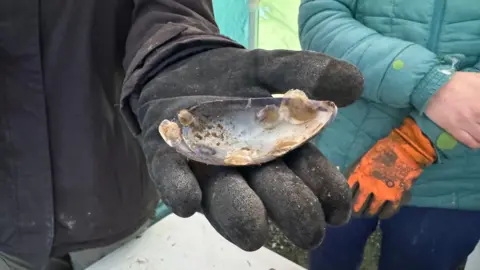
Belfast Lough has always played a key role in the drainage system of the city.
But water quality, particularly in the inner lough, has been deteriorating due to discharges from the Combined Sewer Overflow (CSO) system and pollution from agriculture.
The Office for Environmental Protection has launched an investigation, expressing concern about the "serious degradation" of the lough.
Infrastructure projects aimed at improving wastewater and drainage systems have been paused due to a lack of funding.
'They're a little nursery for baby fish and crabs'
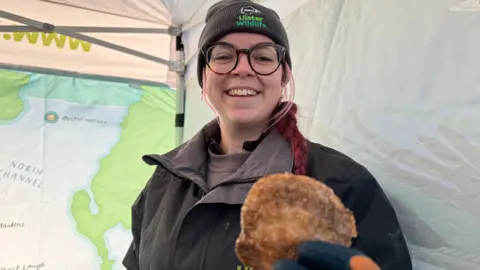
As filter feeders, shellfish like oysters contribute to improving water quality.
Jess Sennett-Seale, a Marine Restoration Assistant with the Oyster Project, said that's not all they do.
"They also provide habitat because they build reefs together so they form clusters and that is really important not only for stopping wave energy and stabilising our shores and stopping so much coastal erosion, but it also forms habitats for baby animals.
"So they act as a little nursery for lots of different baby fish and crabs and other invertebrates."
'First' for Northern Ireland
The native oyster all but disappeared from Belfast Lough in the early 20th Century, due to over-fishing, pollution and habitat loss.
Outbreaks of typhoid at the time were, in part, blamed on sewage pollution of the water, contaminating the shellfish that were a large part of the diet for poorer communities.
Laws were then introduced prohibiting the gathering of any shellfish from Belfast Lough for consumption.
To this day, recreational fishing for shellfish in Belfast Lough remains forbidden.
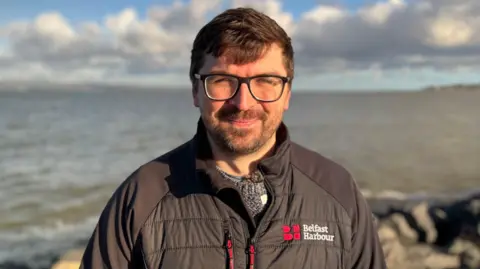
While these oysters will not be eaten, this "first of its kind in Northern Ireland" project has been a labour of love for Belfast Harbour's Marine Environment and Biodiversity Officer Simon Gibson, despite the challenges.
"It was a bit of a process trying to figure out how we can get this off the ground, working with Daera and the Crown Estate as well.
"It's a great way to help boost the biodiversity in Belfast Lough, as well as looking at nature-based solutions for tackling water quality and biodiversity issues."
He said the oysters are great for improving water quality.
"I'm very excited now it's actually happening and I think it'll be a good way as a pilot programme that can be expanded in the future," he added.
The project is supported by Ulster Wildlife members, Belfast Harbour and the Department of Agriculture, Environment and Rural Affairs via the Carrier Bag Levy.
