Polygamous working: Your questions answered

 BBC
BBCPolygamous working is under growing scrutiny as more public‑sector staff are found to be holding second jobs at the same time - and not declaring them.
Imtiaz Shams - now the CEO of a tech start-up - told BBC London about previously having a secret private-sector job while working as a finance assistant in the public sector.
But when is working multiple jobs allowed and when is it not?
If a worker is fulfilling their duties, what is the problem?
It all boils down to the contract.
Polygamous working is not inherently unlawful but if your contract says that you cannot work multiple jobs at the same time, you could be dismissed for gross misconduct or even be prosecuted for fraud by false representation.
You could also be prosecuted for sharing confidential information, according to Kaajal Nathwani, an employment lawyer at Osborne & Wise.
Balancing two full-time jobs can also lead to poor performance, especially in safety-critical roles, and in the public sector this would be a waste of taxpayers' money.
However, some private-sector bosses have told the BBC they actively encourage their staff to work multiple jobs so they remain engaged and happy.
Are MPs allowed to do multiple jobs?
Yes they are, as long as they are not a minister and are not being paid for parliamentary advice.
MPs who take on outside employment must have a contract or written statement detailing their duties. They must record their earnings in the Register of Members' Financial Interests.
The BBC analysed the most recent January 2026 Register of Interests and found 144 out of 650 MPs had declared extra employment and earnings, including working as a doctor, for paid media appearances, as well as for writing books and articles.
Having MPs with second professions has been seen as a good thing.
In 1995, the Committee on Standards in Public Life said that a "Parliament composed entirely of full-time professional politicians would not serve the best interests of democracy".
It argued that Parliament needed "a wide range of current experience which can contribute to its expertise".
But MPs' second jobs have been subject to mounting scrutiny and more recently, in 2025, the Committee on Standards launched an inquiry into whether there should be changes to the rules relating to outside interests and employment in the Code of Conduct for Members of Parliament.
Can doctors work for the NHS and privately? Does this count as polygamous?
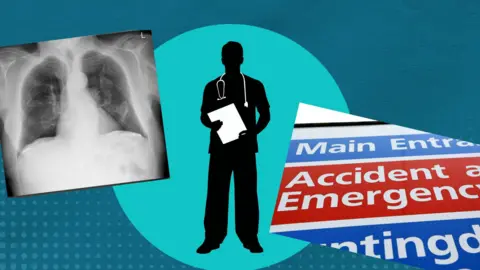
In theory, any registered NHS medical practitioner can also work in the private sector - although doctors with provisional or limited registration cannot practise without supervision.
The majority of doctors who work both for the NHS and privately are consultants. A small proportion of doctors work exclusively in full-time private practice.
Those who are in both sectors must tell the NHS about any private practice commitments.
If they stick to the rules, this does not count as polygamous working - which is done in secret.
According to the British Medical Association, consultants must ensure their private practice does not have a detrimental effect on NHS patients or services, nor diminish available NHS public resources - there must be no conflict of interest between their NHS and private work.
In one recent case, a former NHS resident doctor was sentenced to three years' imprisonment after pleading guilty to defrauding the NHS out of more than £268,000, following an NHS Counter Fraud Authority investigation.
Richard Akinrolabu, 61, had been employed by the Princess Royal University Hospital (PRUH) in London.
Between October 2018 and December 2021, he worked on-call and did night shifts at three other trusts, despite informing his employer he was unfit to do the same work for them. He worked these shifts while on sick leave or on reduced duties from King's College Hospital.
How is it even possible for public-sector workers to hold down two jobs?
The government and local authorities are concerned that polygamous working happens particularly in remote or hybrid roles, where employees can more easily have multiple jobs away from the watchful eye of their employer.
Some have questioned what this says about the productivity of public-sector workers, and how somebody could be able to hold down more than one full-time job at once.
Simon Radford, a Labour councillor at Barnet Council, which recently prosecuted an employee for working for two London authorities, rejects the idea there is a problem with productivity, saying that "if people are not working as hard as they should, and not providing [value for money] for taxpayers, we will find out".
HM Revenue & Customs can pick up on multiple incomes but it focuses on tax compliance and does not always have the full picture.
To address this issue, the government's National Fraud Initiative (NFI) is taking data from several different bodies matching payroll, pension and benefits information to spot inconsistencies.
Could these workers get multiple pensions?
Short answer - yes.
In a recent case, a council worker was convicted of fraud for having full-time jobs at two London councils.
Barnet Council told us that in this particular case the individual was an agency worker, so the pension was not applied.
But in other cases, an employee could be enrolled on two pension schemes, such as somebody on PAYE at two local authorities.
The NFI uses pension data to spot inconsistencies, helping it to discover polygamous workers.
The Cabinet Office told BBC London that since 2016, its national anti-fraud initiative had caught out more than 300 employees in the public sector and recovered £1.35m in salary payments.
Is polygamous working the same thing as moonlighting?
Not exactly.
While both are informal terms, "moonlighting" refers to what is typically a side job, often done at night as the term suggests.
"Polygamous working" is a growing phenomenon involving having multiple jobs at the same time in secret, made easier in the post-lockdown age by remote and hybrid working.
Listen to the best of BBC Radio London on Sounds and follow BBC London on Facebook, X and Instagram. Send your story ideas to hello.bbclondon@bbc.co.uk
