Bill to permanently ban fracking approved by NI Executive

 Getty Images
The Northern Ireland Executive has approved legislation that will permanently end petroleum exploration and licensing, including fracking, in Northern Ireland.
The Department for the Economy said it will introduce the bill to the Northern Ireland Assembly "at the earliest opportunity".
Fracking involves injecting high-pressure liquid between layers of rock to force open fissures and release any oil and natural gas stored there.
The Economy Minister Caoimhe Archibald has welcomed the move saying it "marks a significant milestone" in her commitment to decarbonisation.
The legislation would remove the Department for the Economy's statutory powers to issue licences for petroleum exploration or extraction.
Archibald said: "The evidence is clear: petroleum development will not deliver meaningful economic benefit for our region, carries significant environmental and community risks, and is incompatible with the Executive's commitments on climate action and energy transition."
The NI Executive endorsed the introduction of the Petroleum Exploration and Licensing (Repeal) Bill.
That came after independent research, public consultation, and detailed assessment of the economic, environmental and social impacts.
Those assessments concluded that petroleum extraction would be inconsistent with NI's obligations to reduce greenhouse gas emissions and transition to a low‑carbon energy system.
In December 2024, the executive agreed to a temporary moratorium on petroleum licensing.
Archibald said that by ending petroleum licensing, efforts can be focussed on things like renewable energy and energy efficiency.
As well as "emerging green technologies that will deliver real economic opportunity and support energy security."
 PA Media
What is fracking?
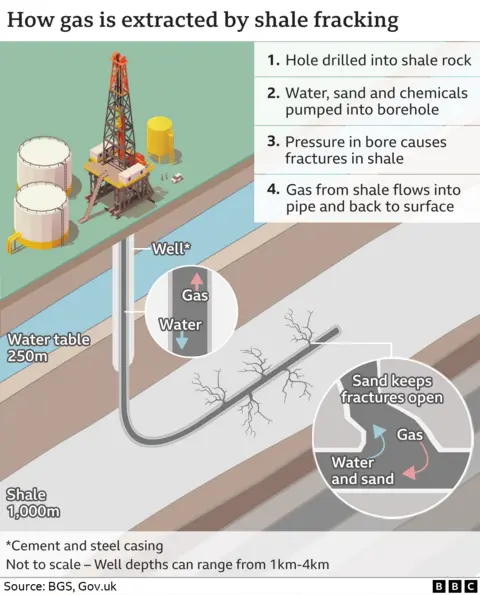
Hydraulic fracturing, or fracking, is a technique for recovering gas and oil from shale rock.
It involves drilling into the earth and directing a high-pressure mixture of water, sand and chemicals at a rock layer, to release the gas inside.
Wells can be drilled vertically or horizontally in order to release the gas.
Why is it controversial?
The injection of fluid at high pressure into the rock can cause earth tremors - small movements in the earth's surface.
Seismic events of this scale are considered minor and are rarely felt by people, but they are a concern to local residents.
Shale gas is also a fossil fuel, and campaigners say allowing fracking could distract energy firms and governments from investing in renewable and green sources of energy.
Fracking also uses huge amounts of water, which must be transported to the site at significant environmental cost.
Past proposals to use it in County Fermanagh faced significant political and community opposition.
Do climate change commitments gel with fossil fuel exploration?
In a fossil-fuel driven economic environment, it made sense to offer opportunities for petroleum exploration in Northern Ireland.
But the world has changed.
The impact of human activities on our climate is making itself felt here and around the world.
While fossil fuels still play a big part in the energy market, more power was generated by renewable energy in the EU last year for the first time.
And half of Northern Ireland's energy comes from renewables – a new support scheme was announced last year to support their expansion although there are concerns that local generation is stagnating.
Things appear to be changing, albeit slowly – the bottom line is Northern Ireland's climate change commitments simply don't gel with exploration for fossil fuels.
'A positive day for the environment'
Sinn Féin MLA Áine Murphy also welcomed the Executive's approval of the legislation.
The Fermanagh and South Tyrone MLA who introduced a bill to ban fracking in the last mandate, said this was "a positive day for the environment and will protect the wellbeing of local communities for generations to come".
