Stephen Colbert says CBS spiked interview with Democrat over FCC fears

 Getty Images
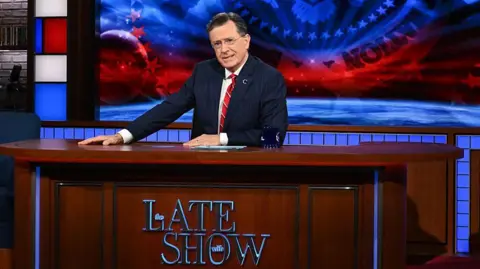
US late-night host Stephen Colbert has accused his network of refusing to broadcast an interview with a Democratic politician over fears of retaliation by the Federal Communications Commission (FCC).
CBS, the network which hosts the programme, denies that it "prohibited" the interview from being aired, saying it gave only "legal guidance".
On Monday night's show, Colbert said that CBS would not show his interview with Texas lawmaker James Talarico out of concerns about a response from the FCC, which has new guidance on equal airtime for political candidates.
"We were told in no uncertain terms by our network's lawyers, who called us directly, that we could not have him on the broadcast," he said.
"Then, then I was told in some uncertain terms that not only could I not have him on, I could not mention me not having him on. And because my network clearly doesn't want us to talk about this, let's talk about this."
Colbert, host of The Late Show, went on to explain that new FCC guidance on the "equal time" rule - which requires certain TV and radio broadcasters to give equal time to rival political candidates - could have created legal trouble for the network, according to CBS lawyers.
The FCC regulates radio, TV and satellite airwaves, giving it power over a range of matters, including mergers and decency complaints.
CBS flatly denied Colbert's claims in a statement on Tuesday.
"The Late Show was not prohibited by CBS from broadcasting the interview with Rep James Talarico," the network said.
It added in a statement: "The show was provided legal guidance that the broadcast could trigger the FCC equal-time rule for two other candidates... and presented options for how the equal time for other candidates could be fulfilled.
"The Late Show decided to present the interview through its YouTube channel with on-air promotion on the broadcast rather than potentially providing the equal-time options."
The full interview was later posted on YouTube, where FCC rules do not apply.
News content has traditionally been exempted from the "equal time" rule.
But the FCC has said the rule may soon apply to late-night programmes like Colbert's. It may also apply to political radio programmes, which tend to have more conservative hosts and listeners.
After issuing the new guidance in January, Brendan Carr, the FCC chairman known for taking an expansive view of his power, said on X that "for years, legacy TV networks assumed that their late-night & daytime talk shows qualify as 'bona fide news' programmes - even when motivated by purely partisan political purposes.
"Today, the FCC reminded them of their obligation to provide all candidates with equal opportunities."
US President Donald Trump has at times said he is considering pulling the FCC licence for several US networks that he says have aired views critical of his presidency.
Paramount Global, the parent company of CBS, agreed in July to pay $16m (£13.5m) to settle a legal dispute with Trump regarding an interview it broadcast on CBS with former Vice-President Kamala Harris.
Business commentators have questioned whether the deal was made partly so as to not affect Paramount's planned merger with Skydance Media, which Trump had the power to halt.
CBS News has a partnership agreement with the BBC, meaning news content including video footage can be shared. BBC News is editorially independent of CBS.
Anna Gomez, the only Democrat on the FCC board, condemned the response by CBS, saying Colbert and the network had the First Amendment constitutional right to free speech.
"This is yet another troubling example of corporate capitulation in the face of this administration's broader campaign to censor and control speech," she said in a statement, adding that the FCC had "no lawful authority to pressure broadcasters for political purposes".
She continued: "It is no secret that Paramount, CBS's parent company, has regulatory matters before the government, but corporate interests cannot justify retreating from airing newsworthy content."
She has previously accused the FCC's Republican leaders of using the equal-time rule to unfairly penalise critics in violation of the constitutional right to free speech.
The Late Show is due to end its 33-year run in May. Colbert has been the host since 2015.
