Reform proposes £50bn welfare bill cut with changes to disability payments for millions

 Getty Images
Reform UK says it would aim to cut about £50bn from the benefits bill and scrap the disability payments system, Pip, if it comes in to government.
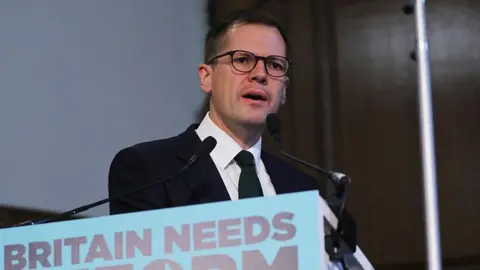
Robert Jenrick, the party's treasury spokesperson, said the plans, to be set out in full on Monday, would be the most comprehensive overhaul to the welfare system in a generation and affect nearly three million people.
In an article for the Sunday Telegraph he said the current system is "suicidal empathy" and "a strange perversion of compassion".
Labour said it was "fantasy economics, built on stripping support from disabled people", while the Conservatives called it a "half-baked policy" and another "attempt to distract from" questions about the £5m gift party leader Nigel Farage received.
Reform's plans include making companies pay for any employees off sick for the first two years. Businesses with more than five employees would have to take out insurance to cover the cost.
Reform says this is modelled on the Dutch system and would incentivise employers to make adaptions and encourage people back to work to reduce their insurance premiums.
The party says they would cut the National Insurance contributions (NICs) paid by employers to offset the cost of this measure, insisting the change would be cost neutral for businesses.
In a policy document to be published next week, which the BBC has seen an extract of, the party estimates 2.89 million people would have their disability payments' removed, or modified, under plans to abolish Personal Independent Payments (Pip) for working age people.
The party would also remove the extra health-related payments on Universal Credit.
A new system, called a Health Security Allowance, would replace both Pip and the Universal Credit health element but only the most "severe, enduring and high-risk cases" would receive cash support, the document says.
Other claimants would be supported through a council-run programme to cover what Reform said would be the "verifiable additional costs" as a result of their disability.
To boost available support for people out of work, the party says it would spend an extra £1.85bn a year on interventions such as cognitive behavioural therapy, physiotherapy, and employment support.
Reform also wants to reform children's benefits, and is promising to align the system for anxiety, depression and ADHD in young people with its changes to the adult system. But this would only apply to new claimants.
In March 2025, the government attempted to tighten the daily living assessments for both current and future claimants, but was forced to dial back after pressure from Labour MPs.
Jenrick described this as an attempt at "modest savings" gutted by backbenchers.
Last month, an interim report was published by Disability Minister Sir Stephen Timms, who has been leading a review into Pip, stating the benefit was "not fit for purpose" and requires a fundamental change.
A Labour spokesperson said: "Reform's £50bn claim is fantasy economics, built on stripping support from disabled people and shifting costs onto employers.
"Labour is already reforming welfare: narrowing the gap between Universal Credit standard and health rates, restoring face-to-face assessments, and investing £3.5bn in employment support to end the culture of people being signed off and written off."
The Conservative's shadow welfare secretary Helen Whately said: "This half-baked policy is just another Reform attempt to distract from Farage's fishy £5m and his embarrassing underperformance in his pointless by-election."
A parliamentary standards investigation is taking place into a £5m gift given to the Reform leader from a donor before he became an MP, with Farage saying the money did not need to be registered. The investigation was paused after Farage resigned as Clacton MP in response to the scrutiny of his financial backing, triggering a by-election last week, which he won.
