India's astrotourism boom draws urban stargazers beyond city limits

 Getty Images
On a cold winter night, around 200km (125 miles) from the Indian capital Delhi, dozens of people huddle around telescopes, waiting for darkness to settle over the landscape.
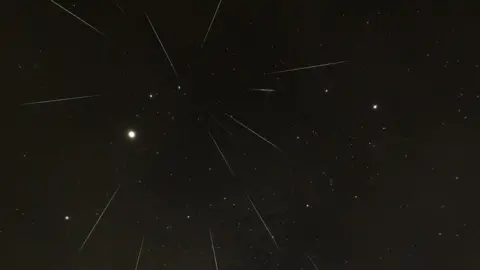
Over the next few hours, more than 150 meteors streak across the sky - a spectacle all but impossible to witness from India's sprawling light-polluted cities. For many travellers, experiences like this are becoming as compelling as visits to monuments or wildlife sanctuaries. Dark skies, once taken for granted, are now a reason to travel.
Stargazing in India has long been the preserve of amateur astronomers and science clubs. But as air pollution and city lights obscure the night sky, the hobby is breaking into the mainstream, sparking a new wave of astrotourism.
The trend is still niche, constrained by the high cost of organised trips and the challenge of reaching remote, light-free locations. But with more urban residents now willing to journey hundreds of kilometres for a glimpse of the cosmos, tour organisers say demand is surging.
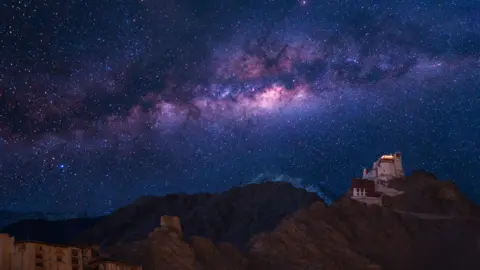
In Ladakh's cold desert, the remote, high-altitude village of Hanle once received around 5,000 visitors a year, according to Dorje Angchuk, engineer-in-charge at the Indian Astronomical Observatory. After it was designated India's first dark-sky reserve in 2022, that figure rose to more than 30,000 last year.
Similar growth is being reported elsewhere. Astroport Global, a private company that offers stargazing experiences and astronomy workshops at five of its resorts across Indian states, says visitor numbers have climbed to around 20,000 a year, up from just a few hundred a few years ago.
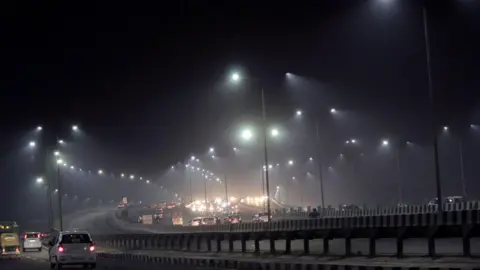
One of the main drivers is visibility. Astronomers measure sky clarity using the Bortle dark-sky scale, which runs from one to nine. Delhi typically ranks between eight and nine, meaning only the brightest stars can be seen.
When PM2.5 (fine particulate matter that can clog lungs) levels rise above 100, visibility drops sharply and most constellations and deep-space objects disappear, says Jasjeet Singh Bagla, a professor at the Indian Institute of Science Education and Research (IISER) in Punjab.
In contrast, higher-altitude regions such as parts of Rajasthan, Himachal Pradesh, Uttarakhand and Ladakh offer far darker skies and clearer air, as colder night-time temperatures push pollutants closer to the ground.
 Jaspreet Singh
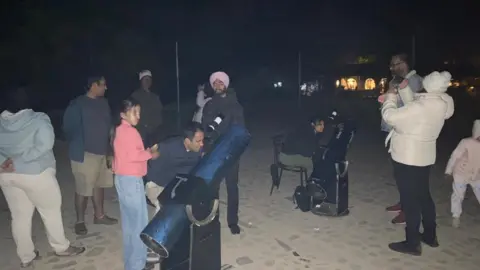
On 13 December, more than three dozen participants gathered near Rajasthan's Sariska Tiger Reserve to watch the Geminid meteor shower, one of the most spectacular events in the celestial calendar. The reserve's skies rank four on the Bortle scale, allowing the Milky Way and dense star fields to be seen without telescopes.
"We hold regular astronomy workshops and most of our guests come from Delhi, where deep-space observation is nearly impossible," says Navjot Singh, a space educator at the resort.
A basic stargazing workshop lasting a few hours can cost around 1,200 rupees ($13; £10) per person, excluding food, accommodation and travel. Longer stays at offbeat resorts typically range from 8,000 to 12,000 rupees, with prices rising further for premium facilities. Interest peaks in winter, when low humidity and clear night skies significantly improve visibility.
For many participants, these trips offer more than a science lesson - it's a chance to relive the night sky of childhood.
 Amrinder Jit Singh
Experts say astrotourism in India is still at an early stage, but it is already opening new pathways for learning.
"When people look through a telescope or watch a meteor shower, space science stops being abstract," says Dr Sachin Bahmba, founder of the Space Group of Companies. "The experience sparks curiosity, questions and learning."
The growth has also brought economic benefits to some remote regions. In Hanle, the number of small hotels has risen sharply over the past three years. The boom has created new jobs for local youth, with residents trained as guides and astro-ambassadors.
Angchuk says the shift has been doubly beneficial. During the day, visitors explore Ladakh's landscape, and by evening, the sky. "Once the sun sets, we dim the lights. That's when they head out to watch the stars and planets," he adds.
As interest grows, state authorities are also getting involved, offering training in telescope use and skywatching, says Bagla. Such programmes can be seen in the Himalayan states of Uttarakhand and Himachal Pradesh.
 NurPhoto via Getty Images
But scaling up remains a challenge. Reaching remote destinations such as Ladakh or Sariska involves high travel costs, limiting who can take part. Even for those who make the journey, options are scarce: India currently has just one officially recognised dark-sky reserve at Hanle, with another emerging at Pench Tiger Reserve in Madhya Pradesh.
At the same time, expanding cities and unchecked lighting continue to eat into natural dark skies, making it difficult to develop similar experiences closer to urban cities.
Unlike many Western countries, India also has few organised dark-sky advocacy groups, though awareness is slowly growing.
There are early signs of change, including government-led initiatives, observatories working with local communities and resorts adopting low-light practices. Still, experts say the sector has a long way to go.
For now, for many city residents, these short trips are about more than leisure. They offer a rare chance to reconnect with a night sky that has quietly disappeared from everyday life.
