AI to help improve technology for disabled people

 BBC
BBCPeople with disabilities who use technology to communicate and carry out everyday tasks say they want it to become more personalised and versatile.
Students at National Star College in Gloucestershire met executives from a global tech company to talk about how AAC (Augmentative and Alternative Communication) devices can improve.
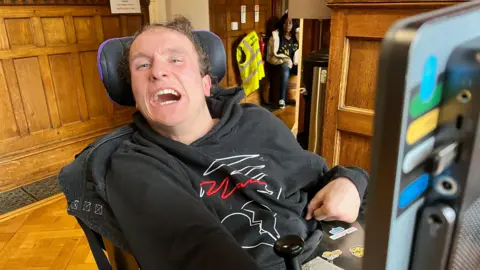
Aid Holmes told the delegates from Smartbox that he used to hate his AAC as a child, but it has since become an essential part of his life.
"Now I take my AAC everywhere I go because I feel naked without it. It would be like someone ripping your voice box out of your body. This is my voice."
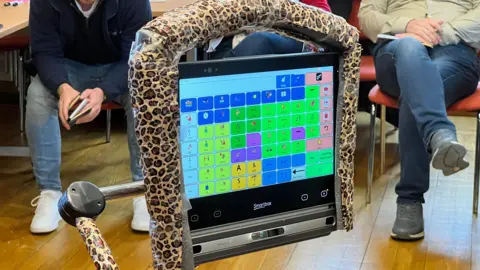
Mr Holmes said a simple solution that would make a big difference would be an AAC device which lasts for 24 hours, "so I can talk all day without charging".
AACs are varied but many work by people programming phrases using a screen.
It can then create phrases using an artificial voice, operate computers and apps or control devices where they live.
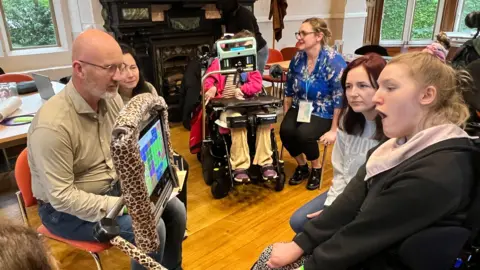
Hannah Hadley has cerebral palsy and controls her device using what is known as Eye Gaze - which tracks her eye movements to navigate the screen.
She told the panel that she would like an app to run her a bath for a sense of independence, and to use her device to pursue her dream of designing adapted fairground rides for disabled people.
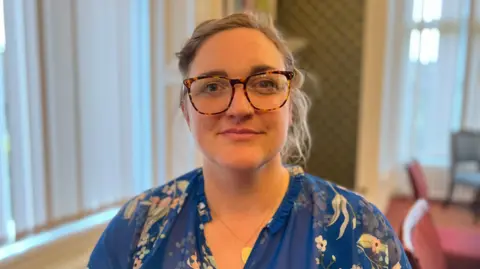
Emily Harris, speech and language therapist at National Star College, says despite their transformative life changing potential, the speed of using the equipment is restrictive.
"They're very difficult to use," she said. "They're often slow, and so trying to bridge that gap between a typical conversation - in terms of speed and content - and the equipment that the AAC users have available to them is the next big challenge that would make a huge difference."
As technology develops, experts say the ability of working faster, having increased autonomy and independence will be helped by artificial intelligence (AI).
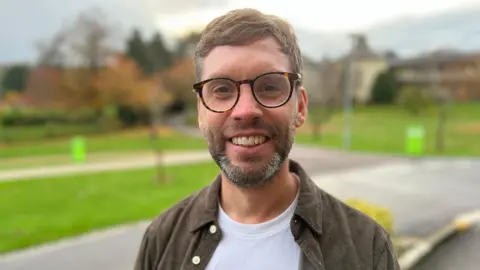
Dougal Hawes, the CEO of SmartBox, said: "AI is often seen or viewed with fear but in our world AI is a real force for good.
"We were talking to students about tools that will really speed up their rate of communication so you help them with correcting their typing, help them use acronyms to say things quicker.
"We also use an AI technology for voice cloning so people can get a personalised voice that sounds like them and where they're from in the country, their age and it really reflects them and their personality so that is now a feature of our products."
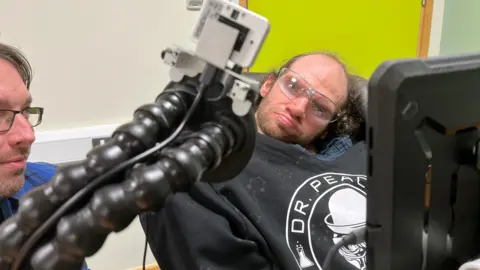
Andy Perrygrove uses technology that tracks a dot on his glasses to play the guitar and he regularly joins in at open mic nights in Gloucester.
His key worker, Dave Stokes, says it can go further.
"Andy's always been a fan of music so to be able to engage in music, something that he's not really been able to do because of his disabilities, has opened up so much for him," he said.
"He's using it to sing as well - it can translate what he's doing using AI to actually create a voice and singing lyrics as well, which is phenomenal."
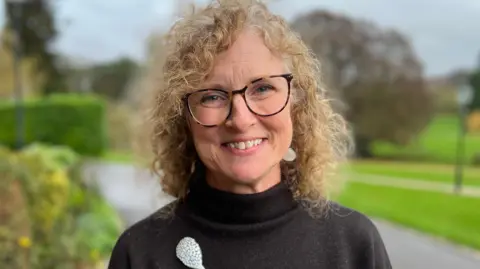
Chief operating officer of Talk To Me Technologies in the US, Kate Dunning, said what they heard means that they have to keep challenging themselves and making technology even more personalised.
"Never automating for automations sake," she said.
"Always thinking about that end user and using the idea of 'what do they have to say' and 'how will they best to say it'."
Follow BBC Gloucestershire on Facebook, X and Instagram. Send your story ideas to us on email or via WhatsApp on 0800 313 4630.
