No keepers in U-7s football will be 'catastrophic'

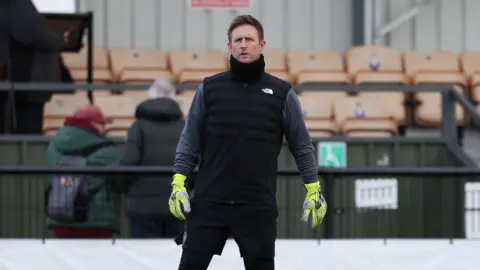 Chelmsford City Football Club
A goalkeeper coach thought new rules that remove goalkeepers from under-7s football would be "catastrophic".
From the beginning of the 2026-27 season, children in this age group will play three-a-side games instead of five-a-side, on smaller pitches and without goalkeepers.
The Football Association (FA) said it made the changes to give players more touches on the ball.
Nick Eyre, head of goalkeeping at Chelmsford City Football Club, said goalkeepers losing a year of development could be problematic for the next generation, and they may opt to pick up other sports instead.
He believed naturally defensive young players will also be let down, and that historic national sides, like Italy, were moulded by "the art of defending".
"There are children that naturally are more predisposed and want to defend," he said.
"I think [that] has gone a little bit from football. The love and the passion for keeping it out of the goal.
"You cannot play football without goalkeepers unless we're going to allow it to become like basketball, where it's end-to-end and high-scoring games."
He added: "Yes, I'm biased. Yes, goalkeepers [is] my whole life, but I do believe that the idea of no goalkeepers is probably catastrophic for English goalkeeping."
New rules
From September, under-7s will play under these rules:
- Three-a-side games (10m x 15m minimum pitch size)
- No referees - Pitch facilitators guide rather than enforce rules
- Six to ten minutes per game, totalling 30 to 40 minutes of game time per player
- Teams rotate between pitches like a carousel
- No substitutes
- No official results or league tables
Goalkeepers will be introduced at the under-8 stage.
Players will only start 11-a-side football at the under-14s stage, instead of at the under-13s.
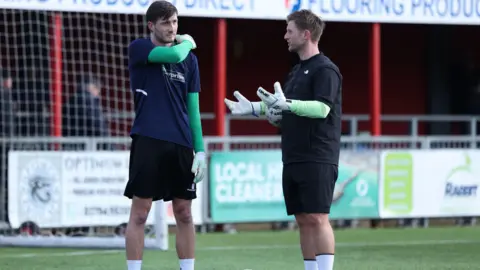 Chelmsford City Football Club
Speaking to BBC Radio 5 Live, Eyre said goalkeeper skills are transferable, like how basketball players attack a high ball and how gymnasts spring off the ground.
He suggested that potential goalkeepers could go elsewhere.
"If they're naturally hand-eye orientated... maybe we lose them. Maybe they go and play different sports, maybe they don't stay in football," he said.
Chris Rowlett, former Billericay Town coach, noticed children enjoying smaller games and believes the new format deserves a chance.
"On the technical side of it, I think it's going to do them a world of good...having that foundation with your feet as you move up through the ages," he said.
"Sometimes pressure from parents and coaches to get results is still quite high, even though it's classed as non-competitive football, and I do think 3-v-3 will take that down a little bit."
In 2023, a referee told the BBC that parents are the biggest problem with discipline in youth football.
'Absolutely crazy'
 Supplied
However, Terry Claydon, an under-10s coach at Grays Athletic, disagrees with Rowlett.
"You're ostracising a whole group of players who want to play. It's also going to have a negative effect," he said.
He told Ian Puckey on BBC Essex that it was an "absolutely crazy" idea and that these formats can be used in training sessions.
Claydon expressed frustration with the FA's tendency to keep changing the game, including phasing out heading in youth football.
This began after a study found former professional footballers were three-and-a-half times more likely to be diagnosed with dementia than the general population.
The FA were approached for comment and said the rules were developed following the Future of Youth Football Review and were the product of three years of extensive research, consultation, and testing across the grassroots game in England.
It represented the FA's evidence-led commitment to reshaping how every child from Under-7 through to Under-18 experiences the game, it said.
It added that 400 grassroots matches were studied from under-6 to under-14 and found that "significant numbers" of children were not involved with play.
It concluded that smaller games led to more intense movement and running.
Do you have a story suggestion for Essex? Contact us below.
Follow Essex news on BBC Sounds, Facebook, Instagram and X.
