What a mature driver review revealed about my driving

 BBC
BBCAs the government consults on tougher safety checks for older drivers, a mature driver review highlights the small changes that can improve your confidence and safety on the road. Reporter Jane Douglas - who took her test more than 40 years ago - puts her own driving under scrutiny.
According to Department of Transport figures, older drivers make up 14% of UK licence holders but account for 25% of fatal accidents on our roads.
Meanwhile road safety charity IAM RoadSmart said its latest research showed nearly one in two people have had a difficult conversation with an older relative about their driving.
As someone who passed their driving test more than 40 years ago, and with grandchildren to drive around, these statistics have given me pause for thought.
I regularly drive on roads in the south west and I wanted to know if I was as safe as I hoped and what improvements I could make.
While my assessor did find I was still a safe driver, the mature driver review left me with plenty more to think about.
What a mature driver review involves
There are a range of voluntary older driver assessments available. The one I opted for was the mature driver review offered by road safety charity IAM RoadSmart. It is not legally binding, it is more of a driver's skills check-in.
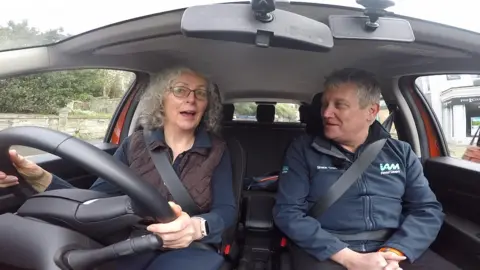
My assessor was Shaun Cronin who spent 30 years with the Dorset police force, 20 of them working as a traffic police officer. He is now the South West Regional Manager for IAM RoadSmart.
The review began with an eyesight check. Being able to read a number plate from 20 metres. I passed but not everyone gets their eyes checked regularly," said Cronin.
He assured me the review was not like re-taking my driving test and observed me while I drove on the roads in Plymouth, a city I know well.
What has changed in driving?
Cronin's first observation was that I came from an age "where we changed down through gears to slow down" but he said the advice on that had changed.
"Brakes to slow. Gears to go," he advised. If you think about it, gearboxes are expensive things, aren't they? And brake pads are generally cheaper things," he added.
Next came something I suspected I might be guilty of, getting too close behind other cars.
Cronin asked: "How much room are we going to give ourselves to the car in front?"
I replied that I was always told "so you could see the edge of the bonnet" but Cronin's advice was that I should also be able to see the tyres of the car in front.
"I reckon you need to be another metre or so back, because if that car in front of you, for any reason broke down, you need to ask: "Have we got enough room to drive round it?"
" Do you remember that old expression: It'll be a fool who breaks the two second rule?"
What the assessor found
After an hour of driving it was time for the verdict.
Much to my surprise, Cronin said: "So Jane I am really pleased to say I'm very comfortable. You're a safe driver. I have no real concerns, and maybe we gave you a few top tips along the way about leaving some time and space but that can be quite common."
He added: "Safe, competent, in control, so you're safe to continue driving."
I understand there's always more I could work on but for now I am glad I am safe on the roads.
Cronin advised that, like having regular health and dental check-ups, it is worth continuing to check you are fit to drive.
"As we mature, every year, it is worth a check up, just to see that you are still safe and competent to drive," he said.
How could older drivers be affected?
With older drivers making up about 14% of all licence holders but accounting for 25% of those killed on the roads, a high number of older drivers are likely to be affected by the government measures.
The government is now consulting on its Road Safety Strategy. Among the changes are mandatory eye tests for older drivers.
It is also not just older drivers who are being reviewed. The consultation will also look at stricter drink driving limits, and learner drivers facing a minimum learning period between sitting their theory and practical tests.
Nicholas Lyes, the policy and standards director at IAM RoadSmart said: "We know that younger drivers tend to be riskier on the roads, and we know that when drivers get to 75 and upwards the number of those involved in serious collisions also increases - so this is about looking at the ranges where there are the biggest risks."
He said as well as sight checks there was also a new emphasis on cognitive development.
"So one of the things that has come out of the government's Road Safety Strategy is the development of a cognitive test which looks at a broad range of things, including health and skills, and that's a welcome development," Lyes added.
