Trump's envoys Witkoff and Kushner to fly to Pakistan for Iran talks

 Reuters
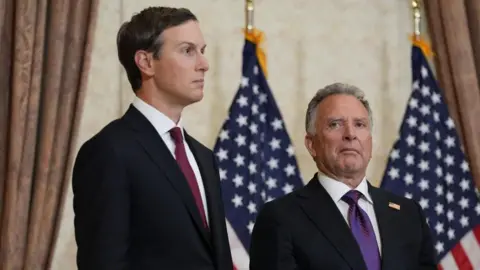
Donald Trump's special envoy Steve Witkoff and the US president's son-in-law Jared Kushner are heading to Pakistan for peace talks with Iran on Saturday morning, the White House has said.
"The Iranians want to talk," White House press secretary Karoline Leavitt said, adding that US Vice-President JD Vance was "on standby" to travel if the talks proved successful.
Iran's foreign ministry spokesman Esmail Baqaei said he and Foreign Minister Abbas Araghchi had arrived in Islamabad on Friday evening, and Araghchi would be meeting "Pakistani high-level officials".
He added that: "No meeting is planned to take place between Iran and the US. Iran's observations would be conveyed to Pakistan."
Ahead of Baqaei's comments, US Defence Secretary Pete Hegseth said Tehran had a chance to make a "good deal", stressing that "all they have to do is abandon a nuclear weapon and in meaningful and verifiable ways".
At Friday's news briefing, Hegseth also warned that Washington's continuing blockade of the Strait of Hormuz - a major oil shipping route - was "growing and going global".
The US and Israel began attacking Iran on 28 February, and Tehran subsequently restricted shipping through the Strait of Hormuz.
The moves by the warring sides have sent oil prices skyrocketing around the globe.
Speaking to reporters on Friday, Leavitt said Trump had decided to send Witkoff and Kushner to Islamabad "to hear the Iranians out", adding that US president is "always willing to give diplomacy a chance".
Leavitt added that "we've certainly seen some progress from the Iranian side in the last couple of days".
Meanwhile, the Iranian embassy in Islamabad said Araghchi planned to "review bilateral matters" and discuss regional developments.
Trump and Hegseth have insisted this week that the US is not feeling pressure to end the war with Iran.
But news that the US-Iran talks are continuing this weekend underscores yet again the divide between the administration's public pronouncements and behind-the-scenes push by the White House to find a way to wind down the war.
This suggests both sides are seeking a path forward, despite the continued mixed messages from Trump and aggressive posturing from Tehran.
The open question now is how much progress the countries can make in Pakistan.
JD Vance led the US delegation in the first round of talks earlier this month but so far is not confirmed to be going to the negotiations this weekend.
Vance's absence, if he does not go, might mean the two countries do not expect a major breakthrough. But the fact that the talks are continuing shows both the US and Iran are interested in a deal.
On Wednesday, Iran's parliamentary speaker Mohammad Bagher Ghalibaf warned that it was "not possible" for the Strait of Hormuz to be opened due to "the blatant violations of the ceasefire" by the US and Israel.
He said the "violations" included the US naval blockade of Iranian ports, which he said amounted to taking the global economy "hostage", and "warmongering" by Israel "on all fronts".
Meanwhile, Iranian President Masoud Pezeshkian said Tehran remained open to negotiations with the US but added that "breach of commitments, blockade and threats are main obstacles to genuine negotiations".
Earlier this week, Trump announced an indefinite extension to the ceasefire with Iran, which was due to expire on Wednesday, so that negotiations could continue.
In other developments on Friday:
- The US treasury imposed sanctions on a major Chinese refinery and 40 other targets - vessels and their owners. The treasury said this was aimed at disrupting "Iran's illicit oil trade"
- Israel and the Iran-backed Hezbollah military group in Lebanon accused each other of ceasefire violations - it came after Trump had announced on Thursday a three-week extension to the Israel-Lebanon truce
