Polls close in first election since Gen Z protests ousted Bangladesh leader

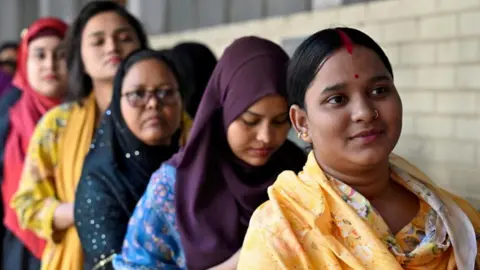 Reuters
Votes are being counted in Bangladesh after its first election since student-led protests ousted prime minister Sheikh Hasina in 2024.
More than 2,000 candidates are vying for 300 elected seats in parliament, though none from the banned Awami League of Hasina, who fled after 15 years in power after a brutal security crackdown in which hundreds of protesters were killed.
The election pits the centre-right Bangladesh Nationalist Party (BNP) against a coalition led by the Islamist Jamaat-e-Islami, which joined forces with a party born out of the student uprising.
Results are expected on Friday and there's widespread hope among voters of a return to democracy.
For the first time since 2008, the outcome of an election in Bangladesh cannot be predicted with certainty. The past few elections were widely condemned as systematically rigged in favour of Sheikh Hasina.
She has been convicted and sentenced to death in absentia for ordering the brutal crackdown against protesters 18 months ago, in which the UN says as many as 1,400 protesters were killed.
Hasina is in exile in India from where she's rejected the charges against her and has questioned the legitimacy of the election.
The ban on her Awami League contesting the polls casts a shadow over whether this election can be described as free and fair. But, for the first time in years, voters on the ground were telling the BBC they feel like they have a choice.
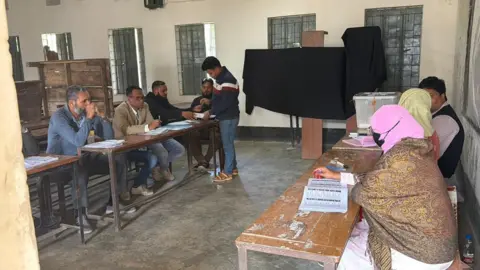
More than 120 million people were eligible to vote, about four in 10 of them under 37. They were also casting their ballots in a referendum on constitutional change, which was proposed by the interim government that replaced Hasina and is aimed at fixing what it has called a completely broken political system.
Speaking after voting, Bangladesh's interim leader - the Nobel Peace Price laureate Muhammad Yunus - said the country had "ended the nightmare and begun a new dream".
Turnout had reached 49% by 14:00 local time (08:00 GMT), the Ministry of Information and Broadcasting told the BBC.
Nearly a million police and soldiers have been deployed to maintain law and order.
Yunus voted in the capital Dhaka, as did the two leading candidates, Tarique Rahman, 60, for the BNP, and Jamaat's leader Shafiqur Rahman, 67.
Before casting his ballot, Rahman said he was feeling "confident" about how the election would play out. He told the BBC he'd been waiting "more than a decade" for this day.
He has criticised Jamaat for using religious sentiment to win votes, and is promising economic and democratic reforms, as well as a "rainbow nation", where a new "National Reconciliation Commission" would help the country move past its divisions.
The son of the late Khaleda Zia, Bangladesh's first female prime minister, Rahman is a product of dynastic politics many reformers would like to change. Zia herself came to power after her husband, a former president, was assassinated in a military coup.
Both the BNP - the Awami League's long-time rival - and Jamaat-e-Islami have a long history in Bangladesh, and both were crushed along with other opponents of Hasina under her long rule.
Rahman, who lived in London during the Hasina years, may be tipped as front-runner for prime minister, but Jamaat is expected to mount a serious challenge.
On two previous occasions - in the 1990s and the early 2000s - Jamaat has been a junior partner in a coalition led by the BNP in constitutionally-secular Bangladesh.
But, with the Awami League absent, Jamaat is for the first time a major player on the ballot - though it's chances of winning are seen by most observers as slim.
Shafiqur Rahman, a former political prisoner, and his party have run a well organised grassroots campaign on a platform of justice and ending corruption. They are also not associated with dynastic politics.
Jamaat gained momentum of its own in the run-up to the vote, and many of its new supporters believe it has modernised.
But many female voters feel sidelined, despite the fact women played a leading role in the uprising.
Of the 30 candidates Jamaat is allowing the student-led National Citizen Party (NCP) to field, only two are women. Jamaat is fielding more than 200 candidates, all of them men. The BNP fielded 10 women out of more than 250 candidates.
