Why you might have noticed more noise from military jets

 Getty Images
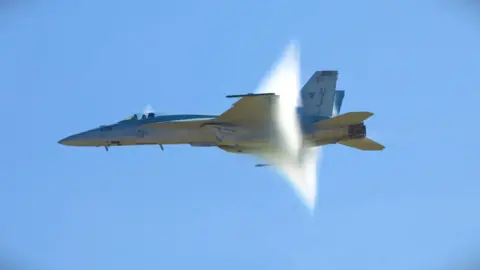
Parts of Norfolk and Suffolk rattled last week when a loud sonic boom was heard.
People across the two counties rushed to social media to comment on the noise and to ask what it was.
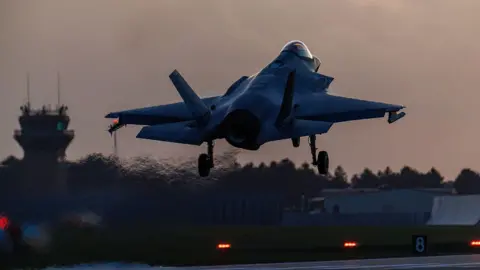
A United States Air Force (USAF) spokesperson later confirmed an F-35A aircraft, based at RAF Lakenheath in Suffolk, had undertaken a corrective manoeuvre on 12 January, "briefly reaching supersonic speed inadvertently".
The boom was a very noticeable reminder of the military planes in the skies above us. But why are they there, and are there more than usual?
The sight and sound of military jets over East Anglia is nothing new.
Air bases such as RAF Lakenheath, RAF Mildenhall and RAF Marham have been here for decades and are deeply rooted in local communities.
But some question whether we are seeing more aviation activity than usual at present.
With heightened geopolitical tensions, including recent unease around President Donald Trump's attempt to acquire Greenland and United States action in Venezuela, more and more people are looking up to see if military aviation traffic can tell them anything more about what is happening in the world.
People often rush to flight tracking apps, such as Flightradar24, to monitor aircraft, which can sometimes have hundreds of thousands of people tracking them.
In November, Liberal Democrat MP for North Norfolk, Steffan Aquarone, told Parliament he had received complaints about military training patterns from "dozens" of constituents.
Al Carns, Armed Forces Minister, replied that the training was to support "increased deployment across Europe".
 Getty Images
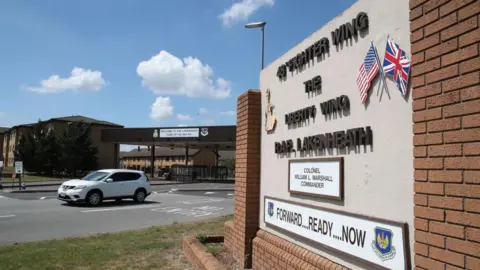
Lt Col Hope Cronin is chief of public affairs at RAF Lakenheath, home of the USAF's 48th Fighter Wing.
She says the base carries out 100 flights daily, and that recently squadrons conducted several operations to meet routine training objectives, "which may have led to a perceived increase".
The wing executes the largest flying hour programme in the USAF, which Cronin says reflects its "readiness standards" and its "scope for our security commitments across Europe and as needed beyond".
Aviation photographer Thomas Watchman has been plane spotting regularly since 2021, particularly around RAF Lakenheath.
He says he has not noticed an increase in military flying over the past few months and that "periods of activity naturally ebb and flow".
He feels perhaps the public are just talking about military aviation far more than they used to.
"Last week's sonic boom understandably drew attention, and with more discussion of military flying on social media and aviation forums, it can give the impression that activity has increased," he explains.
"While recent weather has pushed some training overland rather than over the sea, that doesn't necessarily mean there's more flying overall – just that it's been more noticeable."
 Getty Images
Sometimes these military aircraft also have to conduct training exercises directly above us.
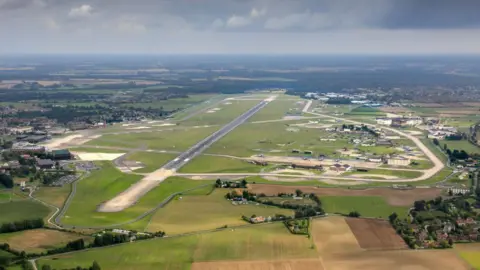
Cronin explains that the 48th Fighter Wing works closely with the Ministry of Defence to optimise the use of Military Air Training Zones (MATZ) across the UK.
The preferred location for the wing's training exercises is over the North Sea, but Cronin says it is shared with several other flying wings from both the USAF and RAF, and can therefore get congested.
An added problem is that winter storms over the North Sea can create unsafe conditions should pilots need to eject in an emergency.
"When possible, and as permitted by UK controllers, the 48th Fighter Wing also prioritizes ranges across North Wales in efforts to reduce the amount of flying activity in the local area," Cronin adds.
However, she explains the North Wales zone is limited by UK controller availability and if that and the North Sea area are unavailable, East Anglia has to be used.
Airspace in the south and west of England is restricted due to civil traffic and cannot be used.
 Roger Smith
Roger Smith is an aviation expert from Suffolk who regularly keeps an eye on the skies.
He says bad weather plays a significant role in the training exercises.
"With that cold, wet and windy weather, the sea temperature drops and the wave height increases," he says.
"If that happens, they have a point where they [question], 'If one of our pilots had to eject and go into the North Sea, would he survive long enough for us to get him back alive?'
"So they have a cut-off point and then they come [overland] and do air combat manoeuvring, which was happening when the boom went off."
As well as this Smith says pilots will set a "hard deck" — an artificial line that details the minimum altitude they cannot descend below during a training exercise.
"Usually it's somewhere up above 5,000, 6,000, 7,000ft... if they go beneath it then they have to break off, climb back up and start all over again," Smith continues.
"Of course, these air combat manoeuvres don't last very long because it's going around at a great rate of knots with tight turns.
"That's where you get the noise from, because they are pushing hard on the throttle at times and using their afterburners."
 Getty Images
Cronin says the USAF balances its readiness requirements with its "desire to be a considerate neighbour".
She says the chance of errors such as sonic booms happening also decreases as pilots train and gain experience.
All incidents are reported and investigated, while flying complaints are passed directly to the base and "are an extremely small percentage of sorties flown", she says.
"We cherish the unshakable special relationship we hold with our closest ally," she adds.
"We will continue to strive to be thoughtful stewards of the relationships we share across the East Anglia community, which is so deeply rooted in our collective airpower history."
Follow East of England news on X, Instagram and Facebook: BBC Norfolk or BBC Suffolk.
