Asian hornets found inside hidden nest

 Alastair Christie
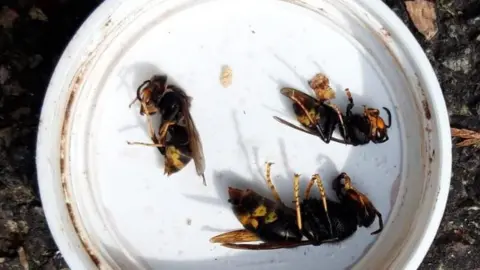
The first confirmed sighting of worker Asian hornets this year has been reported in Jersey.
The animals were found in a hidden nest in St John and captured with the queen, Alastair Christie of the Jersey Asian Hornet Group said.
Asian hornets, also known as a yellow-legged hornet, arrived in Jersey in August 2016 and are considered an invasive species because they are aggressive predators of native insects and a threat to honey bees, according to the island's government.
It added the insects posed the same threat to humans as wasps or European hornets, but can react aggressively if their nest is disturbed and can sting multiple times.
According to the Jersey Beekeepers' Association, Asian hornets can have a "distressing and extreme" impact on honey bee colonies and will pick bees off one-by-one outside hives.
The Jersey Asian Hornet Group said there were 694 nests recorded in 2025, compared with 259 in 2024.
Worker hornets measure up to 25mm (0.9in) in length and queens are up to 33mm (1.2in).
Islanders can report sightings of the Asian hornets and submit photos to the government's map.
'Risky to deal with'
Christie said the first queen of the season had been found in March and there had since been "about double the number" of reports of queens than during the same period in 2025.
He said: "We are well ahead of last year, but the reports are mainly of queens that are killed, which is a good sign as well, because that means they can't go on to make nests."
He confirmed the discovery of worker hornets meant a nest had been made, raising "the risk level" for his team.
"The queens are not expendable, so they will not fight, they will flee," he said.
"With the presence of workers, you have nests that are more risky to deal with and as time goes on, those nests will get larger and even more risky to deal with.
"If we can find nests using these workers earlier on in the season, that's a good thing."
Follow BBC Jersey on X and Facebook. Send your story ideas to channel.islands@bbc.co.uk.
