Mexico's most wanted drug lord 'El Mencho' killed in military operation
 Reuters
Mexico's most wanted man and the leader of the feared Jalisco New Generation (CJNG) drug cartel has been killed during a security operation to arrest him, the defence ministry has said.
Nemesio Oseguera Cervantes, known as "El Mencho", died on Sunday as he was being taken to the capital Mexico City, after being seriously injured in clashes between his supporters and the army.
Four CJNG members were killed in the town of Tapalpa, the central-western Jalisco state. Three army personnel were also injured. The US had given Mexico information that assisted the operation.
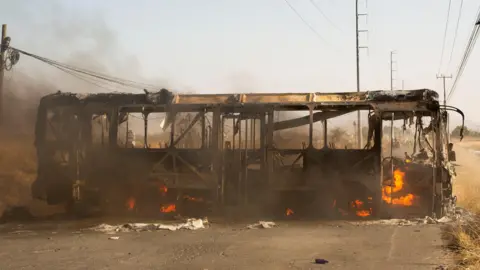
CJNG retaliated by setting cars alight, building roadblocks and attacking security forces in eight states.
The US State Department issued a shelter-in-place warning for US citizens in the states of Jalisco, Tamaulipas, as well as some areas in Michoacan, Guerrero and Nuevo Leon.
Mexico's President Claudia Sheinbaum Pardo later urged people to remain "calm".
She wrote on X that "in most parts of the country, activities are proceeding normally".
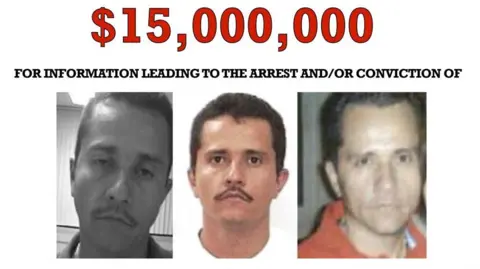
El Mencho, a 59-year-old former police officer, ran a vast criminal organisation responsible for trafficking huge quantities of cocaine, methamphetamine and fentanyl into the US.
The US State Department had offered a $15m (£11.1m) reward for information leading to El Mencho's capture.
The Mexican defence ministry said in a statement that the operation was "planned and executed" by the country's special forces.
Aircraft from the Mexican Air Force and the National Guard were also deployed.
It also said that several armoured vehicles and weapons - including rocket launchers - were seized during the operation.
The US had been providing information to Mexico that assisted its operation, the statement said.
 Reuters
Eyewitnesses have filmed plumes of smoke rising over several cities including Guadalajara - one of the host cities of the forthcoming Fifa World Cup.
In the tourist hotspot of Puerto Vallarta, on the Jalisco coast, potentially thousands of tourists are trapped in the resort because of the unrest.
Throughout Sunday, there were reports of gunmen on the streets in Jalisco and elsewhere.
The governor of Jalisco, Pablo Lemus Navarro, advised residents of the state to adhere to a code red warning and stay in their homes.
He also said that public transport was suspended in the state.
US carriers United Airlines and American Airlines, as well as Air Canada, have cancelled flights to Puerto Vallarta and Guadalajara. A flight operated by Delta Airlines bound for Guadalajara from Atlanta was diverted to Austin, according to flight-tracking site FlightAware.
Former US ambassador to Mexico and Deputy Secretary of State Christopher Landau described El Mencho on social media as "one of the bloodiest and most ruthless drug kingpins".
He added that El Mencho's death was "a great development for Mexico, the US, Latin America, and the world".
Mike Vigil, former chief of international operations for the US Drug Enforcement Administration (DEA), described the operation as "one of the most significant actions undertaken in the history of drug trafficking" to CBS, the BBC's US news partner.
The killing of El Mencho represents a victory for the Mexican president in her fight against the country's drug cartels.
It also could strengthen her relationship with US President Donald Trump, who has threatened to target the cartels on Mexican soil.
Last January, Trump told Fox News that after targeting drug trafficking boats "we are going to start now hitting land," adding that "the cartels are running Mexico".
Sheinbaum later responded by saying a US troop deployment across the southern border was "not on the table".
However, if the security forces cannot bring the situation under control quickly, the Mexican administration's victory may be overshadowed by the cartel's violent response.
The Jalisco cartel has gained notoriety for a series of attacks on security forces and public officials.
It has downed an army helicopter with a rocket-propelled grenade, killed dozens of state officials, and has even been known to hang the bodies of its victims from bridges to intimidate its rivals.
CJNG cartel - Mexico's major drug trafficking player
The CJNG cartel - which had its original power base in Jalisco in 2010 - is now present across Mexico.
The DEA considers it to be rivalling the powerful Sinaloa cartel, which has a presence in all 50 US states.
CJNG is also a key supplier of drugs to the US, earning billions from fentanyl production.
Most fentanyl enters US via Mexico
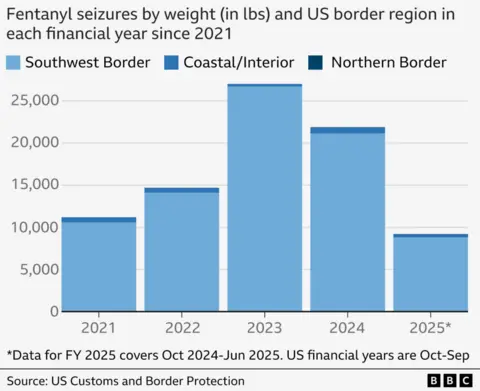
Since October 2024, 9,200lb (4,182kg) of fentanyl has been seized in the US, according to figures published by US Customs and Border Patrol (CBP) in June 2025.
Almost all (96%) was intercepted at the south-west border with Mexico.
Less than 1% was seized across the northern US border with Canada. The remainder was from sea routes or other US checkpoints.