Why are household batteries dangerous in waste?

 BBC
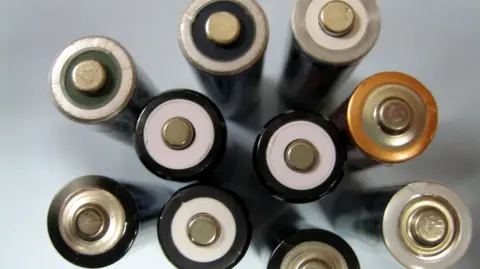
BBCHousehold batteries, including those found in vapes, toys, headphones and car key fobs, are now one of the biggest and fastest-growing causes of fire in household waste and recycling in the UK.
The States of Guernsey said about 40 separate fire incidents at island waste facilities had been caused by hazardous items including batteries in the last four years.
Recently a Guernsey mother who accidentally threw away toys containing batteries was told she faced a £11,500 fine, later reduced to £1,000.
Faye Grime, Island Waste's director, has shared the reasons why batteries should not be put in waste or recycling and how to dispose of them properly.
Lithium-ion batteries are the growing cause of fires according to the Environmental Services Association.
When batteries are discarded in general waste or standard recycling bins, they can be punctured or crushed by heavy machinery during collection or processing.
A lithium battery mixed in with other recycling was thought to have caused a large fire which ripped through a recycling centre in Guernsey in 2018.
A skip fire at Guernsey's Household Waste & Recycling Centre in 2025 was also thought to have been caused by an incorrectly disposed item.
Why are batteries dangerous in waste?
"If a battery comes into the waste, it's an immediate risk of fire because if a battery is not handled correctly it can spark and that can cause thermal runway and then create a fire risk," said Grime.
"It's obviously imperative that we safeguard our employees, our customers, any visitors on site, and we want to minimise any risk to them.
"So throwing batteries in your waste is never the right thing to do. It's always posing a danger and should always be disposed of in the correct way.
"It's imperative that everyone really, really checks their waste carefully to make sure there are no batteries in their waste."
How should I dispose of batteries safely?
"There are collection points for batteries at the Household Waste & Recycling Centre and at our sites," said Grime.
"You can call any of our telephone numbers on our website and we're more than happy to help the public dispose of their batteries in the correct way.
"Once we have the batteries... we can properly make sure they are recycled in the correct way and they're exported off island for careful recycling in the UK."
What should I do with items that have hidden batteries?
"Vapes have become a really, really big problem that's arisen in recent years," said Grime.
"Vapes have got batteries in them, and people aren't always aware of that.
"Batteries are in all sorts of things you wouldn't necessarily expect, car keys, toys, anything that you would plug in and recharge at home, or your small household electrical appliances, they usually have batteries in them as well.
"So it's really important that the general public check everything before they throw it away.
"Usually there'll be a symbol on the item to show that there's a battery inside.
"Double check before you throw your rubbish away, really try hard to make sure that there are no batteries in your rubbish at all."
What other dangerous items shouldn't be thrown away?
"There are lots of forbidden items if you like which we can't accept in the waste," said Grime.
"Things like flares, boat flares, gas canisters, the sort of gas canisters you would use to light a barbecue or camping gas, fireworks.
"All of these items which you would naturally use to create heat or create flame are very, very dangerous and you must never dispose of those in your waste.
"There are proper routes that you can go to for recycling those items and we are here to help the islanders understand what can be recycled in the safest way as possible."
Follow BBC Guernsey on X and Facebook and Instagram. Send your story ideas to channel.islands@bbc.co.uk.
