Broad support around globe for US-Iran ceasefire

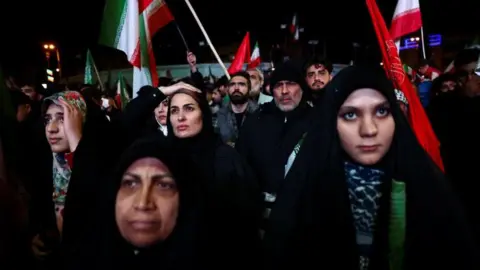 Reuters
Many world leaders have welcomed an agreement by the US and Iran to a two-week ceasefire which will see a reopening of the Strait of Hormuz.
Gulf states including Saudi Arabia, the United Arab Emirates, Qatar and Oman say they support the conditional deal.
Pakistan, which played a key mediation role in talks, backed the ceasefire, while the UK and Russia have also expressed support.
Donald Trump said he would "suspend the bombing" on the condition that Iran reopened the vital Hormuz shipping route, while Tehran's Foreign Minister Seyed Abbas Araghchi said the ceasefire would be agreed if attacks are "halted".
President Trump said there is no question the US had won a "total and complete victory".
Araghchi expressed "gratitude" to Pakistan's Prime Minister Shehbaz Sharif and the head of Pakistan's armed forces, Field Marshal Asim Munir, "for their tireless efforts to end the war in the region".
Israel has backed the deal but says it "does not include Lebanon", renewing strikes on Wednesday in the Tyre and Nabatieh areas in the country's south.
Saudi Arabia has called for a comprehensive deal to bring stability back to the region.
"The kingdom hopes that the ceasefire will represent an opportunity to achieve a comprehensive and sustainable de-escalation, enhancing the security of the region, and that any attacks or policies that undermine the sovereignty, security and stability of the countries in the region will cease," the foreign ministry said.
An official from the United Arab Emirates said the country had "emerged victorious from a war we sincerely sought to avoid" after the truce.
Qatar also also supportive but the foreign ministry said in a statement there was an "importance of full adherence to the ceasefire".
Oman offered its backing but urged "intensifying efforts" to resolve the crisis.
Sir Keir Starmer will travel on Wednesday to meet with leaders of countries in the Gulf to "discuss diplomatic efforts to support and uphold the ceasefire", according to Downing Street.
"Together with our partners we must do all we can to support and sustain this ceasefire, turn it into a lasting agreement and reopen the Strait of Hormuz," Sir Keir said in a statement.
Pakistan's Prime Minister Sharif said: "Both parties have displayed remarkable wisdom and understanding and have remained constructively engaged in furthering the cause of peace and stability". He added that delegations were invited to attend further talks in Islamabad on Friday.
Egypt's Ministry of Foreign Affairs welcomed the ceasefire and reiterated its support for peace and security.
In Iraq, the foreign ministry called for "serious and sustainable dialogue" between the US and Iran "that address the root causes of the disputes and strengthen mutual trust".
Dmitry Medvedev, deputy chair of Russia's Security Council, struck a cautionary note - while the ceasefire showed "common sense has prevailed", he warned that "there'll be no cheap oil".
Global oil prices have fallen sharply and stock markets jumped after news of the ceasefire, with Brent crude falling below $100 a barrel for the first time in weeks.
The economic relief of lower oil prices is likely to be most felt by Asia as an estimated 82% of the oil and gas passing through the Strait of Hormuz is bound for Asian countries.
Japanese government spokesperson Minoru Kihara said "the most important thing is that concrete steps will be taken to de-escalate the situation, including ensuring the safety of navigation through the Strait of Hormuz".
Up to 70% of Japan's oil imports travel through that waterway.
Indonesia's foreign ministry said "all parties should respect sovereignty, territorial integrity [and] diplomacy".
South Korea's Ministry of Foreign affairs said the country "hopes that the free and safe navigation of all vessels, including those of South Korea, through the Strait of Hormuz will be swiftly ensured."
UN Secretary General António Guterres also welcomed the ceasefire,calling for the terms to be followed "to pave the way toward a lasting and comprehensive peace in the region".
Most European leaders were also supportive, but Spain's Prime Minister Pedro Sánchez, who has been scathing of the war from the outset, said while ceasefires are good it was crucial for there to be peace.
"This momentary relief cannot make us forget the chaos, the destruction, and the lives lost," he wrote.
"The government of Spain will not applaud those who set the world on fire just because they show up with a bucket."
Meanwhile, Kyiv urged the US to turn its attention back to the Ukraine war after the ceasefire with Iran.
Later in a post on X, Ukrainian President Volodymyr Zelenskyy repeated the country's push for its own ceasefire with Russia, while adding that "Ukrainian expert military teams will continue to work in the region to help further develop security capabilities".
EU President Ursula von der Leyen welcomed the ceasefire as it "brings much needed de-escalation".
"Now it is crucial that negotiations for an enduring solution to this conflict continue."
German Chancellor Friedrich Merz thanked Pakistan for helping to broker an agreement and said: "The aim now must be to negotiate a lasting end to the war in the coming days".
Australian Prime Minister Anthony Albanese said the move to a ceasefire was "positive", adding that the country has been "calling for de-escalation for some time".
New Zealand's foreign minister, Winston Peters, said the news was "encouraging" but "there remains significant important work to be done in the coming days to secure a lasting ceasefire".
