Sinfield's MND challenge gives hope, says Stewart

 Getty Images
A former footballer diagnosed with motor neurone disease (MND) said Kevin Sinfield's ultramarathon challenge to raise money to help those with the condition has given him hope.
Former rugby league star Sinfield, 45, plans to run seven ultramarathons in seven days across seven cities and regions and will start in Bury St Edmunds, Suffolk.
MND is a neurodegenerative condition where messages from the brain and spinal cord stop reaching the muscles.
Marcus Stewart, 53, who played for Ipswich Town in the early 2000s and was diagnosed with MND in 2022, said the event gave him "hope" that money would "go towards a treatment or a cure eventually".
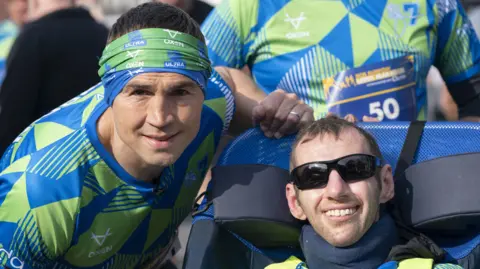
Sinfield is running each ultramarathon in honour of someone who has been affected by MND and the first run is in tribute to Stewart.
The challenge, known as 7 in 7: Together, will see Sinfield running an ultramarathon of at least 45km (27.9 miles) each day, in bursts of 7km (4.3 miles).
Sinfield and his squad set off from The Haberden ground, home of Bury St Edmunds Rugby Club, at 08:40 GMT, and are due to finish at Portman Road, Ipswich, where he will meet Stewart, before 15:00.
"Ipswich was important to us with Stewart, but also we know there is a big rugby community in Bury St Edmunds," said Sinfield.
Stewart said the challenge Sinfield and his team were taking on was "tough".
"I often think who is going to take over the reins after these people leave a legacy once they finish all of their challenges, and I am hoping someone will take over the baton.
"For Kev to do a challenge so close to Christmas and people still put money in is beyond belief, really, because of the time of year," he said.
 PA Media
Sinfield said stopping to speak to people was "vital" while running, adding: "Running is the hard bit but the middle bit where we get to meet people is fun and it is often emotional."
William Affleck, the commercial manager at Bury St Edmunds Rugby Club, said the club was "honoured" to host the start of the challenge.
"It is a real privilege and we want to make sure we send him off in the best way possible," he said.
"He is a legend and you really cannot say enough good about what he is doing."
 7 in 7 Challenge
Sinfield said the ultramarathon challenge was also in honour of his former Leeds Rhinos teammate Rob Burrow, who died from the disease in 2024, aged 41.
Sinfield said he hoped to raise £777,777 during the challenge, which would add to more than £10m fundraised since he began running marathons in 2020, following Burrow's diagnosis in 2019.
Dr Francesca Crawley from West Suffolk Hospital said Sinfield had "done a fantastic job" raising money for MND.
The hospital is part of the MND-Smart trial, which tested potential new treatments for the disease, as well as looking at whether existing treatments for other conditions could have some benefit.
She said the condition could often be misdiagnosed as it could "present in many different ways".
"The disease deserves a lot of research. I think we are probably quite far from a cure," she said.
Follow Suffolk news on BBC Sounds, Facebook, Instagram and X.
