How Israelis and Palestinians see the US election

 BBC / Joe McNally
Last time Donald Trump was president, Israel’s prime minister was so pleased, he named a community after him.
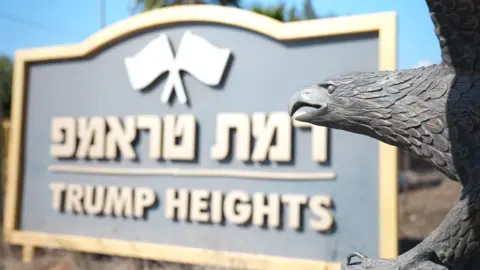
Trump Heights is an isolated cluster of pre-fabricated houses in the rocky, mine-strewn landscape of the Golan Heights, a soaring eagle-and-menorah statue guarding the entrance gate. Mauve mountain peaks jut into the azure sky at the horizon.
This was Trump’s reward for upending half a century of US policy – and wide international consensus – by recognising Israel’s territorial claims to the Golan, captured from Syria in the 1967 war, and later unilaterally annexed.
The question for residents there – two dozen families and a few billeted soldiers – is what impact Republican candidate Trump or his Democratic rival Kamala Harris might have on Israel’s interests in the region now.
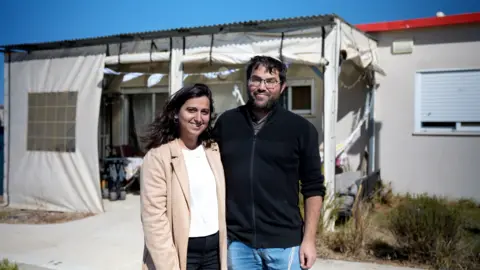
Elik Goldberg and his wife Hodaya moved to Trump Heights with their four children for the security of a small rural community.
Since the 7 October Hamas attacks in southern Israel last year, they’ve watched Israel’s war with Hezbollah, a Hamas ally, escalate along the northern border with Lebanon, 10 miles away from them.
“For the last year, our beautiful green open space has a lot of smoke, and our lovely view is a view of rockets that Hezbollah is sending to us,” said Elik. “This is a war zone and we don’t know when it will end.”
Elik tells me he wants the new US administration to “do the right thing”. When I ask what that means, he replies, “support Israel”.
“Support the good guys, and have the common sense of right and wrong,” he says.
 BBC / Joe McNally
It’s the kind of language you hear a lot in Israel. It’s also the kind of language Trump understands.
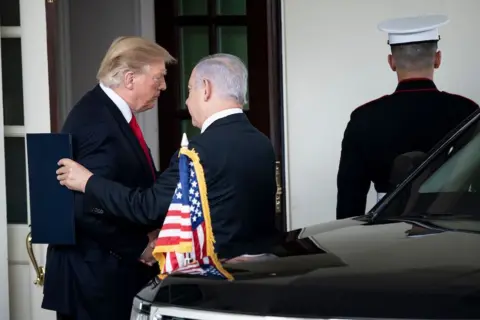
He won favour with Israeli leader, Benjamin Netanyahu, during his last stint as US president by scrapping an Iran nuclear deal that Israel opposed, brokering historic normalisation agreements with several Arab countries, and recognising Jerusalem as Israel’s capital – countering decades of US policy.
Mr Netanyahu once called him “the best friend Israel has ever had in the White House”.
As America prepares to vote, the Israeli leader has not hidden his appreciation for the Republican candidate - and polls suggest he’s not alone.
Around two-thirds of Israelis would prefer to see Trump back in the White House, according to recent surveys.
Less than 20% appear to want Kamala Harris to win. According to one poll, that drops to just 1% among Mr Netanyahu’s own supporters.
 Getty Images
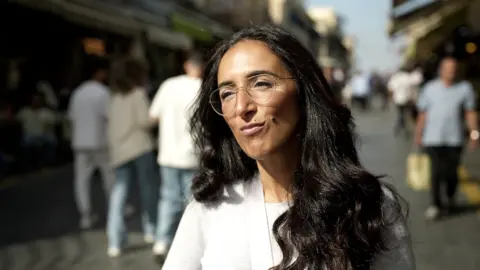
Gili Shmuelevits, 24, shopping in Jerusalem’s Machane Yehuda market, said Ms Harris “showed her true colours” when she appeared to agree with a protester at a rally who accused Israel of genocide. The vice-president said “what he’s talking about, it’s real”.
She later clarified that she did not believe Israel was committing genocide.
Rivka, shopping nearby, said she was “100% for Donald Trump”.
“He cares more for Israel. He's stronger against our enemies, and he's not scared,” she said. “I get that people don’t love him, but I don’t need to love him. I need him to be a good ally for Israel.”
 BBC / Joe McNally
For many people here, good allies never pressure, criticise or constrain. The war in Gaza has helped drive a wedge between Israel and its US ally.
Harris has been more outspoken in calling for a ceasefire in Gaza, and has put more emphasis on humanitarian issues.
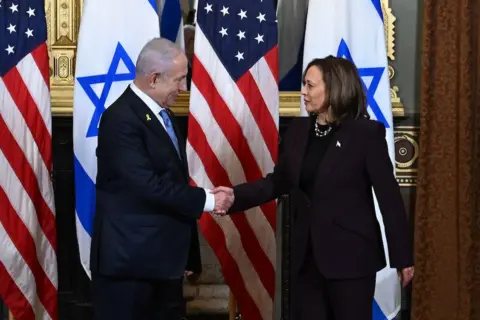
After meeting Netanyahu at the White House in July, she said she would “not be silent” about the situation in Gaza and said she had expressed to him her “serious concern about the scale of human suffering” and the deaths of innocent civilians.
Mr Trump has framed ending the war in terms of Israel’s “victory”, and has opposed an immediate ceasefire in the past, reportedly telling Netanyahu “do what you have to do”.
 Getty Images
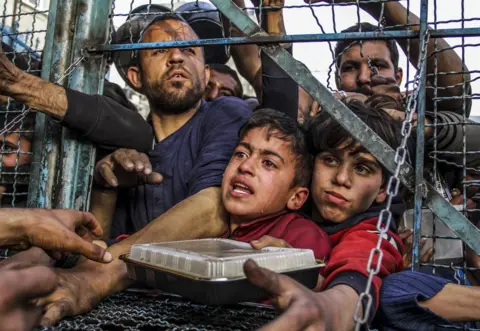
But many Palestinians see little hope in either candidate.
“The overall estimation is that the Democrats are bad, but if Trump is elected it’ll be even worse,” said Mustafa Barghouti, a respected Palestinian analyst and politician in the occupied West Bank.
“The main difference is that Kamala Harris will be more sensitive to the shift in American public opinion, and that means more in favour of a ceasefire.”
The Gaza War has increased pressure from US allies like Saudi Arabia for progress towards a Palestinian State.
But neither candidate has put the establishment of a Palestinian state at the forefront of their agenda.
When Mr Trump was asked during the presidential debates if he would support it, he replied, “I’d have to see”.
Many Palestinians have given up the promise of a Palestinian state – and on US support more generally.
“The general feeling is that the US has failed drastically in protecting international law, has failed the Palestinians more than once [and] took the side of total bias to Israel,” said Mustafa Barghouti.
“The issue of a Palestinian state is nothing but a slogan.”

- SIMPLE GUIDE: Everything you need to know
- EXPLAINER: The seven states that will decide the election
- ECONOMY: Harris and Trump should listen to this mum of seven
- KATTY KAY: What's really behind this men v women election
- PEOPLE: How much is abortion shaping women's vote?
- POLLS: Who is winning the race for the White House?
On wider regional issues like Iran, the two candidates have historically had different approaches with Trump recently advising Israel to “hit the nuclear first and worry about the rest later”.
He was speaking before Israel carried out strikes on Iran in retaliation for an Iranian missile attack earlier this month.
“Maybe Trump would play more hardball, and the Iranians would be more hesitant if he was president,” said former Israeli ambassador to the US, Danny Ayalon, but he says it is easy to overstate the differences between the two candidates.
Both Harris and Trump are now talking about making a new deal to block Iran’s path to a nuclear weapon, and both want to expand the normalisation agreements between Israel and neighbouring Arab countries – in particular Saudi Arabia.
What would be different is their approach.
“I think if it’s Kamala Harris [in the White House], the direction will be bottom-up,” said Danny Ayalon, meaning that ceasefires in Gaza and Lebanon would come first, before turning to the bigger questions of Iran or new regional alliances.
With Trump, he says, “the direction would be top-down - he will go straight to Tehran and from there, try to sort out all the different prongs and theatres throughout the Middle East”.
 Getty Images
Political insiders in both Israel and the US see Kamala Harris as closer to America’s traditional bipartisan positions on foreign policy in the Middle East – and Donald Trump as unpredictable, reluctant to involve America in foreign conflicts, and prone to ad-hoc deal-making.
But Ambassador Ayalon believes it’s not only policy that has an impact on public mood in Israel.
“Biden stood by Israel for the entire year,” he said. “But did not get his recognition [because of] things like not inviting him to the White House – things that are more optics than real issues.”
When it comes to US-Israeli relations, he says, public gestures - and emotions - count.
“A lot is personal. The [shared] interests are a given, but the personalities matter.”

Between now and the US election on 5 November, BBC correspondents around the world are exploring the impact its outcome could have where they are, and what people around the globe make of this White House race.
