Kegworth air disaster medic 'still sees wreckage'

 BBC
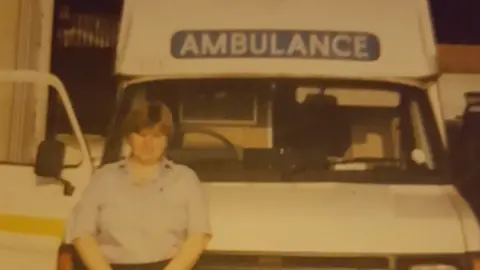
BBCAn ambulance worker who rushed to help stricken passengers after the Kegworth air disaster has said she can still picture the wreckage 37 years on.
Pat Withers was one of the first responders to be called when British Midland flight 92 crashed into the M1 in Leicestershire after one of its engines failed.
Of the 126 people on board, 47 were killed and 74 were seriously injured.
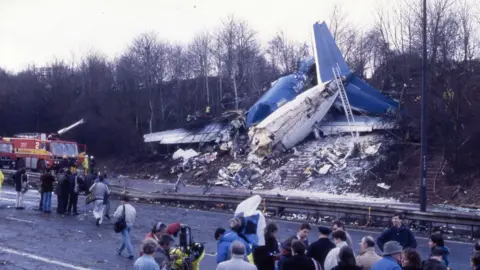
Ms Withers said seeing the wreckage on the side of the motorway was "horrific".
The Boeing 737 crashed on 8 January 1989 after developing a problem in the left engine, shortly after leaving Heathrow for Aldergrove - Belfast's main airport.
The pilots shut down the wrong engine and the plane crashed just short of East Midlands Airport, where they were attempting an emergency landing.
Mrs Withers, from Great Glen in Leicestershire, said she was parked at the Leicester Forest East services on the M1 when she first received a call that a plane was in trouble.
"We've always had calls coming in from the airport saying they have reports of an aircraft having problems, so we didn't think much of it," she said.
"Then they said the plane's down on the motorway - it was sheer shock.
"As we drove up to the scene - it was horrific.
"I could see a broken plane on the embankment as we pulled up.
"I remember standing on the wing and putting my head inside.
"It was so quiet, there was nobody screaming and shouting - it was eerily quiet.
"There was no hysteria, and that threw me.
"You just started doing your job."
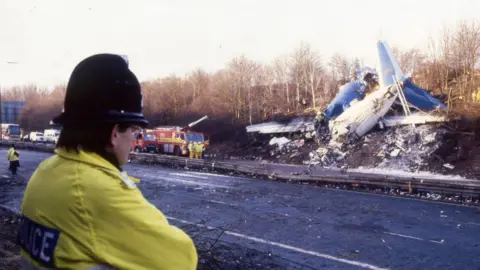
People from Kegworth, and those driving on the M1 at the time of the crash, rushed to the aid of the stricken passengers.
Over several hours, rescuers crawled through the wreckage, saving those who had survived the crash.
After ferrying injured people to and from hospitals in Nottingham and Leicester, Mrs Withers ended her shift four hours after she was meant to finish.
She said: "I got home and I had to sit at home with a drink thinking, 'oh my god, what has just happened?'
"I couldn't sleep when I got home. Even now, I can still see the plane.
 East Midlands Ambulance Service
"When I drive up the motorway, I automatically look at the spot.
"If I've gone up with family, I tell them that's where it happened.
"It's just horrific when you think what all those people went through."
Kegworth: Flight to Disaster, a new documentary telling the story of the crash appearing on BBC iPlayer and BBC One Northern Ireland at 22:40 GMT on Thursday, has heard from other people who went to the scene to help injured passengers.
Speaking on the programme, Jeremy Noon, who was working for Leicestershire Fire and Rescue Service at the time, said he was called out after the plane reported the emergency.
He entered the wreckage to help those who had been trapped by crumpled floor panels.
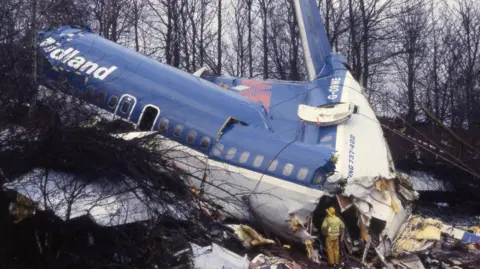
"I noticed where the wing was there was a doorway that had been opened and I went towards that," he said.
"It was pitch black inside and there was a passenger and he stood up in front of me and made me jump.
"It was quiet, no-one cried or anything.
"It was so strange."
An investigation into the cause of the crash found that the engine damage had been caused by a fan blade which had cracked and loosened due to fatigue.
Investigators said pilots Captain Kevin Hunt and First Officer David McClelland had incorrectly identified the failing engine, but had not been given proper training on the recently-redesigned cockpit instruments - in particular the vibration indicators.
But they ultimately decided their responses had been hasty and ill-considered, and they were both dismissed by British Midland.
Follow BBC Leicester on Facebook, on X, or on Instagram. Send your story ideas to eastmidsnews@bbc.co.uk or via WhatsApp on 0808 100 2210.
