The volunteers who want to continue working with sex offenders

 BBC
BBCA charity that helps rehabilitate convicted sex offenders has said it is concerned about its future following the government's decision to pull funding from July.
Circles South West uses a network of volunteers to monitor, support and hold sex offenders to account after they have been released from prison.
"For every man that is in a circle of support and accountability, they are being supported, monitored and held to account; and, if they don't receive that, it's possible they could go on to re-offend," said Circles South West co-ordinator Jamie Stephenson.
The Ministry of Justice said it was considering alternative options to continue the services in the future.
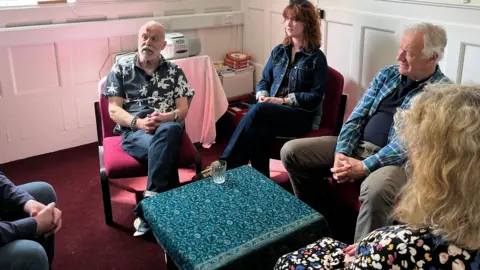
A circle involves four volunteers who meet with a convicted sex offender once a week at the same time and location for a period of 12 to 18 months.
The charity works with a range of people from those who commit sexual harm online or other non-contact sexual offences, to those who have committed acts of sexual murder.
The process is voluntary and the core member, as the offender is called by the charity, is referred by the police or the probation service.
Stephenson said: "Protecting victims is our strapline, and the way Circles does that is by targeting the risk factors, which are things like social isolation, loneliness, substance misuse, lack of constructive use of time, sexual preoccupation and using pornography.
"There is empirical evidence that circles makes a difference by reducing the risk that someone could potentially re-offend and, if someone re-offends, then a new victim is created and we are all about no more victims."
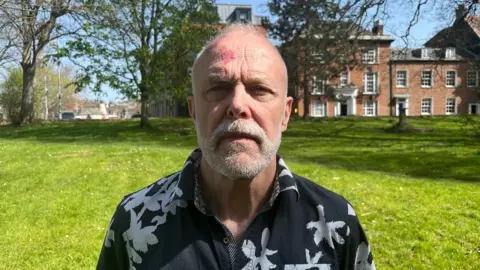
The BBC spoke to one core member who had recently completed a circle following his release from prison.
He had been convicted twice for downloading indecent images of children and is on the sex offenders register.
He said: "I wanted to change my life around for the better, to not offend again. Walking down the streets, I used to have inappropriate thoughts of children which was obviously wrong.
"I knew from the start that the volunteers had knowledge of my convictions and, if they thought there was any risk in what I intended to do, it would be reported to the police or probation services."
This man's offences have spanned a decade and, when asked if the circle had helped stop him re-offending, he said it had helped him introduce new boundaries, such as having a phone without access to the internet.
He said: "Circles has helped me be debt-free. That's one of the main things that was a contribution towards my offending, with all the worries that I had to go with it."
Since Circles South West formed in 2010, its network of volunteers has worked with about 400 convicted sex offenders in circles of support and accountability across the seven counties of the greater South West, from Gloucestershire to Cornwall.
Between April 2025 and March 2026, there were 79 circles across the region. 29 of those were in Devon and Cornwall.
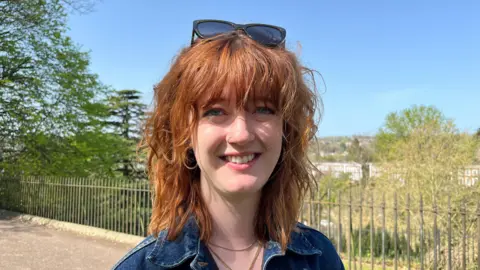
Alice Hobbs, 28, from Plymouth, has been a volunteer at Circles South West for four years and maintained it was important because, without it, people would re-offend.
She said: "I have never worked in a circle where that person doesn't want to improve.
"The whole thing is voluntary; they don't have to be here and, whilst these people have done awful things, there is still a person underneath all that.
"We don't have to say that what they have done is OK - it's not. But it's about investing in the person who comes after that and helping them lead a better life."
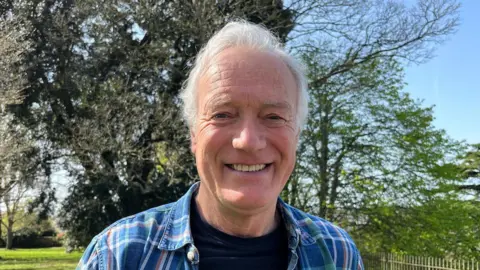
Gerry Shattock, 66, from Dulverton, Somerset, first started volunteering in 2020, during the Covid-19 pandemic.
He said that, if there are any concerns, police and the probation service would be informed and sometimes this had led to a recall to prison.
He said: "We would highlight anything of concern - that could be as simple as a core member joining a gym where we believe there is a swimming pool and we have to make absolutely certain that it has been approved."
Demand is high and there is a waiting list in all seven counties the charity operates in.
The charity also works with children aged 10 years and up who display harmful sexual behaviour and said about 30% of child sexual abuse was carried out by other children and young people.
Each circle costs £12,000 to £14,000 to run.
The charity said a significant part of its funding has come from a three-year contract from the Ministry of Justice and in Devon and Cornwall from the police and crime commissioner's office.
However, the Ministry of Justice has decided to stop the funding in July.
"Removing that money, that removes our ability to provide those services, therefore it puts more people potentially at risk," said Stephenson.
A Ministry of Justice spokesperson said: "As the public rightly expects, we must always ensure we get value for taxpayers' money when considering contracts.
"We are considering alternative options to continue these services in the future."
