Seeing in the new year with dinner in a dinosaur

 Hulton Archive via Getty Images
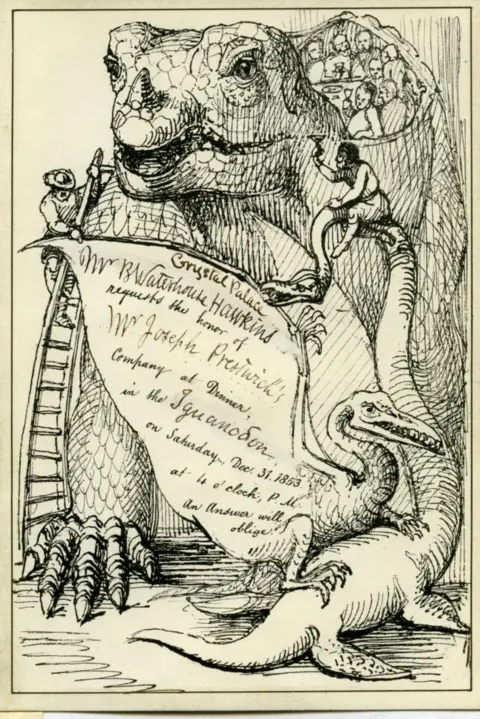
As New Year's Eve invitations go, the one received by 20 men in December 1853 was unusual.
Apart from the fact that presumably none of the attendees wanted to spend the turning of the year with any of their womenfolk, the location was specified as "in the mould of the Iguanodon at the Crystal Palace".
The distinguished guests, invited by Benjamin Waterhouse Hawkins, included Richard Owen (who came up with the word "dinosaur"), Edward Forbes (a naturalist and expert on British starfish), John Gould (an ornithologist and illustrator) and Joseph Prestwich (geologist and pioneer of modern scientific archaeology).
Hawkins's plan was to launch his dinosaur sculptures to the world, and encourage people to visit the newly relocated Crystal Palace and its park - so a reporter or two were also invited, along with local bigwigs, owners and investors in the exhibition centre.
 Hulton Archive via Getty Images
Benjamin Waterhouse Hawkins was a natural history artist who envisioned a grand experiment - bringing to life the "dry bones or oddly shaped stones" found in the British Museum and introducing the masses to the emerging science of palaeontology.
By reconstructing these long-extinct animals, he hoped to "render the appearance and names of the ancient inhabitants of our globe" such that they became as familiar to people as other beasts.
He also had a good eye for a publicity stunt, and one of the invitees was Herbert Ingram, publisher of the Illustrated London News - a paper with a circulation of more than 150,000 - which would produce a full report on the evening alongside a large illustration.
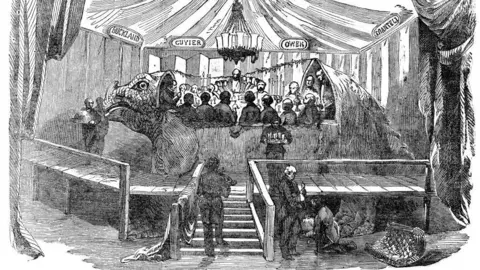
Despite the snow and ice of that evening, the chosen 20 guests donned formal attire and travelled to a large warehouse, where they found a host of creatures sculpted by Hawkins, and within that menagerie, their dinner location.
The iguanodon was the largest of the models, and the men had to climb a flight of steps and clamber on to a platform to reach their table.
![Philip H Delamotte via Heritage Art via Getty Images 'Models of Extinct Animals', Crystal Palace, Sydenham, 1852-1854. Taken during the progress of the works, by desire of the directors, by Philip H Delamotte. Together with a list of the directors and officers of the company, etc". [London, 1855]. Creator: Philip Henry Delamotte. (Photo by Heritage Art/Heritage Images via Getty Images)](https://ichef.bbci.co.uk/news/480/cpsprodpb/2332/live/11466880-df75-11f0-ad0b-4759baf4609b.jpg.webp) Philip H Delamotte via Heritage Art via Getty Images
Philip H Delamotte via Heritage Art via Getty ImagesA giant tent was erected above them, in an attempt to keep the chill wind from whistling round their learned ankles, and a chandelier dangled over the meal.
Banners, somewhat obsequiously, proclaimed the names of famous palaeontologists who had pioneered the study of dinosaurs: Georges Cuvier, Gideon Mantell, William Conybeare and William Buckland.
The names might also have served as conversation starters and fodder for gossip for the gathering - Mantell had died the previous winter from an opium overdose, and there was speculation over whether it was intentional or not; and Buckland, although wealthy enough to be considered an eccentric rather than a lunatic (he and his son Frank tried to eat every animal they could, including mice on toast) was slipping further into what is now thought to have been senile dementia.
 AFP via Getty Images
Richard Owen's assigned seat was inside the head - at the other end there was a bit more space where, according to a later description by Hawkins, "a musician's delightful singing greatly increased the pleasure of the evening".
Around midnight, Owen proposed toasts - and as the festivities were winding up, Forbes stood before the group and launched into a many-versed poem.
Routledge's Guide to the Crystal Palace and Park at Sydenham reported that as Forbes continued through his verses, the men became "so fierce and enthusiastic, as almost to lead to the belief that a herd of iguanodons were bellowing".
Forbes, having eventually finished his epic, declared (according to a later memoir) the whole event as "a good wind-up for a geologist's year".
 SSPL/Getty Images
The Bill of Fare was included alongside the invitations, and guests feasted upon seven courses. A team of liveried servants brought in the food.
Soups: Mock Turtle; Julien; Hare
Fish:Cod and Oyster Sauce; Fillets of Whiting; Turbot a l'Hollandaise
Removes: Roast Turkey; Ham; Raised Pigeon Pie; Boiled Chicken and Celery Sauce
Entrees: Cotelettes de Moutonaux Tomates (lamb) Currie de Lapereaux au riz (rabbit); Salmi de Perdrix (partridge); Mayonnaise de filets de Sole
Game: Pheasants; Woodcocks; Snipes
Sweets: Macedoine (mixed fruit) Jelly, Orange Jelly; Bavaroise (custardy set cream); Charlotte Russe (cake with ladyfingers); French Pastry; Nougat a la Chantilly; Buisson de Meringue
Dessert: Grapes; Apples; Pears; Almonds and Raisins; French Plums; Pines; Filberts (hazelnuts); Walnuts
Wines: Sherry; Madeira; Port; Moselle; Claret
 SSPL/Getty Images
The report in the London Illustrated News described the "the iguanodon, with his socially-loaded stomach, so practicably and easily filled", the dinner as "luxurious and elegantly served", and the models as "trustworthy lessons to the world at large in a branch of science which had hitherto been found too vast and abstruse to call in the aid of art to illustrate its wonderful truths".
It concluded: "After several appropriate toasts, this agreeable party of philosophers returned to London by rail, evidently well pleased with the modern hospitality of the iguanodon, whose ancient sides there is no reason to suppose had ever before been shaken with philosophic mirth".
And speaking of "philosophic mirth" - the humorous magazine Punch's report on the evening ended on this comment: "We congratulate the company on the era in which they live; for if it had been an early geological period, they might perhaps have occupied the iguanodon's inside without having any dinner there."
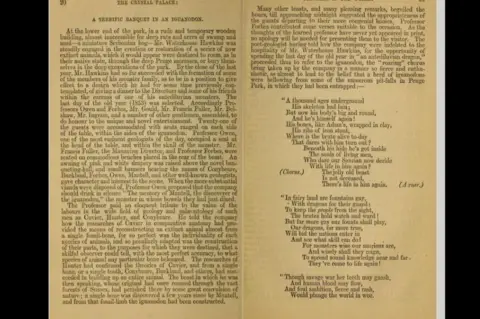 Routledge's Guide
Hawkins's publicity stunt had worked.
The Times, Punch and Ingram's London Illustrated News all published stories about the meal, and it was mentioned in other publications including Charles Dickens's newspaper The Daily News.
Six months later, more than 40,000 people attended the opening of the Crystal Palace and saw Hawkins's beasts.
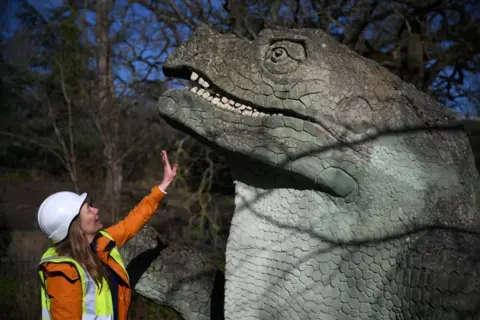
They are now Grade I listed and funding has been allocated for their renovation, although no men-only dinner parties are scheduled for this new year.
The philosophic mirth will have to wait.
Listen to the best of BBC Radio London on Sounds and follow BBC London on Facebook, X and Instagram. Send your story ideas to hello.bbclondon@bbc.co.uk
