Yoon Suk Yeol: The former South Korean leader jailed for life for leading an insurrection

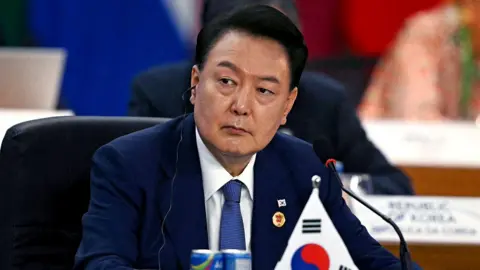 AFP
AFPIt was an unexpected, late-night press conference which would set in motion the start of Yoon Suk Yeol's fall from presidential palace to prison cell.
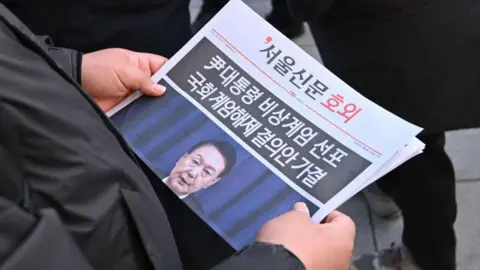
The then-South Korean president appeared on television to declare martial law in December 2024, ordering the army to take control.
Within hours, it had been reversed by parliament, citizens and politicians alike rallying to defend the young democracy.
Yoon, meanwhile, found himself arrested, impeached and indicted for various charges in connection with the botched order.
Just over a year later, he has now been sentenced to life in prison. It is the 65-year-old politician's second conviction - he was jailed for five years in January for abusing power, obstructing justice and falsifying documents.
His martial law order and ensuing legal troubles have divided South Korea, with large crowds gathering against him as well as in support of him. The same was true as he was sentenced in February, when pro-Yoon crowds rallied outside the court in Seoul.
Influential right-wing YouTubers who support Yoon have long peddled conspiracy theories of stolen elections and anti-state Communist forces. And the former president himself channelled these into mainstream discourse, even citing unfounded claims of anti-state forces in the opposition to justify the martial law order.
He had said the opposition was "trying to overthrow free democracy".
But it soon became clear that he was motivated by his own political troubles.
Plagued by personal scandals and mounting pressure from the opposition, Yoon's popularity had been falling since he took office in 2022.
Rise to power
Yoon was a relative newcomer to politics when he won the presidency. He had risen to national prominence for prosecuting the corruption case against disgraced former President Park Geun-hye in 2016.
In 2022, the political novice narrowly beat his liberal opponent Lee Jae Myung by less than 1% of the vote - the closest result the country has seen since direct elections started to be held in 1987.
At a time when South Korean society was grappling with widening divisions over gender issues, Yoon appealed to young male voters by running on an anti-feminism platform.
People had “high hopes” for Yoon when he was elected, said Don S Lee, associate professor of public administration at Sungkyunkwan University. “Those who voted for Yoon believed that a new government under Yoon will pursue such values as principle, transparency and efficiency.”
Yoon has also championed a hawkish stance on North Korea. The communist state was cited by Yoon when he tried to impose martial law.
He said he needed to protect against North Korean forces and “eliminate anti-state elements”, even though it was apparent from the outset that his announcement was less about the threat from the North and more about his domestic woes.
Yoon is known for gaffes, which haven’t helped his ratings. During his 2022 campaign he had to walk back a comment that authoritarian president Chun Doo-hwan, who declared martial law and was responsible for massacring protestors in 1980, had been "good at politics".
Later that year he was forced to deny insulting the US Congress in remarks made after meeting US President Joe Biden in New York.
He was caught on a hot mic and seen on camera seemingly calling US lawmakers a Korean word that can be translated as "idiots" or something much stronger. The footage quickly went viral in South Korea.
Still,Yoon has had some success in foreign policy, notably improving ties in his country's historically fraught relationship with Japan.
‘Political miscalculation’
Much of the scandal during Yoon's presidency centred around his wife Kim Keon Hee, who was accused of corruption and influence peddling, most notably allegedly accepting luxury bags from a pastor.
In November, Yoon apologised on behalf of his wife while rejecting calls for an investigation into her activities - a move that did little to help his wobbly approval ratings.
Yoon was relegated to a lame-duck president after the opposition Democratic Party won the parliamentary election by a landslide April 2024. The result was widely seen as a vote of no confidence on Yoon's time in office.
He also faced increasing pressure from his political opponents. In the lead-up to the martial law declaration, the opposition slashed the budget proposed by Yoon's ruling party and moved to impeach cabinet members for failing to investigate the first lady.
With his back against the wall, Yoon went for the nuclear option - a move that few, if any, could have predicted.
Many had worried abouta political crisis "because of the confrontation between the president and the opposition-controlled National Assembly", said Celeste Arrington, director of The George Washington University Institute for Korean Studies. "Though few predicted such an extreme move as declaring martial law."
It was "legal overreach and a political miscalculation", said Leif-Eric Easley, professor of international studies at Ewha Womans University in Seoul.
"He sounded like a politician under siege," Dr Easley told the BBC.
"With extremely low public support and without strong backing within his own party and administration, the president should have known how difficult it would be to implement his late-night decree."
 Getty Images
Aftermath
Crisis engulfed Yoon's government in the wake of his martial law order. He was impeached, indicted over a series of charges in connection to it, and finally removed from office in April 2025.
His party paid the price too. The opposition Liberal Democratic Party's Lee Jae-myung won a landslide in the presidential election in June.
Top officials from his cabinet have since been either charged or convicted. Han Duck-soo, the prime minister who became acting president after Yoon was removed, has been jailed for 23 years for his part in the attempt, while former interior minister Lee Sang-min was handed a seven-year term.
In both cases, the courts recognised the declaration of martial law as an act of insurrection.
But even as the saga draws to a close, South Korea is reeling from the divisions that erupted in December 2024.
Although Yoon's People Power Party is in disarray, he still has a vocal support base, which some may argue has even strengthened because of his downfall.
His supporters, mainly young male voters and the elderly, often echo strong right-wing narratives and conspiracy theories, including that Yoon's party was a victim of election fraud. They also believe his declaration of martial law was necessary to protect the country.
Throughout the chaos, Yoon has projected what his critics see as defiance – or, as his supporters see it, determination.
While on trial for insurrection, Yoon defended his martial law order, calling it "a measure to protect the freedom and sovereignty of the people and to preserve the nation and its constitution."
He still faces two trials in connection with the failed martial law bid, and four others over corruption charges.
